Showing posts with label Colonial Virginia. Show all posts

Sunday, November 24, 2019

This Moderate and Less Shamefull Way

I claim William Calvert (c1642/3-1682) as my 9th great-grandfather. Archives of Maryland, Vol. 5 gives title to official position he received in 1670. As the office was conveyed to predecessor (and cousin) Sir William Talbot (c1643-1691):

“ … the Office of chief and principal Secretary of our said Province of Maryland and of all & singular our dominions and Territories thereunto belonging and of the Custody and keeping of the Seals Records and Registerys of the said Office of chief and principal Secretary and of all other the Acts Ordinances Records and Journals & Registeries of our said Province Dominions and Territories and of the Entrings Recording enrolling Registring exemplifying and keeping of all and singular the Acts Ordinances and Pattents Grants Journalls Records and Registries made or to be made within our said Province dominions and Territories thereunto belonging …”

That is quite a title. William Calvert researchers often substitute 'PSOM.' As in 'Principal Secretary of Maryland.'

Cousin James Neal, Jr. (1917-2017) admonished me, after I once disdained Squire Turner's role as Committee Secretary. "They are authors," he countered. "It's often their work product that you find in the written record." Neal also observed Chairpersons are just as likely to play merely titular roles. I'll admit I have since seen Convening Secretaries in particular as well-informed, and intelligently committed to a cause under consideration.

William Calvert's English-born father Leonard Calvert (c1606-1647) died when our subject was but three or four years old. He too had a record as scribe and keeper of files (tasks I can relate to). Leonard had surrendered the Office of Prothonotary and Keeper of the Writs and Files at County Clare in Ireland's Province of Connaught in 1626. King Charles I hoped successors would act "in as ample manner" as Leonard Calvert had. Think of a Prothonotary as Chief Clerk to a law court.

Woodcut depicting George Calvert, First Lord Baltimore, from A Short History of the English People, Vol. 3 (1903), pg. 1048.
Images enlarge when clicked.
No doubt Leonard held what may have been sinecure as result of his father's rank. Before becoming The Right Honourable Lord Baltimore in 1621, George Calvert (1578/9-1632, right) had intrigued discretely and internationally in James Stuart's accession to England's throne. As King James VI and I, he rewarded Calvert grandly: my 11th great-grandfather's fortunes rose following appointment as "Clerk of the Crown" in 1606, around the time of Leonard's birth. George was elevated, to serve on His Majesty's Most Honourable Privy Council, and – ultimately – as James' Secretary of State.

The term 'secretary' rose further in my esteem.


Perhaps with honed administrative skills, Leonard accompanied his father in 1628, as Baron Baltimore took hands-on responsibility as Proprietary Governor of the Province of Avalon. Leonard ventured with his parents to nearly inhospitable Newfoundland. Harsh and barely profitable experience would equip Leonard well.

Charles I succeeded his father James in 1625. George promptly removed himself from the King's Privy Council. After leaving the royal court, George publicly reclaimed Roman Catholic practices of his Yorkshire parents. And yet, ongoing loyalty to the Protestant Crown allowed Charles to cede more hospitable soil to Calvert ... American lands north of the Potomac River, on either side of Chesapeake Bay. Crown seals were applied to the patent five weeks following George Calvert's 1632 death in his mid-fifties. Eldest son Cæcilius ‘Cecil’ Calvert (1605/6-1675), Second Baron Baltimore, First Lord Proprietary, Earl Palatine of the Provinces of Maryland and Avalon in America, appears in The Charter of Maryland "treading in the steps of his Father, being animated with a laudable, and pious Zeal for extending the Christian Religion, and also the Territories of our Empire, [he] hath humbly besought Leave of us, that he may transport, by his own Industry and Expense, a numerous Colony of the English Nation, to a certain Region ... in a Country hitherto uncultivated, in the Parts of America, and partly occupied by Savages having no knowledge of the Divine Being ..."

George's sons Cecil and Leonard had been baptized and confirmed as Protestants. Wilson contended Cecil converted to Catholicism near the time of his c1627 marriage to thirteen-year-old Honourable Anne Arundell (1615/16-1649), daughter of Thomas, First Baron Arundell of Wardour ... and a Count of the Holy Roman Empire. Krugler suspected Cecil (illegally) added Rome to a 1624 itinerary, and may have preceded his father in open practice. Leonard professed his change of faith in 1625 ... again following his father.

Calvert Coat of Arms, 1671 Map of Maryland by John Ogilby. Huntingfield Collection, Maryland State Archives.
Calvert motto "Strong Deeds,
Gentle Words" appears on The
Great Seal of the State of Maryland
Charles I in 1632 constituted Cecil, "the now Baron of Baltimore, and his Heirs, [as] true and absolute Lords and Proprietaries of the Region." They received sole authority for monetary policy, lawmaking, ecclesiastical matters and the "full and unrestrained Power, as any Captain-General of an Army ever hath had" to lord over as many as twelve million acres. Integral to this narrative, Charles conveyed "plenary Power ... to confer Favors, Rewards and Honors, upon such Subjects, inhabiting within the Province aforesaid, as shall be well deserving ..." Cecil was also empowered to execute whomever in Maryland he pleased.

For conveying vast autocratic power – fairly unique in English history – Charles sought annual tribute of two Indian arrows. He retained rights to his royal fish "and also the fifth Part of all Gold and Silver Ore, which shall happen from Time to Time, to be found within the aforesaid Limits."* "There was to be a hereditary feudal monarchy, surrounded by a body of nobility deriving its rank, dignities, and privileges from the prince as the fountain of honour," observed Browne, placing "Cecilius Absolute Lord of Maryland and Avalon" as the Prince.

Portrait of Cecilius Calvert, baron van Baltimore; 1657 - 1690 engraving by Abraham Bloteling; after anonymous. Rijksmuseum, Amsterdam.
As Lord Proprietor, Cecil (left) appointed younger brother Leonard, who had not yet married, the inaugural Proprietary Governor of the Province of Maryland. Marbury also found "Cecilius Calvert, the first Lord Proprietary, appointed his brother, Leonard Calvert, to be Chancellor of Maryland, vesting him at the same time with the functions of Lieutenant General, Chief Justice and Chief Magistrate." Cecil remained in England, devoting no small amount of effort to fending off political and economic intrigue. Leonard led over one hundred adventurers – reported to be evenly distributed between Protestant and Catholic – to Maryland in 1633-1634 voyage.

"There is no reason to suppose that he intended to found a Catholic colony like the Non-conformist colonies to the north," said Browne of Cecil. A body of study has sprung up around 'Maryland designe,' a term derived from edict their Lord Proprietor gave departing colonists. All worship aboard ship was to be a private matter, and to take place inconspicuously or not at all. "Contrary to a misperception common even in Maryland, neither [George nor Cecil] Calvert ever envisioned his colony as a haven for persecuted Catholics," declared Jackson in 2008. There is no doubt that Cecil defended his faith, and doing so came at social and political cost, but the retired judge opined Cecil and his father acted from belief that, "if Maryland was to be a religious haven for anyone, it should be so for all pious Englishmen of any denomination who wanted to be left alone by pious people of other persuasions, and above all by the government."

With the Irish Rebellion of 1641 impeding Charles I's authority, and perhaps Calvert family revenue, Leonard returned to England to confer with Cecil.§ He returned again at outbreak of the First English Civil War. Charles I, denied London by Parliamentarians, not only granted Leonard an audience, on 26 January 1643/4 the King commissioned Leonard to advance upon Virginia and, according to the Maryland Historical Society, "seize all ships, goods and debts, belonging [to] any person from any place in actual rebellion against the King." Half the booty obtained would belong to the King.

Leonard also took an Anne Brent (1622-1646) as his wife.ǂ Our subject William was by this account born at East Sussex, England on 4 Jul 1643. Perhaps among his mother's people. As is contended of William's sister Anne Calvert (1645-1714), the children were more likely born near the Calvert's Yorkshire seat. It seems that Leonard returned to contentious Maryland without his family.

England's Parliament passed an Act authorizing the Lord High Admiral to issue letters of marque. Puritan Ship Master Richard Ingle (1609–1653) appeared in Maryland on 14 February 1645 ... with a grudge and intent to arrest Leonard Calvert ... who fled to Virginia and whose Maryland property was no doubt plundered when Ingle's men occupied and then fortified the Governor's House at Saint Mary's City.

William's mother is to have died in 1646. Leonard was hard-pressed: he solicited a mercenary force, and in December cleared most of beleaguered Maryland of overt Anglo opposition. A summer illness cost Leonard his life the following year. Papenfuse estimated his estate included nine thousand acres, if not patents and certificates for such. Connor claimed "Calvert’s funeral was, by all reckoning, very elaborate, benefiting his office and social pedigree both in England and Maryland." Riordan contended his Administratrix "tried to ensure a traditional Catholic funeral for the governor" but offered, curiously, “there is no evidence of a Catholic priest in Maryland to oversee the burial. All of the Jesuits and secular priests had been scattered or had died during the rebellion." Leonard was about thirty-seven years old; wife Anne had been but twenty-four. William was just a toddler, around the age of four.

Text depicting Calvert v. Stone; Vol. 41, Archives of Maryland Series (1922); Bernard Christian Steiner, editor, under direction of the Maryland Historical Society.
In 1660, while still a minor and apparently in England, our subject "William Calvert Esquier" was represented (right) in Maryland Provincial Court proceedings. "His Guardian the Lord Proprietary demands a writt against Verlinda Stone, Relict and late wife of Capt Wm Stone, deceased, in an action of trespass." In advance of Maryland arrival, William Calvert was introduced as a man of rank. With Baron Baltimore as Guardian. Advantages must have accrued from that.

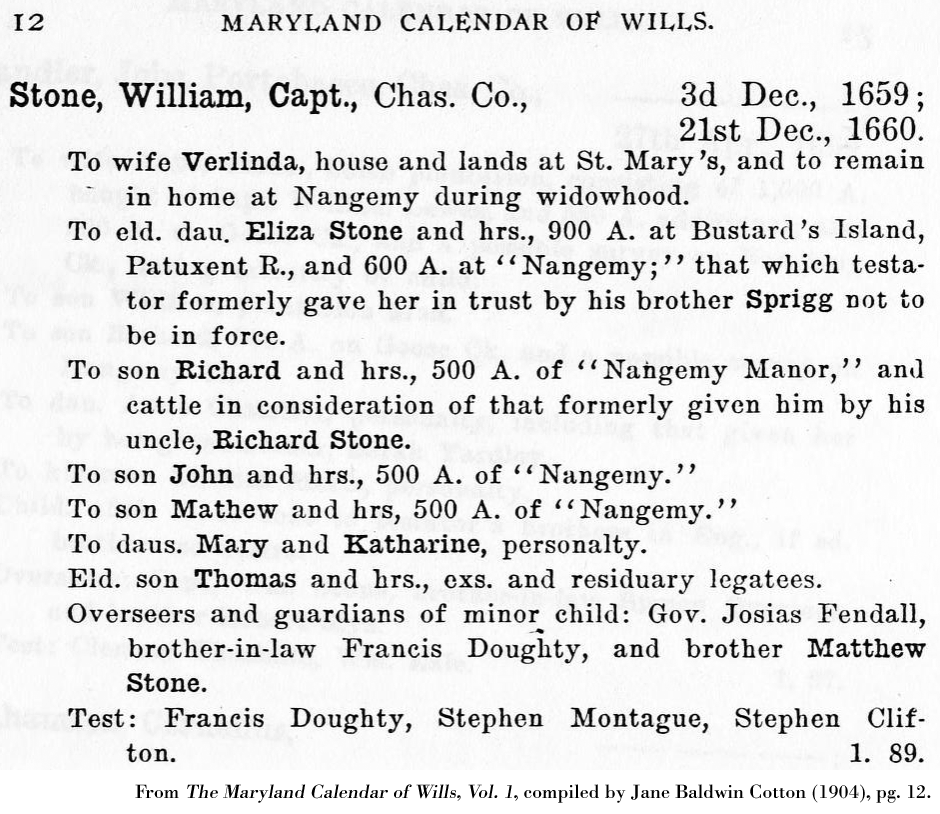
Capt. William Stone will, from From The Maryland Calendar of Wills, Vol. 1, compiled by Jane Baldwin Cotton (1904), pg. 12.
Puritan refugee William Stone (c1603-1660) rose from humbler beginnings. McCartney found Stone indentured to Virginia investors for six years. Following vital militia service, Cecil appointed Captain Stone as Maryland's third Proprietary Governor (1649-1656). The first Protestant given the role. Stone's 1659 will (right) had emerged from probate the week prior to Lord Baltimore's intervention from afar. Instructions conveyed house and lands at Saint Mary's City to widow Verlinda (Gates) Stone (1618-1675). Only after Captain Stone was dead did Cecil contend Stone had not lawfully obtained property in his brother's estate. It may be that, upon his appointment, Stone occupied the vacated Governor's House ... and took it as a perk to tend his plantation as well. [See Good Luck if it Hits, for more on William Stone ... and daughter Mary.]

Image of William Calvert proof of claim; Descendants of Virginia Calverts (1947), compiled by Ella Foy O'Gorman; pp. 18-19.
Leonard apparently mentioned neither wife nor children in deathbed instructions for disposing of his estate. 1661 testimonial (left) is widely used to establish William Calvert's paternity. By it, proven descendants qualify for membership in The Society of The Ark and The Dove. In it, William was styled "sonne and heire" to Leonard Calvert, Esquire ... when Cecil's Attorney General petitioned his Governor and the rest of his Council for possession of Leonard's town lands, 'The Governor's Fields.'** O'Gorman contended a jury of free men awarded William the land. And the cost of bringing suit.

With but a sole, surviving male heir, Cecil – governing from Kiplin Hall at Yorkshire and a London business office – attended closely to William, the only son of his only brother. Cecil flexed a Guardian's legal responsibility. In advertising his nephew's lineage, while securing planting fields at the Provincial capitol, it seems apparent that the Lord Proprietor was positioning my 9th great-grandfather to ably represent family interests in this colonial venture.

"The Calverts won the case," Newman asserted. William Calvert won something else in short order. The heart (and lands) of Elizabeth 'Eliza' Stone (1643-1707).

Papenfuse had William Calvert arriving at Maryland in 1661. Proceedings of the Provincial Court, 1666-1670 documented "William Calvert of St Maries" on 3 October making indenture to convey an improved "Tenement or plantacon" of "one hundred and ninty Acres more or lesse" at Saint Gabriel's Manor. Rent, of "two henns or Capons yearely," was not to be delivered to Saint Mary's residence ... but "at the mansion house of the said William Calvert in Calverts rest."

Manor Map, based on Peter Himmelheber research, Retrieved from St. Mary’s Families, 19 Nov 2019.
"The whole of St. Mary's County, lying south of Trinity (now Smith's) Creek was laid out for the Governor, Leonard Calvert, in 1639, with the right of Court Baron and Court Leet," proclaimed Leakin. From these lands Cecil derived three baronial estates: Leonard became Lord of Trinity, of Saint Michael’s and of Saint Gabriel’s Manors (highlighted in yellow, left). Permission to establish chapels and conduct his own judicial proceedings was attached. Bestowed almost feudal authority, Cecil's Lords of the Manor were empowered to impose taxes ... and deliver non-lethal justice without resort to Provincial, common-law courts. Contiguous administrative districts of six, nine and fifteen hundred acres were formally laid out in 1641. At times administered by a Steward on behalf of absent investors, Cecil generally required importation of a certain number of servants, within a specific time frame, in writs granting title to a manor.

North and East Elevations, Calvert’s Rest; Saint Mary’s County, Maryland; November 1999. Photo: Kirk Ranzetta. Retrieved from Maryland Inventory of Historic Properties, Maryland Historical Trust 19 Nov. 2019.
Calvert's Rest applies to an outpost of Flemish bond brick (some glazed) at a Potomac River landing ... where Calvert Creek empties into Calvert Bay. Our subject seated himself on fourteen hundred acres spilling from Trinity into Saint Gabriel's Manor. Eight miles south of the capitol, just less than halfway by trail to "Point look out," at the tip of the cape (and beneath the word 'Trinity' on the map above). On what is today Curleys Road. In this 'mansion,' two chimneys served a pair of ground-floor rooms, and attic chambers above. Leakin gets me: "His home is still standing," she wrote in 1911, "from which many of the proclamations relating to the colony were issued by him, as its Secretary ..."

Discovery surprised me, that our subject, upon attaining his majority, promptly wed William Stone's eldest surviving daughter Eliza. Courtship would have been brief. (Perhaps union had been prearranged.) Charles, first child born to William and Eliza, is here given a 3 October 1662 date of birth. Enmity over 1660 reclamation of Stone's property at the capitol was not broad, nor long in duration. Eliza's brother Thomas Stone (1635-1676) by 9 September 1663 appointed William Calvert his attorney. In the Archives, Thomas described his sister's husband as "brother." It may have been wise practice, to advertise family relationship to reigning aristocracy. Catholic William's marriage allied him with a Protestant family having a history of robust colonial leadership.

William Calvert exercised another boon provided by his Lord Proprietor. In 1662, and perhaps arriving with it, our subject held license to trade with tribal peoples. A Calvert detractor would in 1667 petition Charles II for redress: among the Puritan's grievances was a trading-post working a market he coveted. "They had no grant of land," declared Virginia-based William Claiborne (1600–1679) of Maryland competitors, "but merely a license to trade; nor did the settlers raise their supplies, but depended for these upon traffic with the Indians ..." O'Gorman acknowledged William's license provided "a profitable source of revenue." In turbulent times at remote location in the realm, capacity to flex trading sinews no doubt advantaged William. Secure relationships with sea captains and well-resourced trading houses at London gave the young man some muscle. Good will among Native traders might have given him a sense of security ... derived from in-the-field intelligence.

Undated image; Calvert House Excavation Site; Town Center, Saint Mary's City. Courtesy Historic St. Mary's City.
Calvert no doubt established himself upon The Governor's Fields, a hundred-acre tobacco plantation. In 1662, Maryland's provincial government pur-chased the "large framd howse" Leonard had died in (and William may have just taken title to). Maryland's Assembly used the manse, one of the largest timber-frame houses then standing in Maryland, as a statehouse. (It would operate as a tavern when the Assembly was not in session.) Saint Mary's County freeholders elected William as a Burgess to the Lower House of the General Assembly of the Province of Maryland in 1663-1664 and 1666 sessions. He would attend to those responsibilities in what had been his father's residence.

On 4 November 1663 Winganetta, "King" of Nangemy Peoples (also seen as Nanjemaick), acknowledged in open court he had received "full satisfaction" for land that had been in William Stone's estate. It is elsewhere described as a five-thousand-acre parcel. 1660 probate had conveyed twenty-one hundred Nangemy acres to Stone's heirs, six hundred of them to Eliza. The bride also brought to her marriage nine hundred acres at Bustard's Island on the Patuxent River.

Cecil appointed William to be his Attorney-General in 1666. He would hold that office for three years.

My 8th great-grandfather, George Calvert, was born in 1668. Purportedly to William and Elizabeth (Stone) Calvert.†† William that year began a three-year stint as Alderman of Saint Mary's City: despite Leakin's reverie, Calvert's Rest may not have been the family home. 1664 contract between a London merchant and Saint Mary's planter occurred "at the now dwelling house of William Calvert, Esq." I suspect it would have been challenging to practice law lucratively ... while ensconced at a remote plantation.

William tread in his grandfather George's grand footsteps. By "special writ" Cecil brought him into the General Assembly's Upper House in 1669, in which the Governor and his Council were then sole office-holders. William held this office for the rest of his life. According to the Archives, on 27 May 1669, Cecil – as Lord Proprietor – appointed “one of my deputies” William Calvert as a “Judge in Testamentary business.” Cecil on 28 July 1669 authorized son Charles Calvert (1637-1715), then a Deputy Lieutenant Governor, "to admit his Lordships dear Nephew William Calvert Esqr. … to be of his Lordships Council and Justice of his Provincial Court.” Our subject received express preference: it was “his Lordships further Pleasure … that his said dear Nephew William Calvert do take his place in the Provincial Court and Council next to the Chancellor.” Philip Calvert (1626-1682) held the post. And rank. Philip was younger half-brother to Cecil and Leonard.
[A family tree chart at conclusion below graphically represents pertinent sons and grandsons to the First Baron Baltimore.]

William Calvert, then in his mid-twenties, gave his oath and took his seat 22 October. A Wikipedia contributor observed “From 1669 to 1689, of 27 men who sat on the Governor's Council, just 8 were Protestant. Most councillors were Catholics, and many were related by blood or marriage to the Calverts, enjoying political patronage and often lucrative offices ...”

Archives are vague. It was in perhaps January 1670 when Virginia Gentleman James Clifton (c1640-c1714/5) appeared before “William Calvert, Esqr., one of his Lordships Privy Council.” Clifton allegedly “did Maliciously and Traiterously Utter publish and declare divers Traiterous words of Concerning and Against the Majesty and Person of our Royal Sovereign King Charles the second King of England … to wit that the King was a Son of a Whore and owed him one thousand pounds and never paid him nor never would.” A witness testified Clifton may have been speaking of an Indian King. Clifton was released.

On 20 July 1670, Monatquund, Speaker for Piscattoway Peoples, along with Tribal Councilors Unnacawsey and Mappassanough, appeared before William Calvert, Esq., and another “Deputy Lieutenant of this Province of Maryland.” Native representatives may have been summonsed. Monatquund is to have testified he and Councilors came “to revive the League between the said Pascattoway Indians and the English.” He appealed “first in the name of the Boys, next in the name of the elder Persons; that they might eat drink Sleep and play in quiet; the women in like manner, desire the peace.” Translation avowed “The old men desire it that they may sleep by their wives quietly and take their Tobacco.” Colonial administrators sought reaffirmation of Maryland’s “Lord Proprietary for their Lord and Protector.”

The parley was anchored in transaction. It had been some time since Piscattoway Peoples could afford to offer gifts: “They came to keep in memory the peace ... now they are reduced to a small Number and therefore they cannot present any thing Considerable." William himself may have produced written record which observed, "Lastly from the miserable Poor they desire that hereafter when their Nation may be reduced to nothing perhaps they may not be Scorned and Chased out of our Protection.”

'Nation' is a key phrase: I will set William's later conduct within that worldview.


Deputy Lieutenants responded “that as they desired to Continue in Amity with us so did we Assure them that we should not break the Articles made & Confirm’d by Act of Assembly between the Lord Proprietary and them.” The Deputies made demand of their counterparts. “We do hope they will be mindful and wary to preserve every of the said Articles and that so long [as amity continues] we should not scorn or Cast of the meanest of them.” Quid pro quo, they sought an Indian who had stroke a colonist be delivered to them ... contending Benjamin Price had died of the blow. “To which they replied that Price died not of the Blow but was in health twenty days after and that the said Price was swimming and diving in the presence of Mr. Chandlers Children at Port Tobacco and came out of the water sick of an Ague and vomited and of the said sickness died.” Complexity – and detail – of language recorded in counter-contention indicates to me that a certain fidelity with proceedings emerged in the written record.

Deputy Lieutenants desired the Pascattoway Emperor appear at October convening of the Privy Council. “To which the Speaker answered the Emperor was at the Sasquehanoughs [Sussquehannock Nation] and that it was not in his Power to promise that he should come.” He suggested, “for Clearing the Business,” that Price’s “head might be Searched.” The Lieutenants agreed, and ordered two surgeons “do view the head” the following month, and that Monatquund be present when officials “Certify what their opinions are, touching the death of the said Price.” It was further ordered “that there be given to the said Monatquund Unnacasey & Wappassanough three Match Coats and two Gallons of Rum.”

Charles Calvert was Maryland’s Lieutenant Governor by 22 July 1670 when, following safe arrival in England, he bestowed right to act in his capacity to three men, including “his dear Cozen William Calvert Esqr.” William was in a small circle, possessed of substantial power. Upon concurrence of any two of them, they were authorized “to Muster and train all sorts of men … in Case of Insurrections or approaching of any Enemy or Enemies, Pyrate or other Robbers, to make War against them & to pursue Enemy or Enemies … as well by Sea as Land and to Vanquish and take them and being so taken to put them to Death by the Law of War or to save them at their pleasure and to do all and every thing … likewise in Case of any Rebellion Tumult or sedition … to exercise martial Law against all Rebellous mutinous and seditious persons of those parts.” Our subject, as one of a trio of Deputy Lieutenant Governors, oversaw levy and collection of taxes as 1670 harvest came in.

“When he became the principal secretary on March 16, 1673/4, William Calvert took an oath to keep all articles of “One certaine act of Assembly,”” Krugler discovered. Calvert no doubt publicly vowed he would hew to Cecil's 1649 Act Concerning Religion. Legislation mandating religious tolerance that William had enforced as the Province's Attorney General, 1666-1669. On 1 August 1764 he signed himself “William Calvert Esqr Principal Secretary of this Province.”

Archives depicted administrative responsibilities. Talbot identified William's offices as “Secretary or Publick Notary of the Province” and “chief Judge for Probate of wills.” As did the prior office holder, Calvert likely conveyed potentially very lucrative right to establish Plantations. The Principal Secretary acted in complete subservience to the Lord Proprietor, however: “You shall apply your self wholly to his Excellency and strictly follow such Orders Rules or directions as he shall Give you in any Business whatsoever.” Calvert kept a "Booke of Secrys ffees." A sixth and final directive distinguished a secretarial role: “You shall once in every month wait upon his said Excellency and give him an account of all Business that shall be transacted by you and also pursue his Excellencys Commands, as well in doing the Business of the Office, as in giving him an Account of the fees or what else his said Excellency shall please to intimate to you.”

Upon the 1675 death of his father Cecil, Charles Calvert returned to London. Where he was elevated as Third Baron Baltimore. Charles inherited the Province of Maryland. While there, a fifteen-page “Complaint from Heaven with a Huy and crye and a petition out Virginia and Maryland” was presented to Charles II and his Parliament in May 1676. Our subject was identified in a hotly damning document: “Wee must annatomize owr present provintiall Court and Assembly … that England may see who are owr Governors and chief rulers, and thereby measur the exactnes of the legalls; viz … William Calvert, nephew ...” Our subject is but one of Cecil Calvert’s “generall kindsman” singled out, “besides the secret Councell of priests and Natlyes with perhaps a son in law or kindered more stronge papists besids … with som protestants for fashion sake.”

Much has been made of anti-Catholic sentiment in this era, but the list of grievances is long. An early complaint over funding frontier defense will reappear as a refrain in run-up to Revolutionary War a hundred years later: Cecil, instead of following royal command to form a defensive league with New York, “raysed the People in Armes for his privat gaine and Interest onely to oppress the king's subjects with great taxes in his and own creatures pokket as principally may appear out of the leavy laest year … and perswaded afterward the Assembly men, not to call him to an account for it, but to give it him. So did hee likewise in the [1669] Indian Wiccomisso Warr, when they tooke all the plunder from the poor souldiers and sent the Indian prisoners to Barbados for Negros, but forced the poore inhabitants to bear and pay all the charges.”‡‡

We will revisit the Wicocomico.


Charles II’s Privy Council directed Charles Calvert to respond to Anglican complaints made against him. "Calvert's council hanged two of the would-be rebels," asserted Brugger. In written reply, Calvert contraried Charles II: he re-asserted Maryland's religious tolerance, confiding Maryland settlers were "Presbyterians, Independents, Anabaptists, and Quakers, those of the Church of England as well as the Romish being the fewest ... it would be a most difficult task to draw such persons to consent unto a Law which shall compel them to maintaine ministers of a contrary perswasion to themselves." Virginians Thomas Jefferson, James Madison and my 4th great-grandfather Andrew Tribble would draw the same conclusion, when advancing A Bill for Establishing Religious Freedom in 1779.

Image of Clayborne's Trading-post, from A Popular History of the United States (1876), Bryant & Gay, editors; pg. 500.
William Calvert was signatory to – if not draftsman of – a 4 March 1681 letter from Lord Baltimore and his Council. In language distinctly superior to the 1676 Complaint, supplication went to the Governor of New York. “In behalf of the inhabitants of this Province, alike subjects to His Majesty the king of England with those of Delaware and New Yorke.” Maryland's Provincial Council were concerned by “northern Indians” whose depredations at Delaware had ceased when New York prohibited trafficking with Native People in shot and powder. Trade restored after negotiation, indigenous warriors began plundering Maryland plantations. Calvert’s men sought “that you will now prohibit any further correspondency with those Indians in a way of Traffick and supplies, unless they will also desist from any acts of hostility against us, and proceed to maintain and keep that league of peace and amity with us made.”

Our subject, “the Secry of the sd province by name Will: Calvert Esqre putt his hand to a pass or writteing under the lesser seale the sd province.” At May 1681 convening of Maryland’s Provincial Court, William gave Christopher Rousby, “his Majestyes Collector” of revenues, "license" to depart the Province. Rousby was perhaps being shoved out: the Lord Proprietor, retaining authority over internal taxation, had it in for the King's man Rousby.§§ Complaint of “Insolent and unwarrantable proceedings of Christopher Rousby the collector … tending greatly to the discouragement of the Trade, diminution of his [Majesty’s] Customes, and disturbance of the peace and Quiett” had been sent to the Crown. Endorsers indicated their religious affiliation: “William Calvert Esq. Secretary R[oman] Cath[olic]” was one of three confessing to the faith: the other five were Protestant. Later in May proceedings, our subject was further described as “William Calvert a R. Cath.” and as a Colonel in command of foot forces at St. Mary’s County ... in which Maryland’s vital seat of government was situated. Six of the ten Maryland counties were commanded by Protestant Colonels.

"There were Seaven people killed at Point Looke out," as tribal warriors harassed the Province generally in September 1681. The Privy Council met and proposed "a Letter be writt to Sr Henry Chickley his Majties Governor of Virginia" soliciting coordinated response. Authorship can be inferred. On 13 September a General Assembly gathered. Our subject appeared in two, distinct initiatives. It was "Ordered that The honble William Calvert Esqr Principall Secry of this Province be the person Especially appointed by his Ldspp to goe ... to the Governor of Virginia." Our subject was styled Colonel William Calvert of Saint Mary's County when inhabitants under the charge of several militias were commissioned to "stand upon their guard and posture of Defence" on 15 September.

William Calvert was in his Provincial Court seat for the 15 November 1681 trial of Josias Fendall, Gentleman (c1630-1692). Fendall had served Cecil as Maryland’s Governor, from 1656 until Cromwell’s Puritan government fell in London four years later. "Traytor" Fendall was indicted for mutiny and sedition. Additional accusations were more personal: Fendall was charged with plotting to employ “force and armes to attempt the securing” and imprison the Lord Proprietor and two cousins ... including our “William Calvert Esqre principal secretary of this Province.”

According to Wikipedia contributors who did not provide sources, “Rumors circulated in 1681” that Fendall and Maryland Assemblyman John Coode planned moving their families temporarily to Virginia. Upon hearing this, Lord Baltimore had them arrested, fearing the men were fomenting rebellion. “It is very doubtful that a rebellion was actually under way." The contention was supported by out-of-state actors: "Virginia observers felt that Lord Baltimore's charges against the two men were unsupported and “of little weight.” Some suggested the arrests were merely an attempt to prevent participation by either Coode or Fendall in the upcoming session of the Assembly, which already promised to be a heated confrontation over defense policies.” And funding said policies, I suspect.

The pair's trial was supposedly flawed in several respects. “For fear that Fendall would have time to influence the people who charged him, he was not allowed by the courts to enquire into the evidence of his crime." He was allowed to screen jurors, dismissing Catholics and retaining Protestants. Coode was acquitted, and advised to "keepe a Guard upon your Tongue." Following substantial witness testimony, jurors found Fendall guilty of attempting to raise a mutiny, and sedition through utterance of "malicious words against the government." Fendall was fined forty thousand pounds of tobacco, followed by banishment from the province. “The sentence is as favourable as could be expected,” our subject declared at sentencing. “The Law of our Province would have allowed boaring of the Tongue, cropping one or both Ears, and other corporall punishments; but wee have forbourne that, and taken this moderate and less shamefull way of [punishment].”

Our subject is seen, in standard English, as 'William Calvert, Esquire, Colonel' on a 28 April 1682 solicitation by Maryland's Upper House appearing in Maryland Archives, Vol. 7. "The Honourable the Secretary" was dispatched to the Lower House ... seeking bicameral conference; a "Consult of the Northern Indian Affairs;" and response to a letter received from New York's Acting Governor Anthony Brockholls. Success in implementing the Lord Proprietor's program would require utmost diplomatic skills. Counterparts included New Yorkers over whom they had no direct, political influence; as well as sovereigns among non-English-speaking and much more culturally distinct Susquehannah, Pisscattaway and Nanticoke Peoples, let alone further removed and lesser-known 'northern' Omeydes (Oneidas) and Onondagoes. William Calvert embarked on international affairs among what are plainly described as "Indian Nations." He appears to me as emulating his grandfather's service to James I ... as Secretary of State.

While the Assembly addressed a half-dozen issues, including acts encouraging "making Linen and Woollen Cloth" and "Sowing and making Hemp and flax," the Committee of both houses met daily. Until, on 4 May, they offered "their Advice and Report." Their clerk noted "the Pisscattaways became Enimies to the Susquehannahs meerly upon the Score of Articles made with the Honourable Leonard Calvert Esqr at first, and after by Assisting us against them in the year 1676," and "if we Abandon the Pisscattaways they must incorporate with the Northern Indians, and in that Case become another Enraged Enemy." The Committee proposed some Assembly members "be sent to New York to treate with all the Northern Nations of Indians, and to make peace for Our Selves and all Our Neighbour Indians," and that "the Pisscattaway Indians be protected in the meantime with Arms Ammunition and Men (if need require)." They also suggested "Eastern Shore Indians be Supplyed with Ammunition if they desire it." In the interim, Military Officers should conduct "frequent Musters and Appearances in Arms of Our English," and "Commission for a Defensive Warr."

On 9 May 1682 "The honble William Calvert Esqr Secy" was one of five seated in Council as warrant was issued. “Whereas his [Lordship] and Councill have been informed that Two Indians … under Subjection of the King of Wicocomico, [are] guilty of hogstealeing." Prior demand – that the pair be delivered up to English justice – had been unmet. Another militia Colonel was ordered “to take with you twenty men in Armes well mounted on horse back and … Demand peremptorily the Delivery of the sd Indians to be proceeded against according to Law.”

William Calvert's rank in Saint Mary's County Militia appeared in a 13 May remonstrance by twenty-five prominent Church of England Members. As did his religious custom. Calvert was identified as one of "onely three of the Romish perswasion" serving as "Colonells or principall officers of the militia ... in like manner all other officers and places of honor or profitt within this Province, Civill or Military, [are] impartially and equally if not for the most part on Protestants conferred. This not only in vindication of his Lordshipp's honor, and this his government, but also for the Publick Interest ..." Declaration published "to the world" cited "the general freedom & priviledge which we and all persons whatsoever Inhabitants of this Province, of what condicion soever, doe enjoy in our lives, liberties and estates under this His Lordship's Government." The testimonial was certainly a tool the Lord Proprietor could use to quell discontent in Charles II's Privy Council. I find it affirming that a cadre of Protestants "observed his Lordshipp's favours impartially distributed, and Places of Honor, trust and profit conferred on the most qualified for that purpose & service without any respect or regard had to the religion of the participants ..."

Our subject last appeared in Council Proceedings on 9 May 1682. "In Complyance with the vote of both houses of Assembly for makeing peace with the Northern Indians for ourselves Virginia and our neighbouring and ffriend Indians," Charles Calvert sought "Emperors of Nantecoke and Assateague, and the severall Kings under them" know "his Ldspp intends very speedily to send Agents to New Yorke to make peace with the Northern Indians for our selves and all our ffriend Indians." Idea had arisen in the Lower House that indigenous leaders "(if they see good) send with ours some Agents of theirs who may be Spectators of our honest endeavours for them, and (if need be) Ratifye and confirme the peace (if any to be procured)."

The Calvert Genealogy Group contended our subject "drowned when his boat capsized while crossing the swollen Wicomico River." A sloop did appear in inventory of William Calvert's estate, along with a dozen slaves, eight Whites remaining in servitude, fourteen hundred acres, eight thousand pounds of tobacco, an impressive twenty-eight books ... and nearly a thousand pounds sterling. Papenfuse, who provided this inventory, wrote Calvert "drowned while trying to ford the swollen Wicomico River" ... and gave 26 May 1682 as date of Calvert's death.

'Wicomico' is constant in more intimate accounts of Calvert's death. Though some contend the waterway on which he died was in Charles County, no account further details the event ... or provides witness testimony. I will quickly observe Maryland's Council had only weeks before "peremptorily" demanded two Wicocomico nationals be brought by force of arms.

Final reference to William Calvert was recorded postmortem, 12 October 1682. Thomas Perry deposition exposed Fendall (at whose trial and order of banishment Calvert sat in judgement the previous November) plotting to "secure my Lord the Chancelor, the Secry, and Coll Darnall." Following his intended kidnapping of our subject, Fendall had asserted, "the rest would fall" ... meaning the Calvert government.

Lythgoe found "Josias Fendall, Gent." and wife Mary ... then living in not-too-distant Westmoreland County, Virginia ... in Charles County, Maryland records for 28 April 1683. The Fendalls conveyed fourteen thousand "acres on Wicomico River" to William Digges, a Charles Calvert son-in-law. Who, with our subject, had sat in judgment over Fendall. The Colonial Encounters project included history when describing a Josias Fendall archaeological site: "Fendall had settled at a plantation between Hatton and Charleston creeks on the west side of the Wicomico River." (They also cited Palmer when contending widow Mary Fendall sued Digges in 1688 ... for eighty thousand pounds of tobacco.) The rebellious Fendall had many adherents along the swollen Wicomico at the time of our subject's demise; it's not precisely clear how soon following 1682 banishment he left the area.

William Calvert, former Chief Judge for Probate of Wills, died intestate. 13 July 1682 inventory of his estate depicted (debts of £662.18 and) Elisabeth Calvert as Administratrix/Executrix. Accounting seemed to follow rhythm of the seasons. Archives noted the Provincial Council on 2 March 1685 found ten thousand pounds of tobacco were due Calvert, "prooved by the said Calverts Booke of Secrys ffees." More than forty creditors were declared satisfied on 30 April 1686.

Calvert had likely been less than forty years old at his death. Besides widow Eliza, he left – by my account – four sons and a daughter. None of the children had reached their majority.

Detail from chart, 'Prominent Members of the Calvert Family,' from The Calvert Papers: Calendar and Guide to the Microfilm Edition, edited by Donna M. Ellis and Karen A. Stuart, (1989); pg. 17.


NOTES:

Particularly when events fell in close order, Double Dating between Julian and Gregorian calendars vexed research. My practice was to present dates as they appeared in a record.

* In Shoemaker v. United States (1893) the U.S. Supreme Court affirmed gold deposits in private land Congress condemned for Rock Creek Park at the District of Columbia became United States property. Evidence presented in District Court tended to show certain lands; which the court held to be subject to a reservation of "royal mines" in a patent granted by Maryland's Lord Proprietary in 1772; were conveyed by Charles I grant of patent to Cecil in 1632. "The royalty of one fifth part of the gold and silver reserved to the King" became, "by the Revolution," vested in the state of Maryland. "Consequently the United States succeeded to the state's title by the act of cession of 1791."

1865 reprint of Frontispiece; 1634 text, 'A relation of the successefull beginnings of the Lord Baltemore's plantation in Mary-land; being an extract of certaine letters written from thence, by some of the aduenturers to their friends in England;' retrieved from The Library of Congress.
 Hawley (a merchant) and Lewger (a Calvert investor who would be first to hold office as Principal Secretary in the Province) authored A Relation of Maryland, printed at London in 1635. The 103-page pamphlet depicts Leonard settling into "a very commodious situation." He established Saint Mary's City at Yoacomaco Peoples' principal village. For trade goods and cloth, Native leaders "freely gave consent that he and his companions should dwell in one part of their town, and reserved the other for themselves." First Peoples, dwelling in what became the English part of the town, "freely left them their houses and some corn that they had begun to plant." Yoacomacoes agreed at the outset "that, at the end of harvest, they should leave the whole town." And depart what would become The Governor's Fields.

Dowdy warned, in her excellent thesis (2019) 'Robinson Crusoe as Promotion Literature: the Reality of English Settlement in the Chesapeake, 1624-1680,' "It is unclear how much of what was reported to have taken place actually happened. This is a published English interpretation, probably made in order to reassure investors that local tribes in Maryland were peaceful." By 1637 Leonard referenced his dwelling place as a "ffort." Feasibility study for Friends of the John Smith Chesapeake National Historic Trail (2009), with tribal assistance detailed inter-tribal complexity at the time of contact.

 Krugler's The Calvert Vision: A New Model for Church-State Relations offered deep insight on religious tolerance, baked into Cecil Calvert's “Maryland designe." My post Another Tongue o' Clishmaclaver attends to church-state constructs in this period at The Colony of Virginia.

§ Cecil and Leonard's Irish religiopolitical ties – if not actual landholdings – were in jeopardy. Their father, then Knight of Danbywiske, Yorkshire; and Clerk of the King's Privy Council; had been youngest among a quartet of ministers James I dispatched to Ireland in 1613 ... to examine Catholic grievances. It confused biographers that George then helped draft recommendation for compulsory Church of England attendance, and suppression of "Popish" schools and priests. On 18 February 1621 James granted royal favor for political deftness: Baltimore Manor on twenty-three thousand acres in County Longford, Ireland were conveyed to George Calvert, Knight.

"These lands were held under the condition that all settlers upon them should take the oath of supremacy and "be conformable [to the Church of England] in point of religion." Calvert four years later professed Roman Catholic faith: "He surrendered his patent and received it back with the religious clause omitted," William Hand Browne conveyed, in George Calvert and Cecilius Calvert: Barons Baltimore of Baltimore (1890). A few weeks before his 1625 death, James I "created the aforesaid George Calvert, Knight, unto the estate, degree, dignity, and honour of Baron Baltimore of Baltimore, within Our Kingdom of Ireland."

'Baltimore' is thought by some to be Anglicization of Irish 'Baile an Tí Mhóir,' meaning "town of the big house." Alternate theory connects the placename to Celtic 'Baal Tine Mor,' "the great fire of Baal."

ǂ In A Biographical Dictionary of the Maryland Legislature 1635-1789 (1979) editor Edward C. Papenfuse acknowledged William Calvert as born to Leonard and Anne, c1642/3. He then cryptically asserted Leonard "returned to England in 1641/42 and 1643/44, during which time he fathered his two children, who were probably illegitimate." Family history researchers tended to posit that Catholic marriages of the period in England were likely secret and unrecorded. Illegitimacy might have prompted Cecil's 1661 testimonial, declaring William's paternity.

 Note the testimony of "Margaret Brent" in the image depicting 1661 restoration of Leonard Calvert's property. Some contend she was elder sister to Leonard's wife Anne: the pair were quite likely cousins of some sort. Margaret Brent (c1601-c1671) never married. Notably styled 'Gentlewoman,' she was allowed to own property in her own right. Loker contends Brent "worked as an attorney, even a prosecutor under Lord Calvert, and is recognized by the American Bar Association as the first female attorney in the United States."

"6 howres before his death" on 19 June 1647, Leonard verbally instructed Brent – as his Executrix – to "take and pay all" from his estate. He had hired mercenaries to take Maryland back from rebellious Puritans. Uncompensated, the men loitered menacingly at Saint Mary's City. Planters had fled two-year rebellion; meager harvest forecast food shortages. Lacking clear authority to act on the Governor's wishes, Brent appeared before the Provincial Court for unique authorization to dispose of Leonard's cattle, thus enabling her to feed and pay disgruntled 'militia.' Without waiting for transatlantic instruction. (Interestingly, House of Names links surname 'Calvert' to Calvehird: "It is a name for a person who tended cattle.")

Bozman imagined Brent "to have possessed a masculine understanding." After presenting a novel case, the court adjudged Brent, as Administratrix of the Provincial Governor's estate, held power of attorney in his affairs. Seemingly in the absence of an Attorney General, the court ruled Brent within her authority to also act as the Lord Proprietor's personal attorney-in-fact, "as governor Calvert had been." She immediately granted herself permission to act.

Brent expended much of our subject's inheritance. She placated the mercenaries and protected Calvert holdings, nudging a complex and tenuous balance of power at a critical juncture. Brent almost immediately lost favor with a suspicious and far-removed Lord Proprietary. "We do Verily Believe and in Conscience report," the Maryland Assembly retorted to Baron Baltimore; after his brother's death, "it was better for the Collonys safety at that time in her hands then in any mans else in the whole Province ... for the Soldiers would never have treated any other with that Civility and respect." According to Archives of Maryland, Vol. 1, "She rather deserved favour and thanks from your Honour for her so much Concurring to the publick safety then to be justly liable to ... bitter invectives you have been pleased to Express against her."

On 21 January 1648 and still wrangling with state finance, Brent petitioned Maryland's Acting Governor and Provincial Assembly to admit her with two votes, one as a free landowner in her own right, and another as Lord Baltimore's acting personal attorney. Refused, she departed with disruptive protest. Sturgill contended Brent thus "became the first woman in the New World to request the right to vote."

Having moved across Chesapeake Bay to found a community called 'Peace' on Virginia's Northern Neck, Brent left a thousand Maryland acres to her nephew James Clifton in 1671. He whose allegedly "Traiterous words" had brought him before William Calvert the year prior.

Until 1670, "Maryland allowed all freemen" (any man who was not indentured), "regardless of color or religion, to participate and vote in the colonial assembly." According to Historic Saint Mary’s City, coastal trader Mathias de Sousa is offered as "the first man of African descent to participate in an Assembly in English America." He was elected in 1642 to the Lower House of Maryland's General Assembly.

** "From the very beginning, titles or distinction in social status in Maryland were religiously employed," found Newman in 1961 study of the Province's social structure during formative years. "At the time Lord Baltimore was formulating plans" for a Province beyond the seas – a project some agrarian-minded English called "western planting" – "the feudal age was still lingering and had not altogether given way to the materialism of commerce which was then dawning in 17th century England. Many of the conservative younger sons at that period, who still regarded the cultivation of the soil as the rightful pursuit of a gentleman, looked upon the Colonies as a medium for the life befitting their birthrights."

The Lord Proprietor assured William Calvert would arrive as 'Esquire' ... “ceremonious title for the squirarchy.” Perhaps holding less land, 'Gentry' were accorded lower rank. 'Gentleman' was highest title accorded freemen of lower-status Yeomanry. All perceived themselves as proprietors over their plantations, above servant and artisan classes. In grave departure from English custom, African slaves would supplant bond servants in Cecil's tenure. Our subject certainly qualified in this assessment: "Many of the squirarchy were descended from the younger sons of the peers or had peerage connections." They were often referred to as "the untitled aristocracy."

Newman also observed religious influence on societal standing: "The magnanimity of the Calverts was their undoing. By the complete tolerance to all Christian doctrine, they invited the Puritan, the Quaker, and the non-Conformist ..." In most instances, "Dissenters of the first generation could not and would not conform to the pattern of the Maryland squirarchy and county gentry."

†† On ancestry of my 9x great-grandfather. Papenfuse (1979) unequivocally depicts "George (1668-aft. 1739), who married Elizabeth Doyne" as third son born to William and Elizabeth (Stone) Calvert. Ella Foy O'Gorman, compiling Descendants of Virginia Calverts (1947), was particularly rigorous, expertly sourcing her work. In delightful, self-questioning banter at the Foreward, she concluded "With so many Stafford County [Virginia] records missing, it seems futile ever to hope to make conclusive proof of the parentage ... of George Calvert of Stafford County. In deference to this seemingly universal tradition of their descent from Lord Baltimore by these Calverts of Prince William and Culpeper counties, the compiler is letting it stand that George Calvert of Stafford County was a son of the Hon. William Calvert of St. Mary's and Charles counties, Maryland."

"Half of Stafford’s historical records were taken as souvenirs or destroyed when Stafford’s Courthouse was looted and later partially burned" contended Virginia's Stafford County Historical Society. In 1862, Brigadier General Daniel Sickles’ Excelsior Brigade conducted two, devastating raids on the courthouse and clerk’s office.

The Calvert Surname Y-DNA Study, acknowledged George (b 1668) "is accepted, but unproven with primary source documents, to be the son of William Calvert, Esq." They went so far as to attempt derive proof from a Philip Calvert, descendant of my 7th great-grandfather John Calvert (c1692-1739). "Philip Calvert's remains were used to attempt to extract DNA. However the attempt was not successful."

"Hopefully, someone – maybe you – will discover the missing link proving this family’s heritage," the Calvert Genealogy Group testified, in 'Who was the First George Calvert of Stafford County, Virginia?' Thirteen-page, scholarly treatment in The Prince William Reliquary, Vol. 9, No.2 was highly collaborative. And innovative ... proposing a land-mapping project. It would most certainly have tickled my hundred-year-old cousin James Neale, Jr. (cited at the outset) to learn that William and Eliza (Stone) Calvert's proven daughter Elizabeth (b c1666) married a James Neale, Jr. (1660-1727).

‡‡ Marye, in ‘The Wiccomiss Indians of Maryland’ for American Antiquity (1938), placed the tribe north of Choptank River on Maryland’s Eastern Shore. “The Wiccomiss Indians (Wicomese, Wicomick, Wickamiss, Wiccomisso, etc.) were persecuted and dispersed by the Government of Maryland,” he noted early in his account. He cited a 1635 source, depicting the tribe as enemies of the Sussquehannock. By 1648 the Wiccomiss had become “forced auxiliaries” of the tribe. Sussquehannock overlords in 1652 ceded “the whole of the Eastern Shore as far south as Choptank River” to the Government of Maryland. Marye wrote “When Maryland was prosecuting its final war against the Wiccomiss it was reported [in Maryland Archives, Vol. 2] that these Indians “have drawne [the Delaware Nation] into League with them.”

§§ Even a royal official required permission to leave the Province. As with Cecil visiting Rome in 1624 without his King's consent, contemplation of Article 13 of the U.N.'s Universal Declaration of Human Rights might prove rewarding. Persons have the right to travel.

The Murder of Christopher Rousby: Part II offered interesting account. A George Talbot, “first cousin of Lord Baltimore [whom] Baltimore had appointed as Surveyor General of Maryland in 1683,” stabbed the revenue collector to death on All Hallows Eve; 31 October 1684.


Thursday, June 27, 2019

Hanging Fork

At Finding Everett I considered conversational taboo regarding ancestors ... as disservice to the living. I wrote of my willingness to research subjects who left no bloodline heirs, and realize these themes again play out ... as result of a Facebook query from Michigan, which diverted my attention to a Peter Tribble.

'P' mark attributed to Peter Tribble (c1670-1738)
Rummaging around, I discovered my personal database profiled ten souls named in variation of 'Peter Tribble.' My 7th great-grandfather, purported by Rozendal to be "founder of the Tribble family in America," bore the appellation (right). The illiterate barrel-maker remained in colonial Virginia, perhaps overseeing family endeavor: father and grandfather, William Tribbles both, are to have returned to Olde World familiarity.

Perhaps accruing luster from his father, the second surviving son born to Baptist pioneer Andrew Tribble (1741-1822) and wife Sarah Ann Burris (1753-1830) achieved veneration. A considerable body of men including those beyond Tribble family lineage were named for Baptist Elder Peter Burris Tribble (1774-1849). Condemned to a life eternal? depicts Burris-Tribble families' adventurous migration into Kentucky ... where our scene opens.

7 Jun 1894 – The Leaf-Chronicle.
I was far from the subject of my initial investigation when realizing the text string, "Son of Mr. Peter Tribble, and a brother of Mr. Zan Tribble," provided significant clue to identifying a "Mr. Joe Tribble," who ended life tragically at Hopkinsville, Kentucky environs in the summer of 1894. (Click on image, right.) Census records divulged Alexander Stephens Tribble (1865-1951) was styled ‘Zan’ from at least age fifteen onward. I knew him to be a son of my second cousin Peter Tribble (1835-1920) and his first bride: the once-widowed Mary Elizabeth (Kenley) Bowdry (1827-1871). It dawned upon me that, perhaps mercifully for Tribbles, reporting did not correctly identify the self-slayer: it had been Joel Craig Tribble (1861-1894) who hanged from a rafter in his father's barn.

Particularly when comparing Joel's negating response to life with that of pioneering Tribble progenitors, I sense deviation has occurred. Willing to puncture taboo, I waded in among his siblings ... to discern the milieu in which thirty-two year old Joel failed to thrive. How much deviance was there?

I of course unearthed no family secrets a century and a quarter later.* Genealogical tools did summons skeletal structures for assessment, however.

Neither Joel nor Zan ever married. Nor did the brothers' youngest known sibling, George Washington Tribble (1865-1895). Passing at age thirty (of consumption, according to death records), George's death followed Joel's by a mere ten months. Half-brother Peter Tribble (b c1876), named for his father no doubt, never surfaced in any records subsequent to the 1880 census.

Peter and Mary Elizabeth's eldest son, Fielding Kenley Tribble (1859-1921), finally married in 1900 but, like all his brothers, did not spawn known children.

Failure to establish families, among a knot of siblings, seems to offer significant anomaly.


I was prepared to secern – what should I call it – a 'dysfunctional pocket' in my family tree. Where, for reasons I suspect dark and murky, a family unit reliant on muscled farm labor resists bringing others into lasting, intimate relationship. I ruminated as to whether I had stumbled over incest indicators.

I looked closely into Peter and Mary Elizabeth’s only known daughter, Mattie Emery (Tribble) Eads (1856-1930). My brooding, on a black cloud hanging over this clan, unfurled completely when I discovered unmarried Mattie on her paternal grandfather’s farmstead by 1880. When she was 24. Had the first-born child fled her father's not-too-distant household? Had Peter's second marriage, to Mary Emma Robinson (1846-1911) in 1875, contributed to Mattie's out-migration?

Like all of Peter and Mary Elizabeth's children, Mattie is not known to have "produced issue" ... in the sense of forwarding the bloodline. This is not to say that Mattie's comparatively long life was free from issues, but their resolution tended to indicate capable, decisive character. I can assume she chose to be childless.

Mattie quite likely proved a helpmate to her grandfather George Washington Tribble (1804-1896) and his second wife. 'G. W.' died a mere twenty months following his namesake, consumptive grandson George, above. Six years later, in 1902 and after Mattie had shared responsibilities there for at least two decades, her grandfather's widow, Lucinda (Kenley) Tribble (c1823-1904), conveyed the 129-acre Hanging Fork Bluegrass Farm on the Stanford and Danville Pike to Mattie. One woman empowered another.

The spread is handsomely depicted in a sale bill, below: thirty-six acres of 'bottoms' along Hanging Fork Creek. Forty acres in bluegrass. More than fifty acres furnished a fruit orchard, and crops of "corn, tobacco, etc." Everlasting springs fed a stone spring-house. It crouched among a buggy barn, double garage, smoke house, stock- and tobacco-barns ... and three chicken coops. After Mattie had cared for it for at least a half century; an airy, two-story home with veranda, and perched in a "pretty lawn," was described at culmination of a "nice avenue."

Mattie’s step-grandmother Lucinda passed in 1904. In February 1906, Martha Clark, wife of the man to whom Mattie had rented Hanging Fork Farm, died of kidney trouble. Clark apparently went back from whence he’d come. Local papers in Stanford and Danville reported Mattie that October, following harvest, rented her farm to landless James Eads for $700.

11 Jan 1907 Stanford Interior Journal.
Mattie in January 1907 married widower James Henderson Eads (1841-1931). Reporting (right) says “It was a case of love almost at first sight …” Between fifty-year-old-Mattie and sixty-five-year-old James, whose daughter and three sons were no doubt resident in the nine-room, Hanging Fork Farmhouse at conclusion of the couple's nuptials.

In contrast with brother Joel, Mattie prevailed upon life. The matrimonial depiction asserts the bride "for several years has managed her farm and always declared a good dividend."

Folks in 1912 still referred to the property as the “Tribble farm,” five years after Eads and his brood took up residency. I was surprised to find our subject that year represented in Kentucky Court of Appeals records. As landholder, Mattie finally prevailed – after what must have been considerable legal wrangling – in retaining right of overland passage across her neighbor's property ... whenever Hanging Fork Creek was in "high water time" and “past fording.”

1907 reporting above portrayed Mattie as “all business.” I appreciate her tenacity.

Between 1912 and 1916 in particular, newspaper front pages annually report Lincoln County Fair judges bestowing all sorts of awards on Mattie. (Canning, baking, floral and needlework prominent among them). In the early spring of 1917, Eads offered livestock and farm equipment for sale, publicly admitting "I am getting too old to farm."

Cause of death for Mattie's father Peter Tribble in 1920 included "gradual wear out." By then Mattie and James cohabited with three 'single' sons, aged twenty-five to thirty-six.§ Based on my research of other farm-based families in the era, these men seem well past marrying age to me.

Mattie died in March, 1930 … at age seventy-three, and having had influence over Eads' children for twenty-three years. James died almost exactly a year later: twenty-two days beyond his 90th birthday. With Eads stepsons as heirs, it’s apparent from the broadside below that Hanging Fork Farm remained in Mattie’s estate, until her affairs were settled and Great Depression grinded into the summer of 1931.

18 Aug 1931 - Stanford Interior Journal.

* I was introduced to Joel Craig Tribble a mere two weeks following the 125th anniversary of his suicide. I had known that John Calhoun Tribble (b 1839) – married with two surviving children – died by his own hand in Madison County, Kentucky on 22 Sep 1886. He took strychnine. Kentucky Advocate reporting on Peter Tribble's first cousin was rather more intimate than that concerning his son Joel. Though "no cause is known for the rash act," friends' observation on the death of two of John's children in the previous year graced readers with some sense of justification ... as contemporaries puzzled over the deed. "He owed a little money, but not enough, perhaps, to have been burdensome." In an era when PTSD afflicts so many veterans, it might be noted that John Calhoun Tribble rode four years with John Hunt Morgan's Confederate cavalry during the Civil War ... and twenty years prior to his demise.

 Interestingly, the landowners contending Hammonds v. Eads were both women. And Judge Robert Hiner Winn had to decide whether men had inadequately conveyed notice of rights of passage retained by Mattie's deeds. Eads' son Hugh Guthrie Eads (1883-1939) was dispatched "at the request of Mattie Eads" to represent her claim to prospective buyers. Hugh dealt not with Pharoba (Combest) Hammonds (1861-1934) however, but with husband Tolbert. Winn noted "It is true that the conveyance stood not in Mr. Hammonds, but in his wife." He then ruled Tolbert was acting for Pharoba in the land transaction, and Mattie prevailed in a second (and concluding) instance. By legal outcome, timely presentation of deed language proved astute forethought on Mattie's part.

 A pair of old workhorses were declared "not afraid of automobiles" and "safe for women to drive." In addition to a "good rubber tire buggy and harness," Eads disposed of an "extra good farm wagon. (There is nothing like a Mitchell wagon.)"

§ I don't know what is the greater oddity; that the men were enumerated as 'grandsons' in 1920 or that name variation, over time, seemed excessive. In trying to assess how many of James Henderson Eads' heirs declined to marry or bear children, I found father and namesake son alternating between 'James' and 'John.'

6 Dec 1912 - Advocate Messenger
Eads' son, listed as 'Cortes' at birth and in 1900 was, by 1920, depicted as grandson 'Charles.' He would be interred in 1972 as 'Carter William Eads.' Cortes/ Charles/ Carter/ "Mr. Eads," was perhaps eighteen years old in 1912 reporting (right) that referenced "the Tribble farm." I think it makes a nostalgic read ... and leaves the living to ponder, "Why was Charley among a family adjacent to his father and step-mother?"

Hugh Guthrie Eads (seen in 1912 court records, above, as 'Hugh Eads') would register for the draft in 1918 under that three-part name (and offer his father as next of kin). He appeared in the 1920 census of Hanging Fork Farm as (grandson and) 'George H. Eads.' He's likely the 'Hugh D. Eads' depicted as residing in a brother-in-law's 1930 household with a daughter born c1911, and a wife he'd purportedly married in 1913.

Since I have it, I thought to contribute the signature of Peter Tribble (1835-1920). As a bookend.

Tuesday, December 31, 2013

Another Tongue o' Clishmaclaver

In 1947, Annie Keith Somerville wrote “the parentage of James Keith is still veiled in obscurity.” But her hand-drawn Family Tree of the Descendants of Rev. James Keith of Virginia provided a sketch of a Spanish coin, purportedly sent Keith by his cousin, a Scottish Earl. The medallion (below), with one face replaced by the Keith family coat of arms, is offered as James Keith's touchstone to an illustrious past.

Another historian had claimed, in 1911, that Keiths of Fauquier County, Virginia, “descended from an ancient and honorable Scotch Clan; they trace their descent from Lord Keith, Earl Marischal, of Scotland, and from Edward III, King of England.” Hardy vaguely places our subject, James Keith (1696-c1752), as son of a Robert, grandson of an Alexander Keith. Several cadet branches of the Earls Marischal do begin with an Alexander.
[See Colonial Families of the Southern States of America, by Stella Pickett Hardy; pg. 311.]

In 1889, Thomas Marshall Green offered sage observation of James Keith’s ancestry: “The statement that he was descended from the particular family of Keiths who were ennobled as Earls Marischal and of Kintore may be true; but - if true at all - his relationship to those of his own generation who held those titles was so exceedingly remote that it is not now, by any human ingenuity, in any way traceable. Fortunately, to his descendants, the truth or falsity of the statement is as little important as it is to the world at large …”
[See Historic Families of Kentucky, by Thomas Marshall Green; pg. 104.]

Most biographers agree that James Keith was born in Peterhead, Aberdeenshire. "The town of Peterhead was erected by the Earl Marischal in a burgh of barony, with large priviledges and immunities, for the advantage of trade ..." reports a 1730 account. "It being an important station, as well for the protecting as advancing that valuable branch of trade, the fisherrie." Peterhead held a window open to the world. With year-round harvests of herring, cod and salmon, "cargoes of fish may be had fitt for the consumpt of any port in Europe."
[See Collections for a History of the Shires of Aberdeen and Banff, Vol. 1, by Joseph Robertson; pg 419.]

Reconstruction watercolor, Inverugie Castle by Andrew Spratt.
Images enlarge when clicked.
Tradition has it that James spent his youth at Inverugie Castle (right), some two miles from Peterhead on the northeast coast of Scotland. Family ties, perhaps in conjunction with the loss of his mother or parents, were sufficient to gain James a place in an Earl's household.

"Innerugie [sic], at the mouth of the [river] Ugie, a famous castle of the Earls Marischal presents itself," described a geographer in 1907. "This barony, with many estates ... passed by right of marriage to the ancient and noble house of the Keiths" who "derive their origin from the Picts ... driven many centuries ago from their ancestral seats ..."
[See Geographical Collections Relating to Scotland Made by Walter MacFarlane, Volume 52; pg. 279.]

A family history declared the following legend 'possibly fable:' "The Keiths of Scotland claim descent from the German tribe of Chattie or Catti, who defied the Senate, foiled the second Caesar and, disdaining to submit to the overpowering force of Germanicus, escaped first to Holland, and, later, by chance and tempest, were driven to Scotland."
[See The Keiths, in the Register of Kentucky State Historical Society, Vol. 1, No. 3, by Annie H. Miles; pp. 71-72.]

MacFarlane's sources inform that, at the time of James Keith's residency, "This house of Keith has, beyond all the rest, the largest properties in the whole of [Aberdeen-shire]; even in Mar and the Mearns it holds considerable estates ..." The Earl may have sailed his own fleet. He had manors at Newburgh, Fetteresso and a 'hotel' or private townhouse in Aberdeen and likely another in London. More important to the following account, Scots Earls could still rely on 'Clan levies' to raise private armies at the dawn of the 18th century.

The Keith household had departed their coastal fortress of Dunnottar Castle, near Stonehaven (pictured at bottom of post), when William Keith (c1614-1671, Scotland's 7th Earl Marischal*) made Cheyne's fortified tower hospitable as Inverugie Castle, c1660. During the English Civil War, Oliver Cromwell's forces had ruined Dunnottar, "the only place in Scotland where the royal flag still flew," by cannonading a small garrison at the culmination of an 8-month siege in 1652.
[See Dunnottar Castle, David Ross, ed. More at 2014 post While She Was Laughing Them To Scorn.]

Image of sword, scepter and crown of Scotland.
The Honours of Scotland
The senior member of Clan Keith had held hereditary office as Great Marischal of Scotland since the 12th-century reign of Scots’ King Malcolm IV. (For 'Marischal,' think of a marshal.) In addition to safeguarding royal regalia (left), Earls Marischal had been responsible for protecting the king's person whenever he attended Parliament. As such, these peers of the realm were firm royalists. The 7th Earl Marischal had been captured prior to Dunnottar's destruction. For nearly ten years - until the Restoration - he was held captive in the Tower of London. Dunottar had been reduced, in part, because regalia necessary for crowning Scots kings had been secured there. On their own initiative, women - both noble and common - organized their secret removal. 'The Honours' also re-surfaced at the Restoration.

James Keith was in his second year when Inverugie descended to the 9th Earl Marischal, another William Keith (c1665-1712). Wikipedia, citing Cokayne’s Complete Peerage of England, offers this observation of William, of the ‘flashy wit:’
“… all Courts endeavour to have him at their side for he gives himself liberty of talking when he is not pleased with the Government. He is a thorough Libertine, yet sets up mightily for Episcopy; a hard drinker; a thin body; a middle stature; ambitious of popularity.”

James was but a couple years younger than William's eldest son George Keith (c1693-1778, of the Spanish coin) and nearly the same age as second son, James Francis Edward Keith (1696-1758, named for James Francis Edward Stuart, then England's Prince of Wales. It is disconcerting that two in the 9th Earl Marischal's household were apparently styled 'James Keith:' I will try not to confuse you.

Also domiciled at Inverugie were William's daughters, Lady Mary (1695-1721) and Lady Anne. As with George and James Frances Edward, they were born to Lady Mary Drummond, daughter of James, the 4th Earl of Perth. (Perth Amboy, New Jersey was named for her father. As William Penn's partner, the Earl had sponsored a 1684 expedition to settle his new lands there.)

The Keith's tutor, William Meston, was known for his burlesque poetry. Meston "seems to have been a good scholar and a wit and pleasant companion: but he was too fond of the bottle," says a biographer.

From Ecclesiastical Chronicle for Scotland, Volume 2, by James Frederick Skinner Gordon; pg. 187.
Robert Keith (1681-1757)
For Preceptor, William chose Robert Keith (1681-1757) to inculcate his sons ... and very likely our subject James Keith. As such, Robert (left) was responsible - from 1703 - for educating and acculturating the Earl's sons to their aristocratic rank. Robert was far-distant cousin to his charges: an eminent, 18th century authority links Robert (without citation) to Alexander Keith, 3rd son of Scotland's 3rd Earl Marischal ... and Lady Elizabeth Gordon (grand-daughter of Scotland's King James I and his wife, Queen Jane Beaufort). [See A Genealogical History of the Dormant: Abeyant, Forfeited, and Extinct Peerages of the British Empire, by Sir John Bernard Burke; pg 303.]

Though wellborn, Robert's Keith ancestors had over generations exchanged large estates for smaller manors. The Marischal's Preceptor may have had an affinity for our subject, his father had died when Robert was not yet two years old. Robert credited his mother: though but a minor landholder, he obtained an excellent college education through her efforts. Robert Keith would provide a moral compass for his charges.

William Keith was by 1701 a member of Scotland's Privy Council. From a position of power he openly opposed union between Scotland and England. His obeisance was due a Scots king. After the 'Glorious Revolution' of 1688 deposed Scotland's King James VII (in England, styled James II), the Earls Marischal continued supporting the house of Stuart, even though their court had gone into foreign exile. [See Jacobism note, below.]

Of William's generation of the house of Keith, one biographer observes: "Here we have the father [William Keith], an Episcopalian; his wife [Lady Mary], a Catholic; and their son [James], a Protestant; all of them desperate to have a Catholic Stuart King on the throne." [See Clan Keith, citing Nothing But My Sword, by Sam Coull; pg. 28.] To this we might add observation that William's first-born George was a deist ... if not an outright non-believer ... despite Robert Keith's undoubtedly fervent religious instruction.

George shared his father's political beliefs from the outset. By 1707, a clandestine Jacobite agent was styling him as 'Chevalier Keith' in correspondence. It was a play on one of James Stuart's titles, the 'Chevalier de St. George.' [See The Jacobites and The Union, Charles Sanford Terry, ed; pg 260.] (George's cipher names would, in the future, include 'Charpentier,' and '9/m.')

William likely decamped to France, where he acknowledged the Stuart succession. As did Pope Clement XI from Rome. James VII and II's male heir, James Francis Edward Stuart (above), added 'Knight of the Thistle' to William's other titles ... in February 1708. For his overt militancy, William, Scotland's 9th Earl Marischal, was imprisoned in Edinburgh Castle later that year. Our subject, the likely fatherless James Keith, would have been twelve years old when the head of his household was abducted.

The results, in terms of family stability, grew disastrous.


Robert Keith retired from service to the Earl's household in 1710, when he entered the ministry of the Scottish Episcopal Church. George Keith became the 10th Earl Marischal upon William's death in 1712. Robert is to have guided George's brother, James Francis Edward Keith – contemporary of our James Keith – into the study of law at his alma mater, Marischal College (founded 1593 by George Keith, the 5th Earl Marischal, left). Robert quite likely was stimulus for our subject to study divinity - as he had - at Marischal College at Aberdeen. (Some speculate James' father was, or had been, professor there.) Tumultuous conflict would prevent either James Keith from taking a degree. [More on the Keiths and Marischal College at my 2014 post Lat Thame Say.]

From Anne, the reigning Queen of England, George Keith "received the command of a troop of horse." He was promptly made Captain of Her Majesty's Guards, in February 1714. Anne was dead by July. Despite signing her successor's (German-speaking Georg Ludwig, a prince in the house of Hanover) proclamation in August, the Earl Marischal was deprived of his royal command. "On his way back to Scotland, he met his brother James at York, [who was] hastening to London to apply for promotion in the army. They returned home together and, instigated by their mother, who was a Jacobite and a Roman Catholic, they at once engaged in the rebellion of 1715." [See The Scottish Nation, Volume 3, by William Anderson; pg 107.] Brother James, in his memoirs, seemed to be racing to London for another reason: he may have been called to join a coup d'etat. The Irish and very popular James Butler, 2nd Duke of Ormonde - in his role as Captain General of the British army - contemplated seizing the Tower of London, and using regular troops to enthrone James Stuart following Anne's death. [See The King Over the Water, by Shield and Lang; pg 25; and A Fragment of a Memoir of Field-Marshal James Keith, by James Keith; pp. 4-5.]

In October 1714, Prince Georg and England's ruling Council declared a change in long-held protocol regarding coronation. Scotland's Earl Marischal, now also a peer of the English realm, would process 'on the left hand' of England's Earl Marshal ... one place removed from the sword of state. "It may be noticed, however, that the Earl Marischal of Scotland has never appeared in any ceremonial since the Union," reads a footnote. [See Sketch of the History of the High Constables of Edinburgh, by Sir James David Marwick; pg. 42.] The author observes that, by the time protocol had been established, it was too late to notify anyone in Scotland. The Earl Marischal may have been thinking of his own sword, when England crowned King George I a few days later.

Aligned with his cousin the Earl of Mar, George Keith sought to put the Scottish crown on the head of James Stuart. One would like to think our subject was among the young Marischal's party in this account of 20 September 1715: George "accompanied by a number of noblemen, entered Aberdeen and proceeded to the Cross and there proclaimed the accession of James VIII to the throne of his ancestors. The depute-sheriff read the proclamation; at night the city was illuminated, and the bells of St. Nicholas Tower were rung in honour of the new king. On the succeeding day, Earl Marischal and his party were hospitably entertained by the members of the Incorporated Trades; and in the afternoon they accompanied him to his mansion of Inverugie." [See Historic Earls and Earldoms of Scotland, by John Mackintosh; pg 295.] While modern writers often provide the appellation 'Old Pretender,' George and his brother almost invariably styled James Francis Edward Stuart as 'King' henceforth in their correspondence.

Image of Market Cross, Aberdeen, Scotland

Whether provided by their Preceptor or another, it is apparent that the young scholars had received training in arms and martial tactics. All three of their generation - George, James Francis Edward, and James Keith - feuded in militant 'uprisings' in late 1715. Not yet twenty, Our subject was wounded in the Battle of Sheriffmuir on 13 November, undoubtedly following the Marischal. (Alexander Chalmer's Biographical Dictionary has the more renown James Francis Edward Keith wounded "in this unhappy contest." [See Vol. 19, pg. 286.]) Under the Earl of Mar and commanding a pair of cavalry squads, George led an advance force of Scottish highlanders up the boggy ground of Stone Hill near Dunblane (also Dumblain). “At the breaking out of the Rebellion of 1715, with his relatives George and James Keith, under the banner of the Pretender, [our James Keith] wielded a claymore at the battle of Sheriff-Muir, where he was wounded ...” [See A History of Kentucky and Kentuckians, by Johnson E. Polk; pg. 1380.] Ashby McGowan, in the August 1996 issue of Military History magazine, acknowledges the claymore sword in that encounter: "They liked pistols, but did most of their fighting with basket-hilted broadswords, dirks (daggers) and targs (shields)." [See Robert Burns note, below.]

Woodcut from The Lion in the North: a Personal View of Scotland's History, by John Prebble, 1981.
Peterhead, 1715
James Francis Edward Stuart, now the attainted Prince of Wales, arrived at Peterhead on 22 December 1715. Having been passed over to succeed his father as King of Scotland, England and Ireland, Stuart had inspired 'The Fifteen,' a general uprising from northern Scots' strongholds. Some say by the fluke of a storm, Stuart used the Keith’s Port Henry as a means of landing and departing. Contrary to the 18th-century image (left), James Francis Edward Keith recalled: "The King indeed arrived safely in the end of December 1715, after a great many dangers, but came in a very small fishing barck with only two servants, and without any of those things which we had so much depended on ..." [See Keith, pg. 24.]

Stuart would have relied on the regalia in the Marischal's responsibility, if he'd gone through with plans to be crowned at Scone. George and the would-be king moved for days among the Earl's various manors. When Stuart made his public procession into Dundee, the Earl Marischal rode at his left hand ... the Earl of Mar (James Francis Edward Keith styles him 'Duke') on his right.

The enterprise failed. Sherrifmuir had not been a decisive victory against English forces. Scottish clans divided, and then sparred among themselves. None claim the sickly Stuart was a charismatic leader. When the Catholic aspirant - expatriate since he was six months old - did not get popular support from sought-after subjects, Stuart retreated to French protection.

For leading troops against his lawful King, George and his family were stripped of their titles and also attainted for treason. As the young Earl Marischal slipped into French exile, the English crown seized his lands. "George Earl Marischal was forfeited by the Duke of Brunswick, and his estate reckoned at one thousand six hundred and seventy-six pounds sterling, yearly; partly in Aberdeen and partly in Kincardin shires; and consisting of ... cash, six hundred and twenty-two pounds; barley, one thousand and seventy-two bolls; oatmeal, one thousand six hundred and ninety-nine bolls ..." and 640 eggs accruing to more than a thousand fowl.
[See Robertson, pp. 420-21.]

Rev. Robert Keith and other Edinburgh clergy were prosecuted for not praying for the Hanoverian -now styled King George I - in 1716. A Commission of the Judiciary fined him; Robert "was prohibited from ministry."

Lady Mary, George and James' mother, is credited [by Shield and Lang, pg. 131] with this reflection, after her sons were deprived of nearly all:

"A curse on dull and drawling Whig,
The whining, ranting, low deceiver,
Wi' heart sae black and look sae big,
And canting tongue o' clishmaclaver.
My father was a good lord's son,
My mother an earl's daughter,
And I'll be Lady Keith again,
That day our king comes o'er the water."

Like his cousins, our James Keith embraced the Stuart cause. A trained Protestant defending a Catholic aspirant to power, he risked death in the service of his cousin George Keith, an 'avowed religious skeptic.' Green wrote that young James, “remained for several years among the highland fastnesses; but again proved his fidelity to the Stuarts, by aiding in the abortive attempt of Seaforth and [the attainted 10th] Marischal to raise the highlands in 1719.” [See Green, pg. 104.]

James Francis Edward Kieth, also in exile, went from studying military tactics at the Paris Academy to join his brother in Spain, which also recognized Stuart as King of England. Spanish authorities entrusted the Marischal's brother with about 18,000 crowns for a "fiery cross mission," to equip two frigates and "raise the Jacobites in France." [See Shield and Lang, pg. 318.]

Image of Spanish coin, defaced by Keith Coat of Arms
Spanish coin defaced by Keith Coat of Arms
George Keith helped lead a March 1719 invasion force of perhaps 6,000 men, many Irish, in a fleet that included ten ships of war under the Spanish flag. A storm dissipated the ships and "only a small force effected a landing in the Western Highlands, [where] a few [Marquess of] Seaforth Highlanders joined them." Too weak for the erstwhile Marischal's planned assault on Inverness, "the small army took up a position in the pass of Glenshiel, and attempted to make a stand. They were soon attacked by Government troops, driven from height to height, and defeated. George and other officers retired to the Western Isles and, after lying concealed for some time, he escaped to Spain." [See Mackintosh, pg. 296.] It was George Keith - the last Earl Marischal - who was to have provided the Spanish coin (above, right) as a memento of his affection for his kinsman and childhood associate ... our James Keith. Perhaps the dispensation was one of the 18,000 crowns.**

Paxton, in his 1885 book, has our subject intriguing with his cousins. Together, they "fomented discontent." After being repulsed in 1719, the Marischal and his brother engaged in "secret correspondence with their friends." It was "conducted through their cousin James, and he, when discovered, took refuge in the Colony of Virginia." [See The Marshall Family, by William McClung Paxton; pg. 24.] Miles claims our James Keith had been "compromised by the intrigues." [See Miles, pg 72.] One correspondent asserts James had a 'price on his head.' Amid the continental exodus of Clan Keith, our subject may have also fled to France. [See The Keith Diaspora (below).] Ambiguity is at any rate concluded: only our James Keith arrived in the New World.

It would not be the end of James Keith intrigues.


© The Trustees of the British Museum
Bishop Edmund Gibson, 1728
German-born George II was crowned England's King in June 1727. James Keith is known to have been in Scotland - and ordained an Episcopal Deacon - in December 1728. The Right Reverend Edmund Gibson, Bishop of London (right), is to have given license for Keith to preach in the Anglican Church the following month. Incongruous for his earlier opposition to the English crown, in March 1729, the newly Reverend James Keith obtained a King’s Bounty of £20 and secured passage to America. [See A list of Emigrant Ministers to America, 1690-1811, by Gerald Fothergill; pg. 38 & footnote 25 in Virginia Council Journals 1726-1753, in The Virginia Magazine of History and Biography; pg. 327.]

Raised at most on the fringes and perhaps near the center of the sumptuous and courtly lifestyle an Earl could provide, James Keith had also known the deprivations and lawlessness of war. "The great scarcity of good books in this country is a very considerable discouragement ... to the minister," observed one Virginia correspondent, prior to Keith's arrival. [See Historical Collections Relating to the American Colonial Church, by William Stevens Perry; pg 335.] Purportedly educated by wordsmiths among libraries in one of his native land’s two top-tier, post-medieval, 'civic universities,' Keith would have been one of the more learned among his colonial peers. He would have been nearly thirty-three years old as he took up a new start.

To Keith's advantage, Anglican priests were a relatively rare commodity in Virginia. Before being licensed, native-born colonials were required to "take holy orders" in the mother country. Aspiring, New World clerics had to then twice cross the Atlantic. Survival rates were surprisingly low among colleagues attempting it.

Henrico highlighted in 'Atlas of County Boundary Changes in Virginia, 1634-1895,' by Michael Doran.
Rev. Keith’s initial ministry was to Henrico Parish. His sphere of influence centered on Curle’s Church (also styled Four Mile, for a nearby tributary) on the James River plantation of Richard Randolph (1686-1748). Sometimes spelled 'Curls,' and thought by some to describe the river's flow around Curle's Neck; the main, parish church stood (on the northern bank) about twenty miles downriver from a trading fort that would be laid out as Richmond, Virginia in 1737. Keith became responsible for ministry in 450 square-miles of sparsely inhabited wilderness.

By law, colonial Virginians were members of the Church of England. County courts had it in their power to prosecute and perhaps 'give the lash' those who failed to attend services. Buonomi and Eisenstadt indicate that while "Catholics and Protestant dissenters represented a significant element in Maryland;" before 1743, "Virginia was the most uniformly Anglican colony."† This is to overlook Fort Germanna, where German Protestants, conveyed to mine iron for Alexander Spotswood had - c1714 - formed the first German Reformed Church in America. Given the interesting mix of beliefs in the Marischal's household, James Keith had fetched himself to an environment of decreased religious tolerance. Candidates for colonial office were required to meet 'the test' ... which required an oath refuting belief in transubstantiation in the sacraments. "To profess Catholicism" in Henrico Parish, "was to court social and political oblivion."
[See Fauquier County in the Revolution, by Thomas Triplett Russell and John Kenneth Gott; pg. 15. My post, This Moderate and Less Shamefull Way explores government and Catholicism in the Province of Maryland.]

Government and religion played mutually reinforcing roles in colonial life. Legislators in royalists' "Old Dominion" made it the legal responsibility of ministers to "preach at least one sermon on Sundays, visit the sick, avoid social excesses, and catechize children and non-Christians." [See Virginians Reborn: Anglican Monopoly, Evangelical Dissent, and the Rise of the Baptists in the Late Eighteenth Century, by Jewel L. Spangler; pg 13.]

About four hundred families populated the district when - in 1724 - an unidentified Henrico Parish pastor reported to London: "The masters do nothing for their servants, but let some of them now and then go to church." Styled "Infidels, bond or free" in the original, 'servants' was later euphemism for slaves. "One or two hundred persons are at church [Good Friday and Christmas]. The families are so distant that it is difficult to have the children brought to catechism, and when they grow to any bigness they do not like to be publicly catechized. The teachers and parents do whatever is done in that way. There was no public school for youth. There were only about twenty communicants at a time, when the sacrament was administered." [See Old Churches, Ministers and Families of Virginia, Vol. 1, by William Meade (1878); pg. 137.] The correspondent described his Henrico Parish flock as "not so observant of Devout postures as could be wished." He begged for the means to fund a school and parochial library. Fearing the vestry are "generally too backward" to effect repairs on the parsonage, he may be indicating true power in church administration lay among vestrymen.
[See Perry, pp. 304-05.]

1947 Map of 18th-century Henrico Parish churches.
Falls Chapel stood at a cataract that proved the James River's uppermost navigable reach at the time. More substantial was Jefferson's Church at Rock Hall. Future President Thomas Jefferson's grandfather (of the same name) had contracted to build the structure in 1723, six years before Keith preached there as part of his rounds. Vestry funds, for 'ferriage,' compensated Jefferson when Keith used his service to cross the James.

Keith was provided a home, situated between Curle's Church and the falls. "Next to the Varina plantation was the glebe of the parish, consisting of between 195 and 200 acres, which at an early date had taken the place of the one at Rock Hall, on the southern side of the James." From these farmlands, set aside by colonial officials, the one-time swordsman was to supplement his income and assure himself of fodder, sustenance and firewood. It is unclear whether our subject actually farmed. It was also the custom for ministers to rent to others their glebe lands - and any slaves provided. [See Annals of Henrico Parish, by Lewis William Burton; pg 13.]

“The oldest extant record book of the vestry of [Henrico] parish begins on October 28th 1730. When this book was begun, the principal church of the Parish was Curie's [sic] …” [See Goodwin’s article in Colonial Churches in the Original Colony of Virginia, pg. 52.] Our subject is at last incontrovertibly identified: in it, the Rector styles himself ‘The Reverend Mr. James Keith.’ A state-run church, Keith's work was financed by mandatory 'tithes' generated by a head tax on every male Virginian - and every female slave - over the age of sixteen. Payment was required regardless of a subject's religious inclination. In 1730, Henrico Parish assessed 1,680 'tithables' requiring 25½ pounds of tobacco be diverted to Keith from each adult parishioner. His annual compensation was 16,000 pounds of tobacco; legal tender permissible even unto taxation. Tobacco prices fluctuated: his salary's buying power in the market was depressed when they declined. It would have been challenging to grow net worth, based on perishable goods.

On Rev. Keith's ministerial staff were three lay readers, with salaries of 2,000 pounds of tobacco. "Many colonists only saw the rector of the parish once every three or four weeks," as they rotated through regional pulpits. Readers provided church services in the minister's absence. [See 'Church of England in Virginia, contributed by Edward L. Bond to the Encyclopedia of Virginia.] Turnover among Keith's readers may indicate a certain lack of cohesion ... or the whims of a ruling class.

The minister was responsible to twelve vestrymen, who generally held positions in civil government as well as parish office. "They considered themselves, to use their own language, as 'masters of the parson,' agreeing with him only from year to year, with authority to turn him off from their service whenever they would."
[See The History of the Church of England in the Colonies and Foreign Dependencies of the British Empire, Volume 3, by James Stuart Murray Anderson; pg. 123.]

Enter the Randolphs.


Predominant among vestrymen overseeing Henrico parish financial matters was Richard Randolph (1686-1748), then a member of Virginia's House of Burgesses ... but not yet having succeeded his brother William as the colony's treasurer. About three years senior to our Rector, Randolph was established in 'upper echelons of the colony’s elite.' Upstream from Williamsburg, the seat of colonial power, Keith was fortunate in his clerical assignment. Unless one takes into account that even superior colonial service almost never led to advancement in the greater Anglican Church.

The Rector's role was in large part clerical ... in both ecclesiastic and secular senses. Vestry records delve deep into resolution of land boundaries, for example. Parishes compiled vital statistics for births, deaths and marriages. Assessment, accounting and preliminary enforcement of property rights and revenue collection were all roles required in church administration. In addition to 'reading prayers and preaching;' performing marriages, funerals and baptisms; the itinerant minister and vestrymen were responsible for adjudicating the needs of the feeble, foundlings, insolvents, idiots and bastard children. Vestry records indicate Keith was an able administrator, circulating through various pulpits and undoubtedly into the nearby courthouse.

The position could be tenuous. Local vestrymen had dismissal authority and were not required to make any case of wrongdoing. The vestry were known to summarily expel their ministers, and lower expenses by 16,000 pounds of tobacco. "Vestries could use their ministers and lay-readers how they pleased, pay them what they listed and discard them whensoever they had a mind to it." [See Perry, pp. 334-35.] In 1734, in nearby St. George's Parish, "Mr. Smith's preaching was so generally disliked," the vestry refused to receive him as their Minister." Bishop Gibson held deep respect for tradition. He bound appointed ministers to strict, formal practices. Vagaries among vestries often led to 'irregular' practices, however. Among them, Ministers were asked "to alter the Liturgy ... at the the dictation of those among whom he officiated; to discard the use of the surplice; to sit during the celebration of the Holy Communion; to administer Baptism, and solemnize marriage in private houses, without any regard to the time of day, or the season of the year; and to bury the dead in gardens or orchards, within temporary enclosures ..." [See Anderson, pp. 123-24.]

"Vestrymen tended to belong to the economic and political leadership and might be understood to express the interests and views of the planting elite far more than the plain folk of the parish," admonishes one historian. [See Spangler, pg 16.] Not only did Keith walk a tightrope with his vestry, relationships with common parishioners were subject to friction as well. Neighboring Curle's Church were the Henrico courthouse and jail. "Abuses that are frequently put upon [ministers] by sheriffs and other Collectors of the Parish Levies," created animosity ... between constituents in general and those responsible for tax assessment and revenue collection. It had lately been practice to station the Sheriff at the church door. Given that attendance was mandatory, it eased his task of serving warrants and apprehending those he sought.

Our subject was a long way from home, and likely lacking any financial resiliency. The risk of vestrymen "shutting the church doors against the Clergyman, and stopping his supplies at any moment," made Keith's position precarious. Raised in an Earl's household, Keith would have known rank, and the merits of appeasing the powerful Randolph family.

Col. Thomas Randolph (1683-1729, of Tuckahoe Plantation, brother of Richard and William, above), having died two years earlier, his heir, young William Randolph (1713-1745), became a Henrico Parish Church Warden in October, 1731. In addition to parish administration, "Church wardens acted as censors for the church in reporting all swearing, sabbath-breaking, drunkenness and other 'abominable sins,' to the court held in December and April." Our subject was about to collide with this moral surveillance.
[See Life of Commissary James Blair, by Daniel Esten Motley; pg. 16.]

It was a vigorous time for Henrico Parish: 2,200 pounds of tobacco were spent on a floor, and glass was installed in the 'Church Winder' at Curle's. A thousand pounds of tobacco were allocated to repairing Falls Chapel. Settlement proceeded and tithable units rose; individual tithes were assessed at 29 pounds of tobacco. Our Scots immigrant faced pleasing prospects in the church ledger.

That is not to say James Keith had moved beyond all civil strife. In 1732, "some wicked and evil Disposed persons" burned Germanna Church to the ground. Spotsylvania countians complained this seat of administration was convenient to no one but former Colonial Governor Alexander Spotswood and his tenants. Parishioners petitioned for a courthouse and church be built "in their neighborhood." [See Holy Things and Profane: Anglican Parish Churches in Colonial Virginia, by Dell Upton; pg 14.]

Our roving parson engaged in deep, personal ministry as well. Keith no doubt offered solace to young William Randolph’s youngest sister, Mary Isham Randolph (c1718-c1772). If sordid accounts are true, she had must have been traumatized when her family is to have slain her child and the slave overseer she’d eloped with in 1732. Mary, in some disgrace, had likely returned to Tuckahoe Plantation ... in upper reaches of Henrico sectioned off as Goochland County in 1728. [See earlier post Young Fellows upon Wrong Pursuits.] One account painted Mary as "scorned and derided for her mesalliance." [Italics in the original, see Virginia Council Journals 1726-1753, pg. 395.]

At perhaps age thirty-seven, Keith was more than twenty years older than the teen-aged widow. Gail Raney Fleischaker, a 7th-generation descendant of James Keith, has him “romancing" Mary Isham Randolph. [Here.] Another source alleges the pair were caught ‘in flagrante delicto.’ Despite Keith's education and collateral lineage, the Randolphs deemed the Reverend – very likely without land of his own – as poor of a match for Mary as had been overseer Enoch Arden. From the heights of hierarchical, Virginia society, our cleric was in some regard simply a 'clerk.'

The Randolphs did not murder Keith. They did however apply their considerable stature to have the minister ejected from Virginia. Mary’s father Thomas was dead, but Fleischaker reports, “Two other Randolphs were active in the administration of Henrico Parish: Richard Randolph, Mary’s uncle, was a vestryman, and William Randolph, her brother, was Church Warden.” Rev. Dr. James Blair, as his Commissary, was the Bishop of London’s man in Virginia. He reported to the Right Reverend Edmund Gibson - who had (above) ordained Reverend Keith - that the parson was “guilty of fornication with a young Gentlewoman.” Randolph family and friends “did so dislike his character that they would not let her marry him,” wrote Blair. [See John Marshall: Definer of a Nation, by Jean Edward Smith; pg 24.] The Randolphs forced Keith's resignation, which he supplied on 12 October 1733. Brother of the injured party, it is William Randolph’s signature appearing beneath this curt entry in the church record:
"Ordered,
That the refignation of Mr. James Keith as Minister of this Parifh be received.
Ordered,
That the Church Wardens of this parifh in behalf of the Veftry do make a reprefentation hereof to the Governor."
[See Burton, Appendix, pg. 16.]
Keith once again took flight. Smith asserted he “departed for Maryland immediately thereafter.” William Randolph no doubt shared his umbrage with Sir William Gooch, Royal Lieutenant Governor of Virginia (the actual Governor lived in England).

On 14 Jan 1734 Gooch described mutual political favors in correspondence with Bishop Gibson. When he referenced a Maryland appointment, Gooch noted: “to which province Keith saw fit to retire with his guilt." [See The Fulham Papers, item 215-16.] All Church of England ministers and missionaries were required to be presented to the pertinent colonial governor before assuming their position: it is likely Gooch personally knew whom he disparaged.

Portrait of Rev. James Blair, courtesy of Muscarelle Museum of Art at the College of William & Mary, via Encyclopedia Virginia.
Rev. James Blair (1656-1743)
On 24 March 1734 Rev. Dr. Blair (left) countered the governor's report in his own letter to the Bishop, contending Gooch had actually recommended Keith to Maryland's Governor. [See The Fulham Papers, item 231-14.] Nearly two years later, Gooch wrote of a ministerial replacement finally provided Henrico, "the parish Mr. Keith has left, a very good one, where, I make no doubt, [the new appointment's] Conduct will make amends to the People for the failings of that unhappy Gentleman." Blair alluded to Parson Keith. [See The Virginia Clergy, G. McLaren Brydon, ed., in The Virginia Magazine of History and Biography, Vol. 32, No. 4; pp. 333-34.]

Blair had been dealing with errant clergy since he pulled a minister's concubine from her pew soon after his arrival in Virginia. In 1724 he reported to the then newly-installed Bishop Gibson on a pair of ministers, "very scandalous for drunkenness & fighting & quarreling publicly, in their drink." "For want of clergymen we are obliged to bear with those we have," wrote Blair, before circumstances made Keith available. [See Perry, pp. 252-3.]

Perhaps to improve the quality of their ministry, or to take leadership from a minister forged with a colonial perspective, parishioners had recently (and clandestinely, according to Blair) sent a Virginia schoolmaster to take holy orders in England. He "took their money and has never returned." [See Perry, pp. 358.]

Scandals had been so prevalent, Virginia's House of Burgesses had legislated relief after receiving (likely Blair's) 'Proposition for supplying the country of Virginia with a sufficient number of much better Clergymen than have usually come into it.' The proponent cited "fornication, adultery, Blasphemy, ridiculing of the Holy Scriptures," in a category before "cursing, swearing, Drunkeness, [and] fighting," as "unbecoming the Gravity of a minister." Drunkenness being "most common," the author went to great lengths proposing proofs of such conduct, "such as sitting an hour or longer in the Company where they were a drinking strong drink and in the meantime drinking of healths or otherwise taking his cups as they came round like the rest of the company; striking, challenging, threatening to fight, or laying aside any of his Garments for that purpose; staggering, reeling, vomiting, incoherent, impertinent, obscene or rude talking." [See Perry, pg. 342.] For his role in the community, Parson Keith navigated a social environment bearing strict moral expectations. It's hard to fathom the depth of transgression he had engaged in.

Blair was aware that the Bishop had received an anonymous communique maintaining, “If you sent a dozen clergymen hither every man would have a parish.” Wrote Blair, “I believe he did not mean that there were there so many vacant parishes but, in disparagement of the present Clergy, he meant that if they had better men to substitute in their places they would turn out some that they have & take in others.” Blair admitted to Gibson "there may be some truth in what [the writer] objects to [amid] the Clergy; in the point of drinking, it is neither so general nor to such a degree as he represents it." As church administrator, the growing need for pastors plagues him. “We have now the most vacancies I have known in the Country,” he bemoaned, after specifically noting Keith’s removal. [See Perry, pp. 357-8.]

Blair openly equivocated as to the disgraced Reverend Keith: "I gave your Lordship an account of the misfortune which occasioned [Keith's resignation] tho' I did not then know what I have learned since … from some of the circumstances in his case …” Conjecture here may be that a) Blair realized Keith intended to remain in ministry, and b) the couple married.


Smith opined on what was not specifically conveyed: “The circumstances are not mentioned by Blair, but presumably pertained to the fact that James Keith and Mary Randolph were deeply in love.”

It is likely that the couple had legally married. One online database gives the wedding date as 1733; more commonly accepted is 2 March 1734. All are vague on citations, but generally indicate a Virginia license, and infer capitulation by the Randolphs. Birth dates for first-born son, James Keith, Jr. (c1734-1824), are also vague, and generally approximate the wedding dates. [See Virginia Council Journals 1726-1753, pg. 395.]

A popular author has Mary Isham Randolph accompanying James Keith to Maryland. The excitable Paxton wrote of Mary, “It is charged that her marriage to Parson Keith was concealed from her brothers, and that she stole away to accompany her husband, when he returned to Scotland for orders.” [See Paxton, pg. 25.]

Keith may have sought the intervention of his cousin and childhood Preceptor. The Right Reverend Robert Keith had by then been appointed Bishop of Caithness, Orkney and The Isles, and was soon to add the diocese of Fife to his portfolio. While it is feasible for James Keith to have twice again crossed the Atlantic, the known timeline makes it unlikely.

Rev. Dr. James Blair is portrayed as one of the few persons in Virginia who could have openly defied the Randolphs. The Bishop's Commissary had long held a secure position on the Governor’s Council; he’d been the principal founder of the College of William and Mary. “Blair was regarded as the éminence grise of Virginia politics,” Smith declared. A native Scot, he'd become a missionary after being deprived of his Edinburgh parish for taking the losing side in a split of the Episcopal state church, rejecting Roman Catholic influence. Blair had placed Keith in his own former pastorate of Henrico Parish, a plum position, rife with social opportunity. “Circumstances suggest that Keith may have been Blair’s protégé or that Blair at least had a special interest in his well-being.”
[See Smith footnote, pg. 25.] Blair had graduated from the College of Edinburgh: Smith contended he had been a classmate of James Keith’s mysterious father. Paxton went so far as to posit Bishop Robert Keith (who was - by 18 years - James Keith's senior) was our subject's father.

Virginians had - only two years prior - gone to great lengths following another scandal with an Anglican cleric. After Blair had "taxed him with rumours of 'scandalous conversations' with a gentlewoman," a minister named Wright had gone to Maryland in 1732. Blair had "forewarned Commissary Henderson, so [Wright] went on to Pennsylvania, where he was exposed by Colonel Spotswood, who happened to be there." [See The Fulham Papers, item 178-9.]

Instead of hounding him, Blair rescinded Keith's exile to Maryland.

Parson Keith's new appointment was further removed from the center of civil society. Given that trade and intercourse largely followed navigable waterways, the distance between the Randolphs, on James River, and Keith's new assignment, along the northern Potomac, was more substantial than eighty miles as the crow flies. “Hamilton Parish contained in Prince William and [later] Fauquier [Counties] a … large area to be served by a church, situated on the Quantico …”

The date given in the following account is troubling. “It was at the church on the Quantico that Mr. Keith assumed his duties in 1733, and he preached there ...” [See The Journal of the 135th Annual Council of the Protestant Episcopal Church in the Diocese of Virginia; pg. 76.] Either the date is a year premature, or Parson Keith - discharged in October - had been recalled from Maryland (if he ever went) by year's end.

Virginia's General Assembly had ordered - after 1 January 1730 - Overwharton Parish be divided. Land south of a line drawn from the head of the north branch of Chopawansick Creek, southwest to Hanover Parish, "shall thereafter be called, and known by the name of Hamilton." Freeholders and 'housekeepers' of the new parish met at the "church above Occoquan ferry" to elect vestrymen and hear their oaths of office. As seeming vindication of Blair's contention about the scarcity of available ministers, those in the new parish may have waited years for an inaugural appointment. [See An Act for making a new parish, on the head of Overwharton Parish, in Stafford County, here.]

Overwharton Parish had centered on Potomac Church, which remained in their keeping. When the legislature ruled "Whereas, the inhabitants of the new parish have born a great part of the charge and expence of the building and repairing of the glebe of the parish of Overwharton, and other houses belonging thereto; and now, by the division thereof, must be at the charge of purchasing land for a glebe and building convenient houses on the same," Overwharton parishioners were ordered to raise 10,000 pounds of tobacco ... for Hamilton Parish vestrymen to use in providing their own glebe.


By the time of Keith's arrival, the legislature had 'erected' Prince William as a distinct Virginia county in nether, northwest environs. Their 1731 act also accounted for expenses associated with the eradication of wolves. [See An Act for erecting a new County on the Heads of Stafford and King George Counties, here.]

Writing of Hamilton parish six years earlier, Meade explained “Being then a frontier-county, its limits were not known, but it was inhabited about eighty miles along the Potomac and from three to twenty miles in the interior. There were six hundred and fifty families, eighty to one hundred communicants in attendance, one church and several chapels.” Quantico harbor had boomed in 1731, with erection of a public tobacco warehouse and royal customs house. Surprisingly, "Throughout the mid-17th century, the port on Quantico Creek was one of the busiest in colonial America, comparable to New York, Philadelphia, and Boston in terms of its shipping trade," according to Historic Dumfries Virginia.

Originally called 'Occoquan Church,' for it's location on the River of that name (from an Algonquian-speaking Doeg Peoples' depiction of "the end of the water"), it was soon referred to as 'Pohick Church' because of its proximity to Pohick Creek. Organized in 1724, Pohick is referred to as "the Mother Church of Northern Virginia." Falls Church historians (in the town of that name) report: "Until 1734, this area was served by clergyman who lived near present-day Quantico, and the nearest church was Occoquan Church near Lorton." [Here.]

In 1732 the Assembly divided Hamilton Parish "by the river of Ockoquan and Bull Run (a branch thereof), and a course from there to the Indian Thoroughfare of the Blue Ridge of Mountains." Hamilton would retain lands south of this line; the new Truro Parish became responsible for the rest of Prince William County. [See here.] Diocesan historians describe settlement patterns: "In the 'back country' of what remained of Hamilton after its separation from Truro ... settlements had already covered the lands of the upper Rappahannock drainage and had passed beyond the Pignut Ridge, while the movement from the Potomac below the Pignut had followed the Occoquan and its tributaries to meet the earlier spread from the western waterway (perhaps the Rapidan River)." Truro Parish and its inaugural appointment had not been a long-lived partnership. After a year, vestrymen began agitating for a replacement. [See Episcopal Journal, pg. 77.]

Image of sunken grave marker, Dumfries, Virginia.
Extant Cemetery, site of Quantico Church.
By the time of the Keith's arrival, vestrymen had likely sited their new Hamilton Parish Church at Quantico. Graves at the site (left) on Quantico Creek, near what is now The Town of Dumfries, date from 1667. An undated silver plate remains, an inscribed gift to the congregation. Quantico Creek presented a harbor and landing to the Potomac River. A customs-house and warehouse had been sited there in 1731: more and more water-powered mills were cropping up along this estuary among tidewaters. Settled by Scots, "It was for a while the centre of a considerable trade." [See Potomac Landings, by Paul Wilstach; pg. 143.] Shipping huge quantities of upland tobacco, Wikipedia reports Dumfries at some point became the "second leading port in Colonial America. This augured well for Pastor Keith and his bride. Says Wilstach: "A parish which raised poor tobacco seldom got a good preacher. It was reported, "some parishes are long vacant upon Account of the Badness of the Tobacco."" [See Wilstach, pg. 245.]

Map depicting location of Pohick Church.
Occoquan (later) Pohick Church became part of Truro Parish in 1732.
When researching The History of Truro Parish in Virginia, Rev. Philip Slaughter discovered “James Keith, of Hamilton Parish ... also officiated in this Parish, when it was without a minister." On 23 Sep 1734 "an order was entered to pay the Rev. Mr. James Keith 10,544 pounds of tobacco for services rendered.” [See pg. 12.] George Washington's father, Augustine, was then a vestrymen. Apparently, Parson Keith was not in contention for permanent assignment among the powerful Mason, Lee and Fairfax families. The following week, vestrymen authorized a representative to approach Bishop Gibson in London for a "discreet and Godly minister." [See Truro Vestry Records, pg 8.] Keith was not shunned. He returned to baptize a child in 1736. [See Births from Truro Parish Vestry Book, in The William and Mary Quarterly, Second Series, Vol. 10, No. 2; pg. 190.]

Slaughter also informs us James Keith was on a 1744 list of voters in an election of the House of Burgesses. In order to qualify, Keith would have been a land-holder. "An elector could vote in every country in which he owned a freehold of 25 acres of improved land, or 100 acres if unimproved." [See Slaughter, pg. 128.]

Authorities again divided Hamilton Parish in 1744 or '45. "Mr. Keith was a worthy man," declares a modern author, "utterly frustrated by the immense size of his parish." "Partly as a result of his urgent pleas, Hamilton Parish was split." Strangely, it was often the case that parish realignment, approved by the legislature, predated lawmakers' subsequent creation of new counties. [See Russell and Gott, pp. 15-16.]

Quantico, and a chapel at the confluence of Broad and Cedar Runs (variously called Slaty and Slater's Run) were removed from Keith's responsibility and assigned to a new parish of Dettingen. At the division, Keith 'was retained' by Hamilton parishioners. This might be an indication of preference for the 48-year-old Parson ... or a known quantity, or simply that vestrymen did not want to wait for a new minister to be appointed. Freeholders were beginning to anticipate how the division of parish boundaries preceded new opportunities in the formation of new posts in local government. As new civil centers were erected, land values increased thereabouts.

"It was necessary also to provide a new parish church, as Quantico church was situated in Dettingen and had been taken over by that parish. The site selected was at Elk run about eight and a half miles south of the parsonage where an Overwharton chapel probably stood ..." [See Fauquier During the Proprietorship, by Harry Connelly Groome; pg. 138.]

In 1745, Parson Keith settled his family near what may have been a simple, frontier chapel. A wooden structure certainly existed by 1744 when a Prince William County Minute Book describes road repairs carried out in front of the Elk Run Chapel, which lay on the on the primitive Falmouth-Winchester Road.

That organization under Keith, his wardens and vestrymen was able, is evidenced by the expansion of their endeavor. “The Church served respectively as a governing and administrative body under British colonial rule, and the bustling village of the 1750s boasted a tavern, a blacksmith shop, an ordinary, and was a stopover point for travelers going north or west in the constant expansion into what later became Fauquier County,” say church historians. [Here.]

The diocesan journal relates, “Church wardens of Hamilton [Parish] purchased new glebe for that parish consisting of three parcels of land on Licking Run, being part of the original Germantown tract. The purchase was made in 1746 and the parsonage, when completed, was occupied by the Rev. Mr. Keith, whose services had been retained by Hamilton.” [See Episcopal Journal, pg. 78.]

Fleischaker disagrees. “Keith had purchased adjoining parcels of land south of Pignut Ridge in the summer of 1747, and he could well have moved his family there in anticipation of the old glebe’s sale before a new parsonage could be constructed. The new parsonage, 'about eight and a half miles' north of Elk Run Church, was not finished until the 1750s, and it is unlikely that the Keith family ever took residence there.” 

Map depicting Hamilton Parish responsibilities of Rev. James Keith.
Portion of Fry-Jefferson Map, charted 1750-1752. (1755 edition)
Preaching responsibilities may have increased. The parsonage, three miles from Germantown, is visible on the Fry and Jefferson map (left). It was "conveniently situated between the two churches of [Hamilton] parish, Elk Run ... and St Mary's, better known as the Turkey Run Church." The wood-framed structure, "... stood on the then Rappahannock-Dumfries road, about a mile and a quarter below the present site of Warrenton." [See Bulletin No. 1, Fauquier Historical Society, pg. 68.] Cartographer Peter Jefferson; son of Thomas, contractor for the Rock Creek Church (above); would have been familiar with the area.

Family researchers muse that these were pleasant times for the couple, and that their love had endured its rocky beginning. Alexander, James and Mary’s last of eight surviving children, was born following their 1747 relocation. Mary Isham (Randolph) Keith’s mother, Judith (Fleming) Randolph (1688-bef 1743) had provided for Mary in her will. Mary may have inherited something upon Fleming's death, but her mother had remarried a man only 8 years older than Mary.

In the 1750s Parson Keith supervised the construction of a 'substantial,' brick church at Elk Run. "An examination of building materials of parish churches shows that framed buildings were most common throughout the colonial era, and that few brick buildings were built before the 18th century." [See Upton, pg 11.] Vestry in Pohick, Quantico, Broad Run and Falls Church also rebuilt - in brick - during this era. [See Groome, footnote pg. 185.]

Image of the cruciform foundation to Elk Run Church.
Foundation, Elk Run Church
More, the form of the building, built in the shape of a Greek cross - sections thirty-four feet on each side and fifty-four feet at their full length - was architecturally distinguished for it's time and location. Keith and his vestrymen showed leadership, later emulated by Aquia Church. Says Upton: "The decision to build a church was a momentous one for any parish. It involved a commitment of supervisory time ... and parish money far beyond that demanded under ordinary circumstances." In the period of Elk Run's re-construction, Upton rules out a boom in economic cycles as instigation. Overwharton parishioners protested the cost of their proposed church to the House of Burgesses in 1745. We might assume Parson Keith and his vestry helped inspire parishioners to go to sufficient trouble and expense.

On 28 July 1752 a 'John Neavill, Junr.' (also seen as Neville) was given permission to bring a suit of trespass against 'James Keith, clerk.' A Price William County court record of 31 May 1753 declares "the suit abates the defendant being dead." [See Miscellaneous Prince William Minute Books, pp. 38 & 146.] James Keith would have been perhaps 56 years old at his death.

James Keith's will is missing. Probate records first appear 25 Jun 1753. They indicate some prosperity. Inventory records show Keith willed his land be divided evenly between three sons. Four lots - Roslin, Stony Wood, Soldiers Retreat and South Run, all beginning at the foot of Pignut Ridge - spanned more than 1100 acres. He was also holding Huntly, 543 acres on Battle Branch. Keith may have acquired slaves.

None of James and Mary's surviving children (between the ages of 4 and 18) had married by the time of their father's death. As executrix of her husband's will, Mary continued appearing in court as late as 1762. "Mary Isham lived into old age, residing in Leeds Parish under the guardianship of her son Thomas who, with his wife Judith, was then residing on a portion of the Pignut Ridge land inherited from his father," says Fleischaker. Financial difficulties caught up with Mary in 1772. On 22 August the "widow and Relict of the late James Keith, Clerk" entered into a covenant with her son, Thomas Randolph Keith (c1736-1805). Thomas covered her debts of £150 and agreed "to support and maintain the said Mary Isham Keith in a decent and genteel Manner." In return, Mary signed over five slaves (including Beck, Finder and Amos), and any inheritance from her mother, due upon her step-father's death. [See Fauquier County Minute Book, Part 2; pg. 762.] Though her precise death date is unknown to me, Mary would be gone about twenty years before whatever property was to pass through Nicholas Davis/Davies could be inherited.

Family historians often relay that James and Mary Isham (Randolph) Keith were laid to rest beneath the chancel of Elk Run Church. Excavation, begun in 2009, revealed a cavity in that location ... but no remains. Ground-penetrating sensors did locate a few burial sites, but it may be the Keith's bodies were exhumed from the building after it fell into disrepair in the 19th century.‡

There will be a final, disturbing chapter to Mary and James Keith’s saga.

==30==
There is some disagreement regarding the Keith succession as Earls Marischal. Some accounts, such as the seminal text A System of Heraldry by Alexander Nisbet (1722), record only nine Earls Marischal before the title was taken away. Other accounts, such as Burke's Peerage and The Scottish Peerage, record ten Earls. In accordance with the Countess of Kintore's The Keiths, this post follows the more inclusive list of ten Earls Marischal.
-------------
** Robert Keith no doubt left lasting influence on his charges. Aberdeen University, current incarnation of Marischal College, holds Keith's Catalogue of the coins and medals of the Kings of Scotland. In 1824 then-Reverend Michael Russell prefaced his own edition of Keith's 1755 Large, New Catalogue of the Bishops of the Several Sees Within the Kingdom of Scotland (dedicated to James Francis Edward Keith) with perhaps the most authoritative biography of Robert Keith. In retirement, Bishop Keith "directed his thoughts with much success to the study of our ancient coins and to the progressive improvement of the European mint." It may be that the defaced Spanish crown is also touchstone to the Keith's Preceptor.
-------------
† See the post 'This Moderate and Less Shamefull Way' for more on the 'Maryland designe' and religious conformity.
-------------
‡ An Elk Run Church Site Preservation Fund has been established. A panel depicting the life of Rev. James Keith was installed in October 2013, in a mini-museum recently erected at the site.

========= ADDENDUM =========
Boldface throughout indicates subject is thought to be the author's direct ancestor.
=========
Elizabeth Keith (1745-1821) was the youngest daughter born to Rev. James and Mary Isham (Randolph) Keith. In 1776 she would marry Edward Ford, Sr. (1738-1814). Ford was the son of Thomas Ford and Jane Milstead, mentioned in my earlier post: Good Luck if it Hits.
=========
Go here for a map of churches Rev. James Keith is known to have served.
On the Jacobites:
James Francis Edward Stuart, Prince of Wales (1688-1766), was born to the second marriage made by King James VII of Scotland, who ruled England as James II. King James, the final English monarch of Catholic faith, had been quickly deposed in the ‘Glorious Revolution of 1688.’ On his father’s death in 1701, the Stuart prince declared himself King and sought the English, Scottish and Irish thrones. By the 1701 Act of Settlement, an English parliament - insuring a Protestant succession - de-legitimized over fifty Roman Catholics who bore closer blood relationships to the existing monarchy: they assured James Stuart’s half-sister, Anne, would become Queen of England in 1702. Adherents to the Stuart’s cause - arguing parliamentary interference with monarchical succession was illegal – resulted in a political movement termed ‘Jacobitism.’ The term derives from Latin inferences regarding the name 'James.'

England's throne passed from the house of Stuart. An Hanoverian dynasty was initiated with the ascension of German-speaking King George I in 1714. James Stuart sought revolt. Attainted for treason in 1702, the ‘Pretender’ - or ‘King Over the Water,’ depending - grew militant. Some Highland chieftains viewed Jacobitism as a means of resisting hostile government intrusion into their territories. "The significance of their support for the Stuarts was that the Highlands was [sic] the only part of Britain which still maintained private armies, in the form of clan levies." [See Wikipedia.]
The Keith Diaspora:
Both Robert and James Francis Edward Keith authored books. Robert would – by 1743 – be elected by his peers as Most Reverend the Primus of the Scottish Episcopal Church (presiding Bishop of the entire Scottish sect). "Deeply versed in archaeology, numismatics and Scottish antiquities," Bishop Keith's pre-eminent, scholarly treatise was The History of the Affairs of the Church and State of Scotland, from the beginning of the Reformation in the Reign of King James V. to the Retreat of Queen Mary into England, anno 1568. The text was published in Edinburgh in 1734 ... near the time of Rev. James Keith's reinstatement as a parish minister. [See Wikipedia.]

James Francis Edward Keith worked his way through Spanish and Russian royal armies until Frederick the Great made him Prussia's Field Marshal in 1747. Marshal Keith was killed in battle in 1758. He wrote A Fragment of a Memoir, published post-mortem in 1843. Covering colorful events in his life up to 1734, I felt certain he would document his childhood relationship to James Keith, subject of this post. Instead, he opens his account with intrigues following the death of Queen Ann ... but not before beginning thus:
“Memoires are commonly so tedious in the beginning, by the recital of genealogies, trifling accidents which happen’d in the childhood, and relatione of minucies (hardly fit to be imparted to the most intimate friend), that it renders them not only uninstructive to the reader, but often loathsome to those who wish to employ their time in any usefull way.”
George Keith, the final Earl Marischal, went on to serve as Ambassador in a Stuart government in exile, and then as Frederick’s Ambassador. According to Lord Macaulay, George was “the only man Frederick the Great ever really loved.” His defense of the Stuart claim was forgiven by England's George II: George Keith had informed England on Spanish intentions when they sided with France against his mother country in 1759. The rehabilitated Earl once more visited Scotland, having been restored to his titles and some of his property. Compensated £3,618, he bought Dunnottar and lands at auction for £31,320 in 1764. George died abroad, without legitimate heir.

Though he never published; George associated with the literati, and – like his father – wielded superior wit. A relationship with Voltaire lasted many years, and spanned George's posts in both France and Prussia. James Boswell and Jean-Jacques Rousseau sought his company in France c1765. Rousseau, in his Confessions, offers amusing examples of Keith’s eccentricities and observes: “When first I beheld this venerable man, my first feeling was to grieve over his sunken and wasted frame; but when I raised my eyes on his noble features, so full of fire, and so expressive of truth, I was struck with admiration.”

The brothers Keith transcended being stripped of their titles and all rights to their property. “Most exiled Jacobite gentlemen hoped for regular financial help from family or friends in Britain. The range of jobs which an exiled aristocrat could accept without demeaning himself in the eyes of contemporaries was very limited; encompassing, at a suitable level, the Church, diplomacy, and the profession of arms. When a great cycle of wars came to an end in 1714, active military commissions became difficult to obtain. Diplomacy was not an easy field to enter, and as the vast majority of Scottish Jacobites were Protestant Episcopalians, a career in the established Church in the Catholic monarchies was closed to them by definition. Some exiles did carve out distinguished careers for themselves. George Keith, Earl Marischal of Scotland, escaped to France after 'The Fifteen,' but then entered the service of Frederick the Great of Prussia. He rose to great heights in the Prussian diplomatic service, acting as Ambassador Extraordinary to the courts of both France and Spain. Decorated with the Order of the Black Eagle, he ended his career as Governor of the Prussian enclave of Neuchâtel. His younger brother entered the Prussian army, rose to be a Field Marshal, and met a hero's death at the Battle of Hochkirchen in 1758. The Keith brothers were exceptional." [From The Jacobite Diaspora 1688-1746: From Despair to Integration, by Bruce Lenman.]

Though the brothers were able to trade on Masonic connections, Marshal Keith is remarkable for his refusal to shift his religious affiliation in the pursuit of higher office. After eight years in Spain’s Royal Army, in 1727 he solicited the king for authority to lead a regiment of his Irish soldiers. “… to which I received the answer I expected: that His Majesty assured me that how soon he knew I was Roman Catholick, I shou’d not only have what I asked, but that he would take care of my fortune.” In his memoirs, Keith continues: since he found being Episcopalian "an invincible obstacle to my continuing …” he offered his services (and amours) to the Empress of Russia.
Robert Burns on the noble Keiths:
Ramsay of Ochtertyre described the renowned Scots poet Robert Burns (1759-1796) thus: "That poor man's principles were abundantly motley, he being a Jacobite, an Arminian, and a Socinian. The first, he said, was owing to his grandfather having been plundered and driven out in the year 1715, when gardener to Earl Marischal at Inverury [sic] ..."

"My forefathers," says Burns in his autobiography, "rented land of the famous, noble Keiths of Marshal [sic], and had the honor to share their fate.' Of the name 'Stuart,' the poet wrote,
"My fathers that name have rever'd on a throne:
My fathers have fallen to right it."
"Though my fathers had not illustrious honors and vast properties to hazard in the contest,'" wrote Burns, "though they left their humble cottages only to add so many units more to the unnoted crowd that followed their leaders - yet what they could they did, and what they had they lost." [From The Life and Works of Robert Burns, Volume 1, by Robert Burns; pg. 23.] Even if Rev. James Keith was raised as a commoner, and had no intersection with the Earls Marischal, Burns lends an essence of what life investment Keith would have made, before migration from Scotland.

Not as popular today as Auld Lang Syne, The Battle of Sherramuir – lamenting the fighting in which James Keith was wounded – became one of Burns' more famous compositions when alive.
Montage images of Dunnottar Castle.
Dunnottar Castle, near Stonehaven, in Aberdeenshire, Scotland.