Showing posts with label Panic of 1893. Show all posts

Saturday, October 3, 2020

Let Us Reason Together Just a Little

"I owned the mother of said Crittenden Parks and he was born my son and has belonged to me ever since," testified Daniel F. Parks in early 1867. 'Crit' Parks had told Union officers he was sixteen years old when, on 3 October 1864, he enlisted in the U.S. Army at Owensboro, Kentucky. Daniel valued the boy at $800 … and a slave owner received $300 in Federal, post-war reparations.

Crittenden had been mustered in, as a Private, to Company G of the 118th Regiment, U.S. Colored Infantry. "In con­sid­er­ation of said enlistment and of said compensa­tion," Daniel Parks agreed more than two years later to "manumit, set free and forever release said Crittenden Parks from all service due me."

Crit became a laudable observer

Full-colored lithograph: Colored Troop Recruiting Handbill.I encountered my subject while researching Grand Army of the Republic (G.A.R.) Post 130. For at least thirty years, Black Civil War veterans kept segregated fraternity at Richmond, Kentucky. Jeremiah Turner (1840-1915) liberated his person from Squire Turner (1793-1871) in 1864. To volunteer for service in the 112th Regiment, U.S. Colored Troops, Heavy Artillery. Afterward, 'Jerry' led the all-Black Sedgwick G.A.R. Post 130 as Commander in 1907 and 1909.

War took 'Crit,' as he was known colloquially, to Virginia. The 118th laid siege to, and in early April 1865 occupied what had been the Confederate Capitol at Richmond. In mid-summer the 118th shipped off to the port of Brazos Santiago. From Fort Brown they patrolled the Texas side of Rio Grande River for banditry, French forces opposite, and to prevent former Confederates from establishing a new government and army in Mexico.[1]

Detail of Crit Parks' enlistment papers.
Note the schoolhouse and newspaper reader in the recruiting poster, above: though Crit Parks only left 'his mark' (right) on enlistment papers, I found written commentary submitted to the press in his name after he was mustered from service at Texas on 6 February 1866. I hope you will find his small but poignant body of work worthy of note.

Crit returned to his Ohio County, Kentucky roots. Described as copper-skinned at enlistment, he was enumerated as Mulatto in 1870 lodgings at the county seat of Hartford.[2] Other than a Black cook, all others domiciled with William H. Miller's family were Euro-American. Crit labored as a Rail Hand, undoubtedly contributing to arrival of the Elizabethtown and Paducah Rail Road the following year. Five-foot, seven inches tall at enlistment, the young man assuredly possessed brawn.

Nineteen-year-old Sena Brown gave birth to son Ballard Parks c1873. Their entry in the 1900 census imprecisely declares a 26-year union, though she and Crit did not formalize a marriage contract until the end of 1883. The earliest appearance of our subject in newsprint that I discovered was dated March 1875. The Hartford Herald gave lurid account of the couple's estrangement under the headline 'Jealousy and Pistols.' "All parties" in the love triangle were described as "conspicuous members" of "upper crust colored society." Unable to make bail, Crit was jailed. In more sober reporting the following week, 'Crit. Park' (punctuated) was described as "one of the civil rights gentlemen," likely mere code illuminating race. A county grand jury indicted him for carrying a concealed weapon, he was promptly acquitted on a charge of breaching the peace by a more local Justices Court. "Crit Parks, of color" was fined $25 and sentenced to ten days of imprisonment for a (perhaps repeated) weapons charge one year later. Daughter Sallie Parks was born to Crit and Sena about 1877. According to her death certificate, daughter Emma Parks was born to Crit and Sena 29 April 1879.

Image of 'Storeboats at Louisville, Kentucky' ~ 1880, from Steamboat Times.
Crit was one of six Men of Color in a crew of eighteen to load a pair of flat-boats at Hartford's wharf on Rough River Creek in mid-January 1880. He drifted south, bound for New Orleans with 26,000 staves and 130,000 hoop-poles … components for barrel-making. Sena and the three children were enumerated without Crit in the 1880 census that summer: she is depicted as Servant on D. B. Walker's Brandy Springs farm at Garrard County, Kentucky. That same week Herald readers were informed Crit and a partner were prepared to dig or clean wells at reasonable rates "anywhere in Ohio County."

By the time Crit and Sena formalized their union, Crit had acquired a town lot at Hayti ... a racially segregated district on Hartford's fringe. We know because he'd only paid $2 of $5.30 due on property tax assessed in 1883.

Image of 1884 advertisement for Ohio County Fair; includes woodcut of men on horseback.
The erstwhile infantryman must have been adept in the saddle. Under new management, The Ohio County Fair Company in 1885 reconstructed it's amphitheater. Crit secured public approbation and a monetary prize in the riding ring: he was that year judged "best colored rider" in competition.

On 28 May 1888 the U.S. War Department's Bureau of Pensions received Crit's filing, wherein he stated he was an invalid as result of his Civil War service. He began receiving $8/month, paid in arrears to date of discharge, when a Federal pension was issued in June 1889.

To step back to a wider issue for a moment; with considerable encouragement from the G.A.R., U.S. Congress had sought to expand veteran pension eligibility in 1887. U.S. President Stephen Grover Cleveland rejected potentially budget-busting legislation. (Among other objections, his veto reasoned disability must not be "the result of [veterans] own vicious habits or gross carelessness.") The G.A.R., nearing its peak of political influence, developed into a highly effective lobbying organization … with strong ties to the Republican Party. Their nominee for U.S. President, Civil War veteran Benjamin Harrison, did not win the popular vote but was elected 6 November 1888. Harrison signed the Dependent and Disability Pension Act in 1890. The G.A.R.'s National Pension Committee crowed the bill was “the most liberal pension measure ever passed by any legislative body in the world,” according to Donovan. Federal expenditure spiked. Quadagno determined "By 1894, pensions consumed more than 37% of the entire federal budget." The last Civil War pension recipient, a veteran's daughter, died June 2020.[3]

Tintype: ‘Young enlisted soldier,’ Military Images magazine; Doug York Collection, Civil War Faces.
Young enlisted soldier, Union Army
Crit disturbed Hayti's Sunday peace on 17 August 1890. He was again jailed for carrying a concealed, deadly weapon. Racial violence increased in the post-Reconstruction period. Lynching, whipping and shootings spiked at Kentucky in the 1890s. White Supremacists directed hostility at Black veterans in particular. Considering his lifestyle, it may have been in Crit's interest to navigate society while armed: about age forty-two and "in a drunken condition," he was viciously bludgeoned in October 1892.

Sena, "in going home from church," came along her husband in a grocery store. Passing "a dive at Hayti," Crit, who was described as "a respectable negro," diverted from her, probably continuing night-long attendance at the house of ill repute. Where he played banjo before a row ensued. Crit had drawn a knife and returned it to his pocket when he was struck from behind, according to a Hartford Republican account.

"Knives were drawn, an ax in the hands of one citizen was brought into dangerous proximity to the brain of another citizen, the peace of the community was seriously disturbed and the Sabbath desecrated," declared the episodically high-principled Republican in subsequent reporting. Crit's assailant, operator of a "tippling house" who had shot a man the preceding 4th of July, was jailed … on what was expected to become a murder charge.

Crit survived. "A large piece of his skull bone was removed," reported the Herald, "which will have to be replaced with a plate of silver, but beyond this, it is thought his injury will not be permanent." A jury acquitted Crit, probably of disturbing the peace, in March 1893. The ax-wielder was acquitted on one charge; he pled guilty to malicious wounding and was fined $50.[4]

Just two weeks prior to the attack, Crit was present and no doubt advocating when the Ohio County School Superintendent visited Hayti's segregated schoolhouse. Promise of new desks was tendered. Crit was on the speakers program when the county's Colored Teachers Association met in early January 1894. At a Black Baptist Church he took affirmative position on the question 'Should Corporal punishment be excluded from the Common Schools?' This erudite participation may indicate that Crit had himself received schooling. It seems clear that an intelligentsia in his community held our subject in some esteem.

Reporting on "Sunday revelries" of 22 April 1894 is some of the most colorful I've come across: one gets a sense of 'Gay Nineties' that "characterized a class of Hayti society for some time." Under sub-headline 'Hayti Puts on Her Fighting Clothes and Makes Things Howl,' the Republican reported Crit at a "blind tiger." After "hard scrimmage" in the home of Shanks Brookins, opponents "got into the yard and before the fight was over they had fought over a whole half acre of ground, which was torn up as though it had been the scene of a bull fight."

'War in Hayti,' with Crit Parks and Dee Walker as "principal belligerents," is worth reading in its entirety. Informants told the Herald the duo imbibed from a jug of "rabbit foot" and "became gay." Further, "They clinched, pounded, scratched and bit each other in a manner that would have done credit to mastiffs." Though Crit struck blows with a griddle from the kitchen, his right thumb nail was "chawed off." Walker likewise lost "the major portion of his nether lip" before "cessation of active hostilities." It is undoubtedly a stretch to associate simulated war correspondence with Crit's history as a veteran.

Crit started home. His adversary overtook him, "making an ugly wound" on his already damaged cranium. With another axe. "And the clinching scene at the house was re-enacted save the weapon, which was a rock in the hands of Dee instead of the griddle in the hands of Crit as before." Crit gave $100 bond and faced a charge of malicious wounding; Walker was jailed in lieu of $250 bail and indicted on a felony. [5]

The story does not end here, however.

Crit makes a statement, or two


Portrait of Cicero Maxwell Barnett (1864-1915).
First, the backstory. Cicero Maxwell Barnett (1864-1915) "in 1888 played an important part in the early political development in Ohio County, Kentucky," according the the Library of Congress. He founded the Hartford Republican and maintained what became a "long-standing quarrel with its rival," the Democrat-backing Hartford Herald. 'Colonel C. M.' Barnett had been unsuccessful in 1892 attempt to unseat Democrat incumbent Alexander Brooks Montgomery, in election to the U.S. House of Representatives. A practicing attorney just turned thirty-one, Barnett defended the homeowner his moralistic paper had accused of operating a blind tiger.

23 Oct 1895 clipping from The Ohio County News (Hartford, Kentucky), pg. 3, col. 4.
The Herald depicted Crit as "well known and substantial" in preface to an affidavit (right) printed 23 October 1895. A preface that also contended Barnett was merely "posing as a Prohibitionist before the whisky election in Hartford." (Ohio County was dry; nearby Beaver Dam, Kentucky considered nullifying a ban outlawing saloons in April ballot that put Barnett in the state legislature.) Crit attested "he was the prosecuting witness against Shanks Brookins … for unlawfully selling liquor." Our subject swore, just before appearance in a prosecution that was ongoing at the time, that Barnett confided to our apparent binge drinker he was "for whisky and wanted Brookins acquitted for that reason."

To further complicate matters, Crit parsed his position two days later. In subsequent affidavit provided by Barnett's Republican, he vouched to readers "Mr. Barnett did not tell me that he was in favor of the sale of whisky in the town of Hartford, and if it is so stated it is incorrect."

This account moves our story forward in two ways. Notably, a companion affidavit, by another purportedly substantial Colored man, avowed Barnett produced a bottle of whiskey from which they drank during the Republican primary election. His testimonial concluded with his mark. Crit, who had left his mark at enlistment, apparently signed his affidavits, indicating acquired literacy. Someone could write a thesis on a freed slave supporting Kentucky Democrats' 1895 agenda. The initial testimonial seems at first blush counter to Crit's interests. It does imply he was involved in politics. If only, perhaps, as a pawn.

Crit's case was "stricken from the docket" in November. Brookins was fined a substantial $200 for selling liquor. Another case against Barnett's client Brookins, where charges are not described, was continued.[6]

The record reveals our subject was to some degree a man of means. Or associated with those who were. Mr. and Mrs. Crit Park (sic), and a Miss Emily Brown, had featured prominently in a January 1895 Republican society column, 'Colored Department.' The trio were among a select African American group, including a preacher and his wife, to fĂȘte three young Women of Color destined for Central Tennessee College. Describing a supper following entertainment, a participant reported "The table was laden with such things as a king might envy."

I stumbled over Emma Parks' paternity. Perhaps I conflate two people: 'Emily Brown' was given an August 1879 date of birth … and depicted as step-daughter in Crit and Sena's 1900 census entry. By which time son Ballard had died. Emma Parks' April 1879 arrival may have prompted Crit's sojourn as a boatman. It is possible that Emma's husband, informant on her 1958 death certificate, simply assumed Crit had fathered his wife.

Crit speaks for a special interest group


"The colored soldiers at this meeting" may indicate inter-racial assembly convened at Ohio County in May 1895. It more likely conveys organizational ownership. Herald reproduction of an unnamed group's statement, under the headline 'Decoration Day for Colored People,' probably signals "a day set apart for the decoration of and honoring the dead by strewing flowers &c., over the graves of the old soldiers of color," was planned by Black veterans. Summons for lodges, to the Colored grave yard, to "show their kindness and respect for those who sleep beneath the sod," went out over the names of two African Americans: Crit Parks was depicted as 'S.O.C.' which to me suggests Soldier of Color. The signatory above his was affixed with 'Commander,' a title then in common use by the G.A.R. to describe post leadership. Inclusion of Crit's name may demonstrate not only personal ownership of a project involving "straightening up the graves," but shared responsibility for messaging.[7] G.A.R. legacy of societal influence includes anchoring ancient remembrance and consecration rituals as Decoration Day, annually on 30 May (what the U.S. Federal Government today commemorates as 'Memorial Day'): these Hayti men were enjoined in national veneration efforts.

1 Jul 1892 clipping from The Hartford Republican (Hartford, Kentucky), pg. 1, col. 7.
Preston Morton Post No. 4 had been convening at Hartford since at least 1891. (Barnett leads Cicero Maxwell Camp No. 35, in public notice, right.)[8] G.A.R. records, now maintained by Sons of Union Veterans of the Civil War, do not date when the post was mustered in. It may be instructive to know that notice of Preston Morton Post gravesite plans for Decoration Day in 1895 resolved "Both the Blue and Gray will be strewn with flowers." Commemoration of Confederate dead no doubt caused consternation among some who had been maimed by or lost loved ones to insurrectionists.

The enigmatic character of Crit's group resolved somewhat just after Christmas 1895. "Washington Eidson Post … Department of Kentucky located at Hartford" announced their monthly meeting in the Republican. Crit Parks' entry among eleven elected officers is followed by 'Agt.,' which is likely corruption of the position of Post Adjutant. 'Department of Kentucky' was parlance used by the G.A.R.: their regulations required the Adjutant keep "books properly prepared." Our socially ingrained subject may have taken on a considerable record-keeping workload. Including minuting meetings, keeping a Journal, a log of Courts Martial and a Black Book of candidates rejected for membership.[9]
[This Moderate and Less Shamefull Way contains observations on the vital role of Secretary.]

"The colored voters of Ohio county met in mass convention" in mid-January 1897. Crit was no pawn in this affair: he addressed the assembly, which resolved to vote for whatever candidate "we may think best" in precinct conventions. They pledged to support whoever emerged as party nominee and "do all in our power to elect the Republican ticket."

'C. Parks' remained Washington Eidson Post Adjutant in 1899: marchers wended from Hayti's Methodist Episcopal Church to decorate graves of deceased comrades, and onward for dinner on the ground in a grove. "Come one and all, let us have a good time on May 30th" declared public notice. Ambitious pageant was on offer. To include "excellent music," performed by a Hartford band, and another composed of local coal miners.

Primary education commenced amid 1899 harvest. Crit's stature was sufficient with the re-named Ohio County Colored Teachers Institute that he was chosen to present a Welcome Address at inception of a three-day event, mandatory for Teachers of Color. It seems likely that Crit served as a Trustee for the Colored School District.

Crit expostulates


"After Lincoln made us free the Republican party made us voters and gave us equal rights to the whites," Crit declared in polemic to which the Republican devoted an entire column at the end of September. "Besides this the Republican party in the Northern States let our children go to school with the white children. Do the Democrats do us this way? No, I say. They won't even let us ride in the same car on the railroads with them." Our subject implied membership in Hayti's Emancipation League. He rebuked a Colored Baptist Church Pastor: the recent arrival had "styled himself leader of the colored people of Ohio county, without ever consulting any of the leading brethren" according to Crit. The League's President, another preacher, had "thought best not to have the celebration this year on account of the smallpox in some of our neighboring towns." It irked Crit that horseraces promised by the usurper "proved a humbug and fraud." He rose to dudgeon in contending the cleric profited from 'Buck Pop,' illegally vended to Emancipation Day attendees at the fairgrounds. "Everybody knew it was only to make the said [Reverend] a few of those mighty dollars, that look as big as moons in his eyes …"

29 Sep 1899 Emancipation Day clipping from The Hartford (Kentucky) Republican, pg. 2, cols. 6-7.
Though Crit was principally animated by speeches' content, he led into commentary (right) with critique evocative of Samuel Langhorne Clemens' literary style as Mark Twain. Of the offending Pastor: "He had no starting point and found no stopping place, but just broke off. He was reckless and embarrassed from the very start and handled his subject in about the same way. He said he was sick when he got up to talk, and most of us thought so before he ran down …"

"Let us reason together just a little" wrote Crit, following on in his public challenge. "Will the gentleman tell me and my people where and when the Democrats ever did anything excepting just on election times and every negro that has any good old horse sense knows what that is for." Crit questioned "hope the revered brother has to get office from the Democrats. All the Democrats want with us colored fellers is to put them in office and then kick us out like we were so many hounds."

He culminated reflection on his emancipation and manumission with testimonial to "colored friends." It was anchored in military service: "We never will amount to anything if we follow the advice of the reverd brother. We won't have any such stuff put in our heads. Let's be men and walk up and vote for the party that shot for us on those bloody battlefields."

I found those to be heady sentiments.

Crit, Sena and Emily were enumerated as (Black and) literate in the 1900 census. Crit's vacillating date of birth was recorded as October 1845, which would have made him just shy of nineteen years old at enlistment. Sena's birth was entered as June 1854. Crit owned his own home at Hayti, free of any mortgage. Employment as a Day Laborer was, like the vast majority of his neighbors, inconstant: the veteran reported being unemployed six months in the preceding year.
[A Race of Extraordinary Goodness describes a tragic victim of the Panic of '93.]

Image of County Jail and Jailer's Residence, Hartford, Kentucky.
"Ordinarily Parks is an orderly good fellow," observed the Republican in late January 1902 … after Crit was taken to the county jail (right) and fined $2.50 for trying to break into a woman's home on a Monday night. "He could assign but one reason for his conduct – drunkenness." No one knows what psychic damage Crit had suffered in war, or consequences of brain trauma when street-fighting afterward.

In 1910 Sena and Crit were domiciled at Hayti beside daughter/step-daughter Emily and Jackson Short (1870-1959), her husband of ten years. They were all enumerated as Mulatto. Purportedly aged 66, our subject farmed for himself ... likely on his half-acre, East Hartford lot. Taxes due on that property were in arrears.

The G.A.R. carried 'Wash Edson' Post 218 on its books through at least 1912. Though the founding Commander had died, six stalwart members remained. One attended the organization's annual encampment, that year convened at Louisville, Kentucky … where it was reported that a hundred members had died, statewide, the previous year.

Crit committed $47.50, to buy a casket for Sena on 24 May 1915. He agreed to pay undertaker Ernest Edgar Birkhead another $5 to arrange her funeral services. Probably beyond age sixty, she was interred at Haiti Cemetery. Crit settled up with cash on 26 June.

The widower lived less than five more months. For casket and services, Birkhead billed his estate $40 on 27 November 1915. Crit had died two days prior.

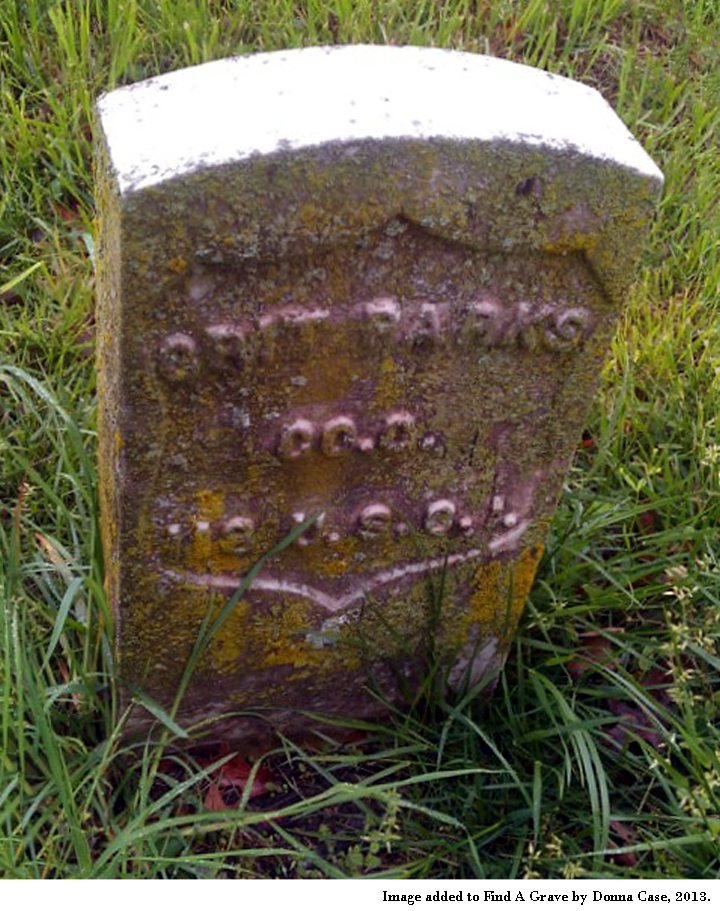
Donna Case image of Crit Parks grave marker, posted to Find A Grave, 2013.
The Republican reported Publisher Barnett recovering from typhoid fever. (He did not.) It made no mention of our subject. The Herald reported Barnett facing gallstone surgery "as soon as his condition will permit." On the back page, into the bottom of the second column, was fitted a death notice: "Crit Park (sic), a well known negro of Hayti, Hartford's colored settlement, died last week. He was quite an old man at the time of his death – about 70 years."

Crit's grave marker (above) at Haiti Cemetery was almost certainly installed at some point by by a veteran's group. It reads "Crit Parks, Co. G., 118 U.S.C.I." No period punctuates his forename.
NOTES:

Images enlarge when clicked.

Madison County jurist Squire Turner led a trio of gubernatorial appointees in codifying Kentucky's laws for the first time, 1851-1852. He by some accounts took greatest satisfaction when drafting property law. History characterizes Turner as pro-slavery: his central premise was that Western law historically prevented abject confiscation. I do not know reasoning for Yankee officers recording slave-holders' names at time of enlistment; whether that was in anticipation of compensation, or as contingency should the United States seek to return property.
[Turner's codification of Kentucky statutes received mention in Credit and Indebtedness, which centered, in part, on his guidance in drafting the state's third constitution.]

Many thanks to Bill Williams, of the Madison County (Kentucky) Historical Society. For digging into G.A.R. archives to document the Wash. Edson post at Hartford. Group composition was not singled out racially in any retrieved reports.

[1] "Ohio County was the scene of intense guerrilla activity," observed Alfaro. Less than ninety days prior to Crit's enlistment, 21 July 1864, a partisan force ambushed a detachment of neighboring Daviess County, Kentucky Home Guards along Rough River Creek. Four, militant union sympathizers were killed not far from Parks and his slave family across the county line. Alfaro tallied 23,702 African American Kentuckians in military service during the Civil War.

Along the Rio Grande, "Black soldiers made a fine adjustment to the hot desert terrain and diverse culture of the Valley," reported Sergeant Major Thomas Boswell of the 116th U.S.C.I. "If our regiment stays here any length of time we will all speak Spanish, as we are learning very fast."

Though 250 men of the 62nd U.S.C.I. skirmished, I did not find the 118th associated with the 12-13 May 1865 Battle of Palmetto Ranch … by some accounts the final armed Civil War encounter. Crit was detached from Co. G of the 118th, to serve as wood-chopper in subtropical climes at the end of November. He was mustered out three months later at White's Ranch, which had been a Confederate outpost just prior to the battle. BACK

[2] Daniel F. Parks held fifteen slaves in 1860. One was male, in his mid-thirties, two women were in their mid-twenties; the rest were youths and all were enumerated as Mulatto. As was a boy of twelve, with Parks on a married niece's Davies County farmstead in 1870. Nephews administered Parks' estate there in 1874. He was 70 years old at death. Parks, who had in 1860 valued real estate at $3,000, and his personal estate at $12,000, declared no net worth in 1870.

A Daniel Parks, owned by Margaret Parks, Daniel F. Parks' widowed sister-in-law, enlisted 18 August 1864 at Camp Nelson, three weeks prior to Jeremiah Turner. Mustered in at age 24 as a Private to Company B of the 5th Regiment, U.S. Colored Cavalry, the self-liberated Daniel Parks (likely saw action and) died of disease 12 August 1865 at the Regimental Hospital at Lexington, Kentucky. He was interred at the National Cemetery there. Private Daniel Parks apparently never received even his first installment of a $100 enlistment bounty due at the end of 1864.

Portrait of Lula (Parks, Barnett) Drane (c1865-1935).
Also in the 1870 Hartford census was John Parks, Mulatto, born c1843. As he likewise worked as a Rail Hand, I assume John to be brother or half-brother to our subject. Charles Parks, Mulatto (born c1846), was at Hayti. Phenie Parks (born c1864, near the time of Crit's enlistment), was enumerated as Mulatto: the teen was Cook in a Euro-American household. A Joseph Parks (born c1840) was in this case enumerated as White; farming outside of Hartford. In his household, with Eliza Parks, Black, (born c1845), were four Mulatto children. Lula (center, in the photo) was eldest, born c1864.

Young Parks (b c1838) and the above Charles and Joseph were all enlisted as property of Daniel F. Parks. Joseph was mustered in, as a Private, to Company D of the 120th Regiment, U.S. Colored Infantry six months after Crit took up arms. Daniel F. Parks made the same oath, claiming Joseph as a son, when filing for reparations. Crit and 'Joe' co-appeared in Ohio County educational initiative.

Image of 1865 courthouse at Ohio County, Kentucky.
Crit was in 1870 domiciled in a Hartford mĂ©nage I contend was headed by William Hart Miller (1827-1871), who gave 'Miller' as his occupation. (The householder inherited after tavern-keeping at the Hartford House in the 1860s.) As 'William H. Miller,' he'd upheld the Union, representing Ohio County in Kentucky's House of Representatives, 1863-1865. Though records were preserved, Confederate cavalry under (Kentuckian) Brigadier General Hylan Benton Lyon (1836-1907) seized Hartford and burned the courthouse/Yankee barracks in December, 1864: Miller contracted to build its replacement (above) the following year. Seen as 'Captain' in a daughter's obituary, Miller's grave in a family cemetery bears a recently installed bronze plaque commemorating service as 1st Lieutenant in Company B, 6th Kentucky Mounted Infantry, Confederate States of America. It bears the name of William Harvey Miller. A family history researcher was unable to document assertion of Confederate service: it may be that a veterans' organization conflated two identities. BACK

[3] Being an invalid carried no discernable stigma I could discern, when associated with the boon of a veteran's pension. Further, "The Civil War pension system was color blind in that there was nothing in the application process that required applicants to be white. But recent scholarly works have made it clear that the process itself was far from color blind," contended Gorman c2012, in treatise peer-reviewed by Virginia Tech's Center for Civil War Studies. She offered pertinent analysis: "Because African American soldiers were both less likely initially to be assigned to combat roles, and then less likely to be hospitalized (early disability applications required documentation from hospitals) if injured, they could not produce the documentation required by the application process. And they were less likely than their white counterparts to have the money necessary to complete the process. Ultimately the fate of black veterans’ applications was decided by white bureaucrats who found it easy to turn them down without fear of retribution. An interesting side note is that the Grand Army of the Republic actively campaigned for their black brethren to be granted pensions just as white veterans were."

Rothbard, in Beginning the Welfare State: Civil War Veterans’ Pensions c1996 acknowledged "a cadre of wealthy pension lawyers" also lobbied Congress, "perturbed at the falling off of pension claims during the late 1870s." The Libertarian economist explained "The Pension Bureau, the Grand Army of the Republic, and the Republican Party acted in happy symbiosis: the GAR lobbied for greater appropriations and personnel for the Pension Bureau, which in turn processed more claims for GAR veterans, who in turn gratefully voted for the Republican Party." I found Rothbard's broader thesis novel: Republicans' 1890 Dependent and Disability Pension Act paved the way for Progressive Era reforms and, ultimately, cash support in Democrats' New Deal. BACK

[4] Assailant Wesley Callahan, described by the Republican as a "worthless and disreputable negro, whose only means of support is keeping a dive at Hayti and voting the Democratic ticket," may have been unable to pay his fine. He was in jail in April. His Hayti home burned two days before his expected release. A threatening note, stuck in the gate to his home/tippling house, stated "forty men, white and colored, would attend to Wes if he fails to skip [town]." I leave it to the reader to speculate on community groups of bi-racial cohesion with such ardor. 'Wes' Callahan remained in Hartford reports of criminal conduct until his 1899 demise.

Our subject does not necessarily stand out in crime reporting in this era; nor do Blacks in particular. Violent acts at Hartford seemed ubiquitous. Crit was often acquitted on one charge and found guilty on another: it may be that - at Hayti and beyond the Town of Hartford's jurisdiction - his peers in Justice Courts did not convict … and that Ohio County and Circuit Court prosecution prevailed. BACK

[5] Dee Walker was shot to death, late August 1897. Walker had remonstrated with his Black assailant … over poor treatment accorded a young White man, intoxicated and wandering Hayti in early-morning hours. BACK

[6] A jury had convicted Brookins in June 1895 and assessed a $200 fine … "with proviso that it was not to be paid but worked out on the streets at $1.00 per day." Perhaps it was Barrett who secured a new trial. Brookins killed himself – and a wife in the process of divorcing him – in 1916. See Uxoricide and Suicide in the Herald. BACK
[7] Crit hoped 'Professor Geary' would choose a day "to cut the trees and make the posts and build the fence." This is reference to African American Schoolteacher Peter Allen Gary (born c1856). In March the Republican columnist called "colored people's attention to the deplorable condition of the colored cemetery of Hayti." An open field in 1895, livestock interfered with graves. "We are not able to rear up marble statues to mark the last resting place of our loved ones, but we can enclose the grounds" to prevent burials from being "torn to pieces by the cattle." BACK

[8] Both the Sons of Veterans camp and Barnett, its Captain, were named for Cicero Maxwell (1831-1865). Maxwell had been Attorney for the Commonwealth of Kentucky and living at Hartford prior to 1861 enrollment. He was mustered in as a Lieutenant Colonel, 26th Regiment of Kentucky Volunteers. The Union infantry unit was mauled at the Battle of Shiloh and Maxwell, prolific in reports including his own letter to Abraham Lincoln, was promoted to Colonel in June 1862. He returned to Hartford periodically, chronically afflicted with indigestion, and died from disease at Bowling Green, Kentucky. Attorneys quickly secured a pension for his orphaned son, William Preston Maxwell.

1859 Woodcut, 'The Murder of Lowe;' Harper's Magazine.
Maxwell can be included in ubiquitous and violent criminal behavior. He seems odd choice for veneration. As District Prosecutor, he left Hancock County, Kentucky Courthouse in 1859 armed with a shotgun (a sitting judge bore a rifle). A shootout in the streets of the County Seat at Hawesville killed one adversary; Maxwell's political rival was seriously injured and taken into custody. Where cronies murdered him in his cell. A Grand Jury declined to indict the assassins, finding the extrajudicial killing of an unarmed inmate an act of self-defense.

Maxwell had publicly accused the victim of being a "tool" of another political actor. This is the precise language duelist Cassius Marcellus Clay (1810-1903) used to provoke Squire Turner in a speech before militia mustering at Foxtown, Kentucky in 1849. Turner's son Cyrus (1819-1849) promptly gave the same retort: the accusation was a "damned lie." BACK

[9] Preston Morton G.A.R. Post sentiments of 1849 included "A true Union or Confederate soldier doesn't feel ashamed to fall in line with his old comrades, as each thought his cause right and just at the time of the trouble." Anonymous announcement in the Herald contended "Both names will stand in history as brave men as long as the world stands. It is the outside hater of all good things that always raises the disturbance between the brave men. As for politics it has nothing to do with our order …"

Waskie, at The Grand Army of the Republic, detailed local Post function. Aspirants were "... voted into membership using the Masonic system of casting black or white balls (except that more than one black ball was required to reject a candidate for membership). When a candidate was rejected, that rejection was reported to the Department which listed the rejection in general orders and those rejections were maintained in a Black Book ..." at state headquarters. BACK

ADDENDUM

Frame from stereoscopic card, 108th USCI on guard duty, Rock Island, Illinois.
It seems fitting to conclude with contention that the Black veterans' post at Hartford was named for George Washington Eidson (1822-1889), who asserted he was age forty-three at enlistment 14 June 1864 (four months prior to Crit) at Owensboro.

'Wash' Eidson was born in Ohio County. Also depicted as copper-complexioned, he was mustered in as a Private to Company B of the 108th Regiment of U.S. Colored Infantry. The 108th saw action before being posted to Guard Duty at Rock Island, Illinois prisoner-of-war camp, where the above photo was taken. Eidson was mustered out as Sergeant in 1866 at Vicksburg, Mississippi. With haversack, canteen and $22.68 in pay. I found no explanation for his elevation in rank.

One Washington Eidson war record indicates 'service' was owed William Eidson of Hartford. William J. Eidson (born 1825) was possessed of 11 slaves there in 1860, some apparently inherited from his father. At enlistment of twenty year-old James Eidson at Hartford in December, 1864 William submitted a Consent in Case of Minor form to simultaneously manumit him.

Carte-de-visite, standing portrait of Samuel Martin, 108th USCI.
Washington Eidson applied for a veteran's pension at the end of 1884. His widow apparently received benefits in 1891. His surname replicates misspelling in military files, but a Haiti Cemetery marker is of the same make as Crit's. Charlotte Temple (Eidson) Wright (1861-1915), the couple's then-unmarried daughter, was Chapter Secretary of the Colored Teachers Association when Crit participated in 1893.

To culminate with opportunity to reflect on Wash Eidson's military service, as I think Black veterans at Hayti intended we do, I provide portrait (left) of 2nd Sergeant Samuel Martin (1845-1885), Company F of the 108th, taken at Rock Island. Eidson held nearly the same rank, in Company B. In pencil on the reverse: "Very light eye and hair, and light complexion ..."

Saturday, October 19, 2019

I Cannot Enjoy Reading Bad News

It startles me. When – after being offered seemingly benign intelligence – meandering around in research can lead to stark portrayal of poignant death.

Image of The Platt Hardesty Wedding Invitation Sent In 1887, offered by 'Pastime Jwls.'
Jason Lombardi, President of the Malvern Historical Society, thought I might be interested to learn a rather pristine, 1887 invitation (right) to the marriage of Caroline 'Carrie' Frances Platt (1859-1919) and Gue C. Hardesty (1860-1895) is available on ebay. I was gratified to see 'Gue' in print: I was unsure I'd entered this first cousin's name correctly in my database. (I found it memorable and tantalizing that, as a newborn, he was enumerated as 'Confucius' in the 1860 census.) [Images enlarge when clicked.]

I was intrigued by mention that the newlyweds would be 'at home' in Leoti City, Kansas ... following nuptials at the Naples, New York home of the bride's brother, Reverend Ward Platt (1853-1916).* I'd not yet associated this Hardesty with a Midwest locale pronounced "Lee-OH-Tah" and alluding to Wichita/Kitikiti'sh People's Caddoan expression for prairie flower.

Accounting for Gue C. Hardesty blossomed grandly, following newfound geographic association.


Coverplate, Illustrated historical atlas of Carroll County, Ohio: from recent and actual surveys and records (1874); H.H. Hardesty (Firm).
Hardesty's profile primarily existed in my family tree as adjunct to that of his father, my purported 4th great-uncle, Hiram Hubbard Hardesty (1833-1898) ... the only son of Malvernians Louisa Knauff (1782-1850) and Reverend William Hardesty (1776-1846) not to "follow the pursuit of their father" and operate their own grinding mills. (See my post Wild Confusion in Every Direction.) H. H. Hardesty & Co. published dozens of historical atlases between 1874 and 1894: his biographical data informs many who today research family history.
[My timeline, anchored on William Hardesty and Methodism, can be found here.]

I say 'purported' as I've long been suspicious that Lousia would have been more than fifty-one years old when Hiram was born ... and that last-born Hiram was almost a decade younger than his next-eldest sibling. My suspicion is enhanced: this branch of my tree played loose with stated marital status. Gue's parents divorced before 1876. His mother, German-born Amelia C. (Paessler) Hardesty (1833-1916) – by the time of Gue's 1887 marriage – portrayed herself as widowed.

Gue was youngest of three sons, and born to Hiram and Amelia at rural East Townsend, Huron County, Ohio. Ninety miles northwest of Malvern. Firstborn Lorin Quimby Hardesty (1854-1908) studied at Oberlin College. He surveyed Ottowa County, Ohio for his father's 1874 atlas of that locale before hanging out a law shingle. Lorin had married an Ohio schoolteacher educated at his alma mater and located at Mitchell, South Dakota by the time Gue and Carrie's invitations went out.

Second-born Emile F. Hardesty (1857-1886) attended Oberlin and the National Normal University at Lebanon, Ohio. He and Gue left teaching and – with their mother – relocated to Wellington, Kansas c1884. The brothers likely read law and were admitted to the bar together shortly after their arrival. "“E. F. Hardesty came to Wichita county in the summer of 1885 on a prospecting tour to seek a location for the firm of Hardesty & Pelham, of Wellington," reported the The Leoti Transcript, referencing partnership with Thomas Walter Pelham (1861-1945).

Image of Thomas Walter Pelham (1861-1945).
Pelham (left), according to an 1892 genealogy, "upon attaining his majority," pushed on from teaching in New York State. For Denver. Perhaps to take advantage of the August 1882 opening of The National Mining and Industrial Exposition. Credibly, Pelham entered service as a railroad conductor, prior to superintending the Denver Circle Line within three years. He resigned in June 1885. Lenders foreclosed on the Denver railway in 1886.

Hardesty & Pelham embraced land speculation. Emile "traveled over the southern tier of counties, but finally decided to identify himself with Leoti and its then proposed town company. He became a member of the company, was appointed secretary, and looked forward to an eventful career incidental to the settlement of a new county." Vast, nearly timberless prairie – that would become Wichita County on Christmas Eve, 1886 – had but seven households when Hardesty scouted the area.

Emile did not survive to attend the Platt/Hardesty marriage.


"Being in delicate health, [Emile] returned to Wellington, to sojourn through the winter, and in the spring of 1866 he manifested considerable anxiety to be in Leoti early in the season. The journey to Leoti exposed him to the inclemency of our spring storms, and contracting a severe cold, his delicate physique succumbed in a few days after his arrival in Leoti. His grief-stricken mother was summonsed just in time to receive his last wishes and to close his eyes" read a subsequent tribute, penned more than a year following his death. It went on, to evoke particularly dramatic phrasing: "E. F. Hardesty was the first martyr to the cause of Leoti." I suspect his remains were the first interred in a cemetery two and a half miles from the hamlet. But something allusive may have lain beneath observation that "the people of Leoti ... looked up to him as one of the ablest champions of Leoti’s claims for county seat honors."

Sketch of Hotel Vendome, from The Great County Seat War: Coronado vs. Leoti, by Steve Harkness.
Emile had good cause to attend to Leoti Town Company plans during March storms. Only four shanties had been erected by November 1885. In February 1886 a Coronado Town Company completed Hotel Vendome (right) three miles distant. Within weeks, structures sprouted up around it. Adjacent townsites became bitter rivals for eventual designation as the seat of Wichita County. A 1911 account described legal wrangling, voter intimidation, bogus balloters, a horsewhipped newspaper editor and hired gunmen shooting up the town. Strife culminated with a shootout on 27 February 1887. Well, sorta: prior to a final ballot, there would be more shooting, an attempted lynching, militia called up, and rifle pits at public wells in both villages.

Emile died intestate. Gue administered his brother's estate ... in Ohio and Kansas probate courts ... from May 1886.

Gue immersed himself in business.
More poignant death was in the offing.


McNeal in 1922 – a bit grandiosely, no doubt – surmised the business plan: he estimated the Leoti town site "which perhaps cost the founders all told three or four thousand dollars, would sell within a few months for more than half a million." I feel it's imperative to quickly reflect that Reverend William Hardesty, pioneer miller, had modeled this career choice. He had financed a survey, and platted out streets and lots for Troy, Ohio in 1834. Speculative investment that would become the village of Malvern.

With natural inclination as a promoter, Gue Hardesty began appearing regularly in the Kansas press. The Republican at Wellington noted in April that “Gue Hardesty has returned from the west where he has been attending court in Meade county, in which he had several cases, as an attorney. He expects soon to remove to Leoti ... where he will practice his profession besides engaging in the banking business.”

Image from Fifth Biennial Report of the Kansas State Board of Agriculture … for the years 1885-1886 (1887), pg. 580.
1886 map, Wichita County, Kansas
Our subject moved swiftly. The following month he and his brother's former partner Pelham announced prospective formation of The Wichita County Bank, capitalized with $25,000. Friends, neighbors, associates and family members no doubt bought underlying shares in the bank's stocks. "Leoti is a rapidly growing town, located in the geographical center of the county, and the prospective county seat. The boys will have the pioneer bank of the county, and will undoubtedly make a good thing of it as a result of their priority of location." Cornado men established a bank of the same name later in 1886. (See the map legend, right.)

“Gue C. Hardesty went to Ohio this week presumably on business," reported The Republican in June. Likely to settle Emile's estate. "Rumor says he went to do what Solomon commanded all men to do: Take unto himself a wife. We shall know more about this when he returns.” Native New Yorker Carrie Platt had attended Oberlin ... perhaps concurrently with Emile Hardesty. She had been teaching school at East Townsend since at least 1880. The above invitation depicts marriage sixteen months following whatever errand Gue Hardesty advanced upon.

Boom! Boom!


Advertisement, 30 Sep 1886 - Leoti Lance, pg. 3.
The 30 September 1886 Leoti Lance becomes typical ... for the number of times Hardesty's name might appear on a single newspaper page. He remained back east "on business." A two-column advertisement promoted "Hardesty & Pelham, Dealers in Clothing" on a prime, Main Street lot. Another block ad (left) screamed the bank was doing business, with Hardesty as President and Pelham, Cashier. Just in time for Christmas, the promoters informed Lance readers in December that “Hardesty & Co’s is the place to get your underwear,” and “Ladies shoes at cost.”

“No enterprise in the history and progress of our rapidly growing city deserves more credit than that of Messrs. G. C. Hardesty and T. W. Pelham of the Wichita County Bank," gushed the Leoti Transcript in early April, 1887. Hardesty had been newsworthy. “On Friday our enterprising townsman ... hearing that a party of surveyors were at work in the vicinity of the Whitewoman and that they were heading for Leoti, drove out about 6 ½ miles from town and found a strong corps running lines near the Sinns’ ranch." Now dry, White Woman Creek can be seen draining south and east on the 1886 map (above).§

"In conversation with Mr. Curtis, who has charge of the survey, Mr. Hardesty elicited the following: corps ... in the employ of [The Denver, Memphis and Atlantic Railway] had started from Pueblo [Colorado], running east and arrived in Wichita county two days previous and that it was the object of the survey to approach Leoti and run a line as close as possible through the center of the city ..." Vitally, to a townsite booster, "Mr. Hardesty believes that it is the object of the D., M. & A. to run a line closer to the center of city than has been done in any previous survey.”

Still under westward construction, the Missouri Pacific Railway took possession of the D. M. & A. the following month. The first steam locomotive attained Coronado from the east on 28 July 1887, "where a depot, machine shops, pump house, well and water tank were all in place," according to the Wichita County Historical Society. Leoti 'City' could but claim a depot and freight yard when locomotion presented itself. Chicago, Kansas & Western Railway Company announced plans to make Leoti a terminus for their west line the following month, however. That enterprise would soon belong to the Atchison, Topeka and Santa Fe Railway.

Image of train engine Chautauqua #4, originally posted by William Bottorff.
Chautauqua, one of two engines built in 1886 for The Denver, Memphis and Atlantic Railway.

"Hardesty & Pelham are erecting palatial residences on their addition to the city," bragged The Leoti Transcript at the end of April 1887. Hardesty & Pelham (at times partnered with Pelham's wife) had engaged in $8492 worth of real estate transfers in the previous seven days. Partners' similar economic feats followed for weeks in succession throughout this period. In early May, while tensions simmered following Coronado gunplay, Hardesty and Pelham contracted for erection of a large, two-story brick hotel. "The boys" solidified themselves in a community ... of influence. In October “The third story of the new brick building of Hardesty & Pelham was built at the request of the Masonic members here," declared the Wichita Standard.

26 May 1887 clipping from The Leoti Transcript (Leoti, Kansas), pg. 5, cols. 1-2.
Malvern Historical Society members might be gratified to learn that, in May 1887, Hardesty's maternal uncle, Theophilus Herman Paessler (1840-1926), arrived in Leoti "with a view to investing." Paessler would be interred at Bethlehem Cemetery in their environs. Malvern's one-time Postmaster & Dry Goods Merchant would also migrate through New Mexico and Oklahoma holdings, to Malibu, California. Hardesty that month became attorney for the Wichita Land & Loan Company ... in an ever-crowding field of local lenders. At the end of the month, the Leoti Transcript revealed other likely hotel guests: “Messrs. Thompson and Rogers, from Malvern, Ohio, friends of Gue C. Hardesty, are in town. Mr. Rogers has determined to locate in the city.” A W. H. Rogers was – with Hardesty – in December elected a steward of Leoti's Methodist Episcopal Church. I think the Reverend Hardesty would be gratified his Methodist legacy endured.

Hardesty was on the make. “The Halcyon town company met at the Wichita County Bank Friday evening and elected Gue C. Hardesty president. Active measures will be taken at once to boom the town and promote its prosperity" reported the Transcript in early July. More important locally was this note in the same issue: “G. C. Hardesty & T. W. Pelham among six elected directors of The Southwestern Kansas Development Company.” The Leoti City Town Company was reincarnated. A financial measure the partners would often replicate.

Hardesty continued efforts to accrue confidence in his social standing. “After the morning exercises on the Fourth [of July], W. R. Gibbs and Jo. M. Kendall accepted an invitation from President Hardesty, of the Wichita County Bank, to his handsome new residence where they partook of a repast that was only excelled by the kindness of Mrs. Hardesty and her worthy son.” Entertaining in his own home was apparently important to semi-public Gue.

Investors had staked the Halcyon Town Company with $10,000 in capital. And declaimed loudly that the site on the eastern edge of Wichita County did not aspire to county seat honors. Though it already had a schoolhouse, selling point for the enterprise centered on purported appearance on three railroad surveys. Backers in June 1887 petitioned county commissioners for $35,000 in bonds, to finance the Missouri Pacific's D. M. & A. Railway ... in exchange for a freight and passenger depot at or near embryonic Halcyon, as well as economic spur for rail investment at Coronado and Leoti.

Our subject's love life continued to elicit comment. That October, “Gue Hardesty boarded the Mo. Pacific, last night, for a trip east. He is supposed to be going after Mrs. Hardesty.” By the invitation above, Carrie would not earn that title for thirteen days following Wichita Standard projection. The couple were married on 26 October. Pelham's wife died 8 December 1887, at Leoti. It was likely around this time that the partners gave up retailing: A "new Hardesty & Pelham brick on S. Main" would be a launch pad for further financial endeavor.

Advertisement, 1 Nov 1888 - Western Farmer, pg. 1.“The Wichita County Bank, the oldest banking institution in the county, will be transformed into the First National Bank of Leoti, about the first of march, with a capital of fifty thousand dollars,” crowed the Leoti Standard in February 1888. Directors Hardesty & Pelham carried on as President and Cashier, respectively. “This is another feather in Leoti’s headgear, and the enterprising gentlemen who are at the head of it should have proper credit.” So noted.

Also in February, a Transcript headline thumped: "Boom! Boom! Leoti’s Wide-Awake Citizens Meet to Devise the Best Methods of Advertising the Best Town and County in Western Kansas.” Leotians, huddled at the courthouse, were keen to refute "slanderous reports circulated by eastern journals, relative to freezing and destitution in western Kansas." Amid broad effort, Hardesty was appointed to a committee to correspond with St Louis railroad officials.

May 1888 rail timetable, The Leoti Transcript, front page, col. 1.
Santa Fe boarding times were
more convenient for Leoti residents.
“Scarcely realizing that the town was only in its third year of settlement I found it making progress when other towns were standing still,” journaled a Wichita, Kansas reporter touring Leoti in July. Hardesty & Pelham’s building, in which a physician had just begun practice "up stairs," was one of two brick structures noted. Five thousand had settled in Wichita County, a thousand in Leoti. As Hardesty foresaw, The Missouri Pacific in fact bisected the county seat. (Depicted on the company's map, below.) Wichita Commercial extolment continued: "The First National Bank ... is the oldest bank and has the largest paid-up capital in Wichita county. The bank was organized about the time Leoti was platted and has developed into one of the strongest financial institutions in western Kansas. It was incorporated as a national bank in the spring of 1888 with a paid-up capital of $50,000, and has since added to its capital a surplus of $2,500. Its officers are men of large experience in the banking business and have the unbounded confidence of the citizens of the county.” Stout competition had emerged: The Bank of Leoti City commenced, backed by $60,000 in capital.

5 Jul 1888 clipping from The Leoti Transcript (Leoti, Kansas), pg. 2, cols. 3-4.
"Hardesty, Pelham & Co., real estate agents, commenced business in January, 1888, and succeeded the old firm of Hardesty & Pelham, who were the pioneer banker and loan agents of this county” the report continued. “This firm is doing a very extensive business in this and adjoining counties and have direct communi-cation with eastern investors to whom they sell the greater number of their loans. They also represent thoroughly reliable companies, through whom they place loans. The firm is very sound financially and is entirely reliable." The Southwestern Development Company was noted as "a prosperous town company,” and yet an ominous chord was struck: “The rainfall this season is only an average but it is enough to inspire confidence in the future. Many of the people had intended to make this the best year and have exhausted every means to produce such a crop as would redound to their credit and put at rest the evil reports that have been made of this country.”

Hardesty's voice was no doubt just one, in a chorus of popular boosterism. “It is claimed that [Wichita] was settled quicker and by a better class of people than any county in the state.” An unnamed source declared “Leoti is the boss town.”

Detail of 1888 Missouri Pacific Railway System map; Kansas Historical Society.Our subject remained competi-tive, even as European bankers established a presence at Leoti. “Messrs. Hardesty and Pelham also have a bank at Eads, Colo., and are largely interested in other financial institutions and have large real estate interest in Leoti and elsewhere.” Eads and Halcyon are depicted on a Missouri Pacific Railway map (right) in use at the time ... Eads being eight stops west of Leoti, and Halcyon just beyond Coronado to the east.

The 1888 Bankers Directory reported the Eads bank, then in Bent County, Colorado, was backed with $5,000 in capital. Having already doubled the capital behind the First National Bank at Leoti, owners declared $5,000 in undivided profits there. Pelham took on an Assistant Cashier. Chase National Bank at New York acted as their clearinghouse, for transactions far from home.

Clipping from 21 Feb 1889 - The Leoti Transcript (Leoti, Kansas), pg. 4, cols. 5-6.Hardesty-Pelham Loan and Investment Company, "negotiators of farm loans," succeeded Hardesty, Pelham & Company in October. Though the name change did not reflect it, Pelham advanced to the brokerage firm's Presidency. Gue C. Hardesty served as Vice President. Five partners capitalized the Leoti venture with an impressive $100,000.

8 Nov 1888 clipping, The Leoti Transcript (Leoti, Kansas), pg. 4, col. 6.
Outlandish boast (right) the following month may have been Pelham's. He returned to New York and re-married that month. The Hardestys lost their first child that year. Likely stillborn, a Leoti grave bears initials 'G. D. Hardesty.'

Hiram Hardesty was but thirteen months old when his father congregated a family-based Temperance Society at his Malvern homestead. At the close of 1888, like-minded Gue became a Trustee of Leoti's Methodist Episcopal Church; he was appointed to serve on Church Extension and Temperance Committees, 1889-1890. On New Year's Day 1889, Hardesty's bride Carrie (on the Music Committee) opened their home to the Leoti Chapter of the Women's Christian Temperance Union.

Later that January, Hardesty proceeded five hundred miles north. To visit brother Lorin at no doubt frigid Mitchell, South Dakota. He may have solicited financial backing for a new endeavor.

Hardesty picked up stakes. High stakes.

9 May 1890 clipping, Allegany County Republican (Wellsville, NY), pg. 2, cols. 7-8.

“Mrs. Gue Hardesty left on Monday last to visit her husband in New York state. Mr. Hardesty is establishing a bank in Angelica, N. Y., which he will run in connection with the First National of Leoti,” the Transcript disclosed on 21 March. Fellow Methodist Church Trustee and Temp-erance Committee member, James Henry Rook (1857-1936) also ceded recent church appointment and relocated from Leoti to Angelica. By May (see right), Hardesty was installed as President of the Bank of Angelica, and Rook as Cashier. Both served as Directors. Upon her final departure, news report bemoaned Carrie's leave-taking. On behalf of Leoti aid societies, through which she'd aggregated charitable contributions.

Partnership simultaneously unfurled into Colorado. May 1889 reporting by The Sheridan Lake Times neatly documented partners' holdings there ... as the pair replicated pioneering success: "The advent of the Kiowa County Bank, which occurred this week, is the most encouraging acquisition the new county-seat has thus far received. Messrs. Hardesty & Pelham, the bankers, are gentlemen of ample means, large experience and liberal spirit, well and favorably known in financial circles throughout the entire country. They advertise individual responsibility to the amount of $2,000,000, and they will improve important factors in the upbuilding of Sheridan Lake and Kiowa county. In addition to their new bank at this place these gentlemen are largely engaged in banking enterprises elsewhere, conducting with marked success, the First National Bank of Leoti, Kansas, the Bank of Angelica, at Angelica, N. Y., the bank at Eads in this county, and the Hardesty-Pelham Investment Company of Leoti." Rhodes' Journal of Banking disclosed in July that "Hardesty & Pelham are doing business under the style of Kiowa County Bank, capital $50,000." They also recorded Pelham stepping up as President of their Leoti bank, and Hardesty moving to Vice President of that firm as well. I will footnote observation regarding Sheridan Lake Times' conclusion: "The high financial standing and superior business qualifications of Messrs. Gue C. Hardesty and T. W. Pelham are sufficient guarantee of the advantages which must accrue to Sheridan Lake by reason of the establishment of their bank at this place."ǂ

Cracks in the foundation.


Hardesty & Pelham were soon afterward named as defendants in at least one Wichita County foreclosure. Then – on the 4th of July – a Sheriff's Sale at the courthouse door apparently auctioned off a different, 160-acre parcel.

Hardesty & Pelham, and their financial backers, suffered their first significant reverse near the end of 1889: The Western Farmer quietly declared “The Halcyon Town Company’s suit against the R. R. company for damages in crossing the town site, was lost,” in November. Hardesty no longer representing them locally, the partners' lawyer was unsuccessful in defending them in legal action by the Atchison, Topeka and Santa Fe Railway. Some portion of investors' property had been condemned, for right of way. Halcyon Town Company went into receivership. Their remaining landholdings were sold at a Sheriff’s Auction, 3 May 1890. Halcyon, Kansas does not appear on any contemporary map.

The partners, and thus the story itself, diverged – geographically – from Leoti in 1890. "The boys" looked eastward. The American Bankers Association reported the Leoti bank profitable, holding a surplus of $4,250, with $25,000 in deposits on hand. The Angelica bank reorganized and began operations regulated by state charter at the first of the year: Hardesty officiated as President; Pelham, Vice President; and Rook as Cashier. It was capitalized with $25,000. "After being without local banking service for four years, due to the closing of the First National Bank, the business men of the village welcomed the new bank," allowed Herrick, in A Century of Banking in Allegany County. Partners' investment was certainly manifest: "The original bank vault was lined with steel plate and a modern five and a half ton door installed." It also cultivated an air of respectability: "The office and lobby plaster walls and ceiling were replaced with decorated metal, completing an attractive banking office.” Hardesty appreciated that appearances built confidence.

Rook would remain Cashier until 1927. Pelham was apparently out of this bank by the end of 1890. Hardesty, though he initially remained a Director of the State Bank at Angelica, would be replaced as President in a decisively important 1891.

Pelham set up at Abilene. The Leoti Transcript observed Pelham "returned from the east" in December, "where he has placed $100,000 of the bonds of the Garden City Irrigation Co. and the Southwestern Irrigation Co., of both which companies he is president, their combined capital being half a million dollars." As Pelham presided over Hardesty-Pelham Loan and Investment Company and First National Bank of Leoti, New York State records declare the Abilene-based loan company sought examination, to do business there. It did not receive a license. Pelham promptly appeared as President of the New York Loan and Trust Company ... at Buffalo.

In place of Hardesty, Edward Campbell Little (1858-1924), “one of the most brilliant young attorneys and among the most entertaining public speakers in Kansas," according to the Abilene Weekly Reflector, "accepted the attorneyship of Hardesty-Pelham Loan and Investment Company ... at a fine salary," in March 1890. Little had represented the firm in district court the past fall: with appeal of another suit wending its way to Kansas' state supreme court, it was time to make an associate of up-and-comer Little.

The big time.


In September 1890, at age thirty, Hardesty became member of – and major stockholder in – the Marion Land and Park Association. New York speculators formed a company for the purpose of buying and selling land on outskirts of Marion, Indiana. I did not discover the value of stock sold, but $4,200 was invested in 37 ½ acres at Grant County.

Buffalo Evening News report on Hardesty was prominent on 22 November 1890. In column one of the front page, under the headline “They Select a Bank Site Today," came excited announcement that “Directors of the new Queen City Bank meet this afternoon." "About $300,000 of the $600,000 capital stock has been placed with Eastern capitalists.” Another Director-in-waiting ten days later confided to a Buffalo Courier reporter "It appears to be understood that Mr. Hardesty of Angelica, the gentleman who was mainly instrumental in the organization of the bank, would be selected as cashier."

Lorin visited brother Gue at Buffalo in January 1891. He returned to Mitchell with tales of investors willing to stake up to half-a-million dollars in a South Dakota irrigation scheme. Credibly, "L. Q. Hardesty, Esq." partnered up, locally. By July he and fabricators had submitted schematics for a Drill-Operating Device. To the U.S. patent office.

Pelham arrived in New York in February. Upon return a month later he told the Abilene Weekly Reflector "I was very successful in my ventures."

‘Foot of Ferry, 1896.’ Image from The Buffalo History Museum. Retrieved from The Public.
The 'Gay Nineties' were on an upswing. Gue rode it: he was among two dozen "Buffalo Men" to purchase McComb House on Grand Island, twelve miles outside the City. "It is proposed to organize a family club with a membership limited to 100, and the hotel and grounds to be used as a summer home for the members and their guests,” announced The Buffalo Commercial in March 1891. The sixty-thousand-dollar deal included a ninety-five room hotel, seven acres of grounds, cottages, docks on Niagara River frontage ... and the steamer Huntress (above). The high-society retreat became known as the Island Club.

These must have been glorious times for the Hardestys. Son Faustus Platt Hardesty (1891-1948) was born to them in August. On Delaware Avenue – in Buffalo's upscale 'Midway' neighborhood – the family took up residence among luxurious Georgian Revival-style row houses, freestanding mansions and social clubs.

Image of interior, Queen City Bank. Buffalo 1893, a descriptive and statistical sketch of the city of Buffalo and its suburbs, by George Milroy Bailey (1893), pg. 44.
State banking records indicate the $600,000 had been raised when Queen City Bank was organized, 20 April 1891. They opened doors to Main Street on 2 May. "The bank is centrally located, audits counting room and offices are elegantly fitted up with tile floors, bronze railings, mahogany fixtures, electric light, etc., in keeping with its high class patronage," observed Buffalo of To-day. Vaults had been fire- and burglar-proofed.

18 Aug 1891 clipping from Buffalo Courier (Buffalo, New York), pg. 3, col. 4.
Pelham and Hardesty both served as inaugural Directors. Hardesty held the Cashier post. Growth was rapid. The bank ended September with over a million dollars in outstanding loans, up twenty-five percent over the initial quarter. “Our success has been much greater than we anticipated,” President William Henry Johnson (1843-1923) informed The Banker's Magazine, in October. Deposits-on-hand, as much as $670,000, had already exceeded first-year expectations. “There has been some stringency in the money market, but all indications point to good times coming. Our tariff laws are favorable, crops abundant, and there is, I believe, a general feeling of security,” the officer disclosed. New York's Superintendent of Banking listed Hardesty as both Director of the bank at Angelica and Cashier for the Buffalo bank on 1 October 1891.

Faltering began.


Meanwhile, back in Leoti, exposĂ© broke in the 28 May 1891 Western Kansan. "About the first of the present year several incidents occurred which seemed to convince parties who had money deposited in the bank that it was more unsafe while deposited there ..." Before again relying on The First National Bank of Leoti as depository, Wichita County Commissioners required .5% interest on their deposits, and that a new bond be posted. "On the old bond of twelve thousand dollars eleven names appeared, while on the new, which is twice is large, only five names are to be found." And they were all members of the bank. Pelham and Hardesty included. Mood varied widely from earlier, all-out boosterism: "Banks often go to the wall, and suppose that would occur here; where is the security?” The bank placed a rather large ad on the front page of the next Western Kansan issue ... boldly declaring a $4,500 surplus.

27 Mar 1891 clipping from The Buffalo Commercial (Buffalo, New York), pg. 6.
We may be witness to partisan press ... and persuasion's role in confidence manipulation. The Leoti Standard published Hardesty's private communication to them in August. His subscription request carried ominous undercurrent. “Gue C. Hardesty, well and favorably known to all our old settlers ... says: “The east is looking back to Kansas again. I have always been interested, but must say it looked dark at times. Like human nature I cannot enjoy reading bad news as I do good, hence I have not been so anxious to get Leoti papers, but now I would like you to send me your paper. I am enjoying a good business. The Queen City is not six months old, with a deposit of $600,000.”"

Directors removed Hardesty's name from Hardesty-Pelham Loan and Investment Company in September. Pelham consolidated his large irrigation interests within the new construct, renaming it the New York Loan and Investment Company. The principle office remained at Abilene; the firm staffed satellite offices at Buffalo, Hartford, Connecticut and New York City as well.

The Marion, Indiana land deal went awry in January 1892. Lenders foreclosed on investors, who had by then platted out 240 town lots. Mortgagees generally became the purchasers when a Sheriff auctioned the property in April.

Someone in the household modestly reported Hardesty as a Buffalo "Bookkeeper" in a February 1892 census. In their 19 March 1892 report to Poor's Hand Book of Investment Securities, the Queen City Bank listed no Cashier (only an Assistant). Pelham remained Director ... of a corporation that loaned out nearly a million and a half dollars in its first year. "While he was cashier of the Queen City Bank ... he had a very bad attack of nervous prostration," contended Lorin, of his younger brother.

Lorin's wife died in South Dakota that year, and the attorney followed in his weakened sibling's wake. ... styling himself 'Judge' Hardesty. Rhodes' Journal notified readers in May that officers had changed at The First National Bank of Leoti: "L. Q. Hardesty, Vice-President in place of G. C. Hardesty."** Pelham continued at the helm, but the Kansas bank's Cashier was simultaneously replaced.

Lorin, at Abilene, further integrated himself in his brother's former Kansas affairs. Perhaps to protect his investment. Pelham's entry in the National Cyclopaedia of American Biography (1899) proclaimed a million and a half Midwestern acres ultimately went into his irrigation scheme. “During the past two years Mr. Little’s time has been so occupied by the extensive legal business of the Hardesty-Pelham Investment (sic), Irrigation and other companies that he has had very little opportunity for other practice,” the Enterprise Eagle disclosed. Little partnered with Judge Hardesty in April. The busy Republican left the firm, and brief law practice with Lorin, in mid-November. When President Benjamin Harrison appointed Little as United States' Consul General for Egypt.

The bounce.


It is difficult to comprehend the scope of Hardesty's next venture. He was identified prominently as one of five 'incoporators' of the Gatling Town Site Company when disclosure broke in the Buffalo Evening News on 29 December 1892. As was Richard Henry Gatling (1870-1941), son of inventor Richard Jordan Gatling ... he of the 1861 Gatling gun. Partners had been surreptitiously contracting with farmers, for rights to a solid block of property nearly two square miles in area. The Gatling Ordnance Company – with government contract to manufacture heavy ordnance under patents held by Gatling, Sr. – had apparently legitimate cause to establish a "manufacturing suburb" near Hamburg, New York. Six thousand one-hundred-dollar shares in the Gatling Town Site Company had been sold: partners were on their way to raising $1,100,000 in capital ... to surround a proposed Great Gatling Steel Plant with roads, rail sidings and switching facilities; a water supply and drainage capacity. Complexities of cross-ownership existed in the scheme: Hardesty was also listed in the 1893 Buffalo Directory as Secretary and Treasurer for the Gatling Ordnance Company.

"The City of Gatling was to be a model industrial town," noted Andrle at his comprehensive Great Gatling Land Boom. Planner's vision manifest Hardesty values: "No liquor was to be sold within its limits and every deed was to contain a clause forbidding forever the sale of liquor on the premises." Judicial review approved temperance deed restrictions. Liberal spirit was plainly evident: "Land will be freely donated at the start for parks, school and church sites."

"The J. J. George Furniture Company, of Buffalo, N. Y., has been formed," the United States Investor alerted in January 1893. Some of the Gatling partners, including Hardesty as Treasurer, arranged for the firm to be capitalized with forty thousand dollars.

Evidence of Hardesty's legal prowess became apparent at the end of March 1893. He understood Indiana law allowed deeds sold under foreclosure to be bought back within a year. “Mr. Hardesty knew that the land would soon rapidly increase in value, and being the owner of the majority of shares, desired to redeem the land,” the Buffalo Courier confided. With just weeks to spare, he gave “his personal note” to the Queen City Bank, in return for $5,200. Terms were certainly suspicious. Lenders retained $1,000 of the loan, as a 'bonus.' He not only gave the bank a deed to all Indiana land thus freed of encumbrance, he deeded a home and lot on Park Street, at Buffalo ... to “a friend of the bank.” He may have staked his and Carrie's residence as collateral.

Work began on rail yards and the steel plant in April. Hardesty, as a Director of the enterprise, was one of five financiers to near-simultaneously organize the innovative Beecher Single Rail Railway Company of Buffalo. Investors ponied up $400,000 in capital. The firm proposed to manufacture, sell and lease "all kinds of electric motive power, locomotives, railroad and street cars, gas and compressed air motors,” according to the popular journal Electricity. Directors promptly announced plans to establish their manufactory at Gatling Town.

Promotional image, Gatling Lots Auction!
I leave it to Andrle to describe the frenetic, weeks-long campaign preceding Gatling Town dedication ceremonies on 3 June 1893. (Which included firing five hundred blank rounds from a Gatling gun, as alert that a special train would depart Buffalo's Central Depot.) Turnout was spectacular. A circus-like atmosphere ensued. Beecher's Railway Company – with prospects to transport eventual commuters – ran a small, sample car on a wire spanning Eighteen Mile Creek gorge. "Bids came quickly and over 30 lots were sold in [the first] hour and a half, at an average price of $215 per lot or almost $2400 an acre for farmland that had been purchased for as little as $95 an acre only six months before."

Panic broke out.


I describe crippling effect brought on by "the great panic of 1893" at my post, A Race of Extraordinary Goodness. Maternal great-grandfather, James Monroe Leer, Sr. (1841-1894), was ruined by international financial collapse, following a cascade of railroad bankruptcies ... beginning in January. Economic historians contend financial meltdown had roots in the protectionist McKinley Tariff of 1890.

"By the end of June, rumors had started that the Gatling Ordnance Company was in financial trouble," Andrle explained. "Little or no payments were made on the land contracts and many of the farms remained uncultivated during the season, the farmers not knowing whether they owned them or not. Stock in the Gatling Town Site Company soon became worthless." I found no further mention of J. J. George Furniture Company or Beecher Single Rail Railway Company.

The Queen City Bank collapsed on the last Monday in June. “They Are Not Involved," asserted the The Abilene Weekly Chronicle at month's end. "The failure of the Queen City Savings bank ... for two million dollars, and in connection with which the names of the Hardesty-Pelham Loan and Investment company and T. W. Pelham, of this city, are mentioned, has caused considerable talk locally." Their source, likely Pelham in an adjoining building, massaged truth in damage control (italics mine): "THE CHRONICLE knows it to be a fact that neither Mr. Hardesty nor Mr. Pelham are now in any way connected with the broken institution. Mr. Hardesty retired long ago, and last April Mr. Pelham sold his $20,000 of stock in the bank. Therefore neither of the parties named nor the Hardesty-Pelham company are or can be affected by the failure.”

Hardesty was greatly affected.


Gue was no longer listed as a Director of the Buffalo bank when investors announced intention to reopen at the end of August. More than a dozen foreclosure notifications, concerning various Hardesty-Pelham ventures, sprouted in Kansas newspapers of 1893. As drought spread, capitalists' collateral evaporated. Hardesty and Pelham were, of course, not alone: each Leoti issue bore as many as sixteen notices of pending Sheriff's auctions. Hardesty's elder brother Lorin braved it out. It seems The First National Bank of Leoti had been reorganized by May ... reduced to $10,000 in capital ... as the First State Bank of Leoti. Pelham remained President. Lorin replaced Gue as a Director, and apparently all managerial ties were severed between the bank and our subject.

The German American Bank at Kansas City had acted as clearinghouse for Hardesty and Pelham's Eads, Colorado Bank. Five years later, in August 1893, the Buffalo Courier observed the Kansas bank had obtained a judgment of $524.29 against Hardesty and another partner ... "the amount of an unpaid promissory note.”

Many are subsequent 1893 real estate transactions, whereby Hardesty liquidated Buffalo property for a symbolic dollar. He apparently scrambled, offering up his holdings, in attempt to make good among those who had trusted his counsel; investors whose capital had been forfeited.

For Hardesty, the bottom fell out completely. The United States Investor reported the Abilene business of Hardesty-Pelham Loan and Investment Company was, on 1 October, turned over to an unidentified company attorney, "... who will settle up the business of the company as rapidly as possible and protect the interests of both investors and the company. The failure of Kansas City banks, in which the company had a large portion of its cash deposited, seriously crippled it; but matters have been satisfactorily arranged with those directly interested." Leading investors "agreed to the new arrangement as the most satisfactory and economical plan for realizing the greatest possible amount out of the company's loans. Its guaranty was suspended two years ago, so that investors will only realize what is represented by their securities." As with Kentucky harvest that fateful summer, "Had crops been good in western Kansas, where nearly all the company's loans are located, there would have probably been no difficulty in pulling through, but the total failure made returns small."

Troubles edged closer to home in April 1894. Overtly. At Buffalo. "Gue C. Hardesty and Carrie F. Hardesty" were prominent in public notice of a Superior Court case brought by Francis Spencer Hubbard (1865–1921), son of a successful drug wholesaler based at Syracuse, New York. Also noted among a raft of defendants were Rook, the Bank of Angelica and The German American Bank.

Perambulation, in search of relief from the bust.


It was in this period that Lorin, who had followed his sole, surviving brother to Buffalo, observed "business troubles" burdened Gue. "My brother's mind has been affected ever since his illness when he was connected with the Queen City Bank," Lorin later told a Buffalo Commercial reporter. Gue "went West" in the summer of 1894. For his health.

He would have probably avoided Leoti, our entry point to this storyline. Almost monthly, local papers printed official notice of new legal proceedings against him and Pelham, Hardesty & Pelham Real Estate Company, Hardesty-Pelham Loan and Investment Company, The First National Bank of Leoti and ... just slightly less frequently ... The Southwestern Kansas Development Company.

Image of Bust-Enhancer, Official Gazette of the United States Patent Office, v.70, Jan.-Mar. 1895, pg. 209.Hardesty was not idle. From Chicago, on 27 September 1894, he filed for patent on a Bust-Developer (left). It may be simply sufficient to observe that – the following January – Hardesty received the right to exclude others from manufacturing the uncomfortable-looking-device.

Dense reporting, under stacked headlines “Mr. Hardesty Against the Queen City Bank” and “Very Complicated Deal,” allows compassion for our subject. Hardesty contended his forecast had proved right: demand had risen for vacant lots near Marion, Indiana. As if trying his slow-moving lawsuit for $32,000 in the press, Buffalo Courier narrative of November is sympathetic. Without his knowledge, consent – or any legal proceedings – his lenders "began to sell lots with indifference." Eighty-eight sub-lots were sold “for inadequate prices.” Not only had discounted conveyance depressed potential speculative reward, Hardesty asserted bank sales returned revenue and securities which “far exceeded” money Hardesty owed one-time Queen City Bank companions.

Often given the title of "Ex-Judge" in eastern reporting, Lorin was busy ... and prominent in the press as well. For three weeks in March 1895 he served as lead defense counsel in the sensationalized murder trial of Charles and Sadie Robinson. "It was assumed that the jury would find the Robinsons either guilty or not guilty of first-degree murder, but they surprised everyone including the defense attorney when they found Clarence Robinson guilty of second-degree murder and Sadie Robinson guilty of manslaughter," testified Wilhelm at his 2019 post The Delaware Avenue Murder. A legal team "had saved the Robinsons from the electric chair." Clarence was sentenced to hard labor in prison for the rest of his life. Sadie received a twenty-year sentence.

Gue Hardesty departed for Detroit in May 1895. To attend to business interests, "which, in spite of his reverses here, were quite large in other cities," reported the Buffalo Evening News. He was in Toledo, Ohio by mid-month. And then his family lost touch with him. "Ever since Gue left Toledo, I have sent inquiries to every city where I thought he might be, to get some trace of him if possible," Lorin told the reporter. He confided that Gue had acted peculiarly after Queen City Bank "went to the wall." The Buffalo Courier asserted Gue's brother, "and his wife, whom he left in Buffalo, were nearly distracted by his sudden and mysterious disappearance."

Carrie acted upon her concerns. "Mrs. Hardesty is in Rochester, where she went a short time ago to endeavor to straighten up some of her husband's affairs before he returned, thinking by so doing to relieve the pressure upon his mind," added the Buffalo Commercial in early June.

She was not at home when a telegram arrived from Little Rock, Arkansas. Word was received from Pulaski County Coroner John R. Walter (1850-1912) in early Monday morning hours of 3 June 1895: his inquest had been completed ... into the death of G. C. Hardesty, whose body was found on the "outskirts" of his city. 'Special dispatch' relayed to the Courier soon revealed the verdict. "He died of poison administered with his own hands with suicidal intent." Sub-headline, beneath "Death by Poison," read "Pathetic Suicide of G. C. Hardesty, of Buffalo." Arkansas report indicated grounds existed to believe Hardesty was "evidently a man of means, education and refinement."

Every Buffalo paper carried divulgence akin to an obituary. Even the New York Times offered a pithy account. Buffalo's Evening News gave the affair front page coverage. Extensive reporting, in a column nearly page-deep, approached from business perspective, but was tempered with reflection obtained from Hiram and Amelia's last surviving son. It quoted Lorin as saying, "I feared he would kill himself." He elaborated: "His health, mentally and physically, was destroyed," following failure of the Queen City Bank. Lorin believed events "affected his mind to such an extent that recovery was almost impossible." Undoubtedly wise to making a case before the persuasive power of the press, the trial lawyer honed in on the bank, slightly exaggerating the amount in contention. And avowing "He had advanced money for some of the stockholders, but he never received any of that back." This reporting ascribed a net worth of $75,000 at Gue's Buffalo arrival, "but his unfortunate connections with shallow real estate deals broke into this money and he lost the greater part of it."

Obituary headlines from 3 Jun 1895 - The Buffalo Commercial (Buffalo, New York), pg. 10, col. 1.
Beneath "Sorrowful Suicide," the Buffalo Commercial asserted "Mr. Hardesty was immensely wealthy." Like most of the accounts, it associated him with successfully organizing the Bank of Angelica and the Queen City Bank. Distinct from other papers' financial analysis, it asserted "His association with ... the Gatling undertaking was heralded as an indication of the stability and ultimate success of the venture." I assume it was this social exposure, Hardesty's personal assurances proved false, which may have made life unbearable for our teetotaler. The Courier surmised he had "lost most of his possessions."

A Buffalo Enquirer sub-head explained "Gue C. Hardesty Ended His Existence by Taking Poison." Most New York reporting cited financial reverses connected to Marion, Indiana. All quoted precisely – and early in their accounts – from a letter found in the dead man's pocket. In an envelope addressed to "Mrs. Caroline F. Hardesty" or a variant. The Evening News declared "Among other things it spoke at length regarding some of his business affairs. In closing he wrote: "I leave this message for two reasons: First, that if my existence was in doubt, you might have trouble with my property or settlements; the other, that it might affect your marriage again, which I hope you will do."" And we circle back to the wedding invitation: both it and the suicide note publicly acknowledge Platt/Hardesty union.

"Pelham, I hope, will do right by you. He should let you have at least $8000 of stock." Hardesty described his case against Queen City Bank "as a just one." He disclosed agreement to pay attorneys Alfred B. Osgoodby (1820-1927) and Jay C. Hamil (1862-1952) "one-third of all that they got" in adjudication. Summonsed by telegraph's electricity, the dead man's words went out in the local press: "Johnson will be all the witness you will need." He likely called out his companion capitalist, William H. Johnson, who took the helm at initial Queen City Bank organization. A man whose vision Hardesty had once trusted implicitly. Probably referring to the 'bonus' paid on his loan, Hardesty perhaps naĂŻvely avowed Johnson "should pay you the $1000 less what he has advanced."

I had to read the following assurance twice, to grasp its meaning: "I have been to God much and am myself." Culmination of the excerpted note read "Forgive me all my wrongs and commend the good." Culmination of the Courier obituary disclosed "His wife and one little boy aged five years survive him."

Obituary in the Enquirer closed with "The deceased was thirty-five years old. The body will probably be brought to Buffalo for burial." It may be indelicate to observe that it is unknown for how long Hardesty's corpse remained undiscovered. Requiem was already spilling into Buffalo papers, however. In a page-four observation, disconnected from the obituary, an Enquirer writer opined "The suicide of Gue C. Hardesty is a sad sequel to the unfortunate business ventures with which he was connected ..." It's difficult to ascertain the amount of disgrace available to survivors. The paragraph concluded with "There are many wrecked lives strung along the paths of "busted" real estate booms."
Clipping, 4 Jun 1895 - The Buffalo Commercial (Buffalo, New York), pg. 10, col. 2.

"The remains of Gue C. Hardesty ... will not be brought to Buffalo until next fall," came Buffalo Commercial report the following day (right). Rationale is disturbing. The family spokesman is discernible: "On account of the extremely hot weather in Arkansas, it has been deemed best to inter the remains at Little Rock for the present. Judge Hardesty of this city, a brother of the dead man, will attend the funeral." Given the environment, short-term solution seemed most judicious.

On Wednesday came another declaration "A change has been made in the arrangements for the funeral of Mr. Gue C. Hardesty ..." Undoubtedly following family deliberations, "Ex-judge Hardesty telegraphed last night to have his brother's body shipped to Buffalo," asserted the Evening News on its front page. I found no further reporting on solemnities.

By way of reading it in another paper, news broke in the Leoti Standard on 6 June. "Our citizens were shocked to learn of the tragic death last Monday morning of one of Leoti's old time and highly respected citizens." Tone was surprisingly deferential. It warmly affirmed association of our subject with that place: "He was the senior member of the well known firm of Hardesty, Pelham & Co., which done (sic) an enormous business in real estate and investments in the early days." All spring the Western Kansan at Leoti had been running a delinquent tax list. In alliance with a multiplicity of partners – but primarily Pelham – perhaps twenty Hardesty-affiliated parcels were headed to auction on 6 September. "A bright man, but not strong enough to bear up under financial reverses," asserted the People's Voice at Wellington, Kansas; where Gue, brother Emile and their mother Amelia had gone ... following Ohio exodus.

Notice of Final Settlement from 27 Jan 1898 - Leoti Standard (Leoti, Kansas), pg. 3, col. 4.
Lorin likely settled Gue's affairs in Buffalo. Real estate attorney P. E. Callahan went on record at Wichita County as Administrator of Hardesty's estate in December. Callahan had been a Director, with Gue, at inception of the Hardesty-Pelham Investment Company. Callahan was in 1895 Vice President, and Pelham President, of the First State Bank of Leoti. Interestingly, as Justice of the Peace, Callahan was known to conduct funeral services. Sheriff's Sales of Hardesty properties in default continued parading through county courts in 1896. A dozen parcels remained delinquent in August.

Legal culmination of Hardesty's Kansas affairs came in March 1898. With no complete cessation of legal acts in the interim, "Mrs. Gue C. Hardesty" was named in a 1919 suit claiming title to five Leoti City lots ... the year that Carrie died, aged sixty. A handful of Wichita County suits were filed against her estate in 1920.

Caroline (Platt) Hardesty never remarried. She remained in Buffalo and was teaching school by 1898, and – until her mother's 1907 death and Faustus went overseas in World War I – lived with them, in what was likely her mother's home. Carrie presumably taught music. She remained active in the Methodist Episcopal Church ... and was socially conspicuous: Carrie was credited as Choir Director in a turn-of-the-century series of fifty-person choral productions at various churches.

Clipping from 2 Jun 1910 - The Buffalo Times (Buffalo, New York), pg. 2, cols. 2-3.
Gue's death lingered in social consciousness. The 2 June 1910 Buffalo Times (right) reminded readers that "well-known Buffalonian" Gue C. Hardesty had committed suicide fifteen years earlier ... "due to business losses."

Gue and Carrie's neighboring graves are humbly marked in a Prospect Lawn Cemetery plot at Hamburg, New York. The Platt plot had been established when Carrie's father died in 1864.

Thomas Walter Pelham continued to thrive. He was early into the Gillette Company. As Vice-President and then General Counsel for the firm, he traveled internationally. He married a third time in 1913 ... to a woman twenty-four years younger than he.

Lorin Quimby Hardesty deserves his own account. In July 1895, just a month following his brother's demise, he sought a new trial for the Robinsons. His mastery of the press was impressive; whether representing victims of police misconduct ... or errant officers themselves. Hardesty made quite a splash in newspapers when, in June 1896, a client attacked him. While abed. His client's wife fled the boarding house. In her bedclothes. Hardesty had gotten a stenographer pregnant in 1893; she, emulating Hardety's mother, would depict herself – in Iowa – as 'widow' of 'Lorenze Q. Hardesty' from the turn of the century. He would marry again, to a woman nineteen years his junior ... and father six more children. Hiram Gue Hardesty was among three who died in infancy.†† There was no mention of Hardesty having served as a judge in his 1908 obituary, drafted at Mitchell, South Dakota. Circuit Court was adjourned, however, so attorneys could attend services.

Amtrak trains do not stop in Leoti, Kansas.
NOTES:

Image of Ward Delos Platt (1853-1916).
* Rev. Ward Delos Platt (right) had a decade earlier published You Don't Say So, the first of a half-dozen titles. A suffragette supporter, he would by 1895 be associated with (The Chautauqua Literary and Scientific Circle and) Susan B. Anthony. He had entered Methodist ministry a dozen years prior to his sister's marriage. I find Platt's vocation gratifying. Gue's grandfather William Hardesty – dead fourteen years before he was born – traversed Methodist circuits, 1792-1816: a son portrayed Hardesty's Malvern pioneer homestead as "the home of the missionary of the Cross: for years it was the only place of worship in the neighborhood."

 According to Fisher, The Denver Circle Rail Road was to serve a visionary "Methodist Prohibition suburb" on the city's south side. Baron Walter von Richthofen (1848-1898, uncle of the World War I flying ace) promoted railway expansion to nearby real estate holdings. He also established Sans Souci Concert Gardens, "to offer entertainment and refreshment to attendees" of the Mining and Industrial Exposition, said McCarthy. "To boost poor attendance, the colorful nobleman decided to introduce a night for the “sporting element” ... euphemism for the underworld that included gamblers, pimps, and prostitutes," Stauffer explained. "The night would become legendary for it’s bacchanalian, booze-fueled sex and brawling." The Circle Line no doubt failed for economic reasons, but it suffered a tremendous loss of good will among clubs and societies formed for civic betterment. Particularly sober Methodists.

 "The fight ended abruptly and tamely by the town of Leoti offering free lots to all Coronado citizens desiring to move to the county seat. This offer was generally accepted, and during the fall and winter of 1888-'89 all of the Coronado town-site buildings were moved to Leoti." 'Leoti vs. Coronado' in Ballots and Bullets: The Bloody County Seat Wars of Kansas by Robert K. DeArment (2006) offers a compelling account. As does The Great County Seat War: Coronado vs. Leoti by Steve Harkness, Chapman Center for Rural Studies (2013). The above Emile F. Hardesty obituary appeared the month following the shootout.

§ Since the late 1800's, legend has it that, on moonlit nights, the illuminated specter of a woman has often been seen running along what is now the dry bed of White Woman Creek. At least three accounts have circulated historically. The least denigrating, recorded by Legends of America, begins with an 1860 attack by Cheyenne/TsĂȘhĂ©stĂĄno People "in retaliation for an earlier raid on their camp by white men." Warriors recaptured stolen goods and kidnapped a dozen settlers ... including a pair of women. "As time passed, the two white women decided to stay with the tribe and married Cheyenne men. One of the women, who the Indians called Anna-Wee, fell in love with Chief Tee-Wah-Nee, and bore him a son."

Artist depiction of Anna-Wee, ‘The Ghost of White Woman Creek,’ from compilation by Kathy Weiser, Legends of Kansas.
After many months a White, male captive stole a horse. Upon arrival at Fort Wallace, "he convinced the army that the remaining whites were being held against their will. The escaped man led a group of soldiers to the Indian camp and the soldiers attacked, killing the Chief and his infant son. As the battle continued, his wife, Anna-Wee retaliated by killing the man who had betrayed them. She then continued to defend the tribal village she had come to think of as home, and in the end, she too, was slain." Some claim to have heard the White woman "singing a mournful Indian song." Two weeks prior to this post, a one-woman opera, The Legend of White Woman Creek, concluded an international tour in Vancouver, British Columbia.

ǂ Nowhere near as bloody as establishing the seat of Wichita County in Kansas, Hardesty no doubt mingled in small-scale Colorado jockeying, if not outright conflagration. The partners had interests at both Eads and Sheridan Lake. "In 1887, news of the coming Missouri Pacific Railroad from Great Bend, Kansas prompted the creation of several settlements," declares Colorado Encyclopedia. "The Missouri Pacific ... and its development company built westward from the Kansas border," establishing Eads near the geographic center of what became Kiowa County ... when it was carved from Bent County in 1899. Off-center Sheridan Lake won contest for county seat status, "but after its courthouse burned down in 1900, the people of Eads were quick to capitalize on the disaster." Who knows what shenanigans went on; "They engineered an election to change the county seat, and on November 5, 1901, Eads was voted the new county seat. The official documents were transferred from Sheridan Lake by rail amidst considerable tension between residents of eastern and central Kiowa County." (Italics mine.) Perhaps cued by a development company enjoying railroad backing, Hardesty- Pelham investors had consolidated at Eads.

 I glance at Malvern-Ohio-born William A. Hardesty (1848-1908) at the post Wild Confusion in Every Direction. It may be interesting to note that, having achieved tremendous success in helming Hardesty Brothers milling firm, he relocated to Columbus and became inaugural President of the State Savings Bank and Trust Company in 1891. William was first cousin to Gue and his brothers. He and Gue appear in the same editions of banking journals.

** After Gue Hardesty's death, the Olean Democrat contended "Too much Buffalo real estate speculation served to depose him from the cashiership of the Queen City bank ..."
Image of Hiram Cue Hardesty grave marker.

†† LezleeO transcribed the infant's Mitchell, South Dakota grave marker as "Hiram Cue Hardesty" at his Find A Grave memorial. Studying the accompanying photo, one can wonder whether 'Gue' was simply a nickname for our subject; that Lorin or Emile had been unable to pronounce Confucius.