Showing posts with label Kinship Ties. Show all posts

Sunday, November 3, 2019

Heirs Were Hunted Up

It's often luck of the draw, as to whose exploits are retained in written records. The Oklahoma Historical Society preserved issues of the Fallis, Oklahoma Gazette. An institution digitized them; newspapers.com indexed them. Read Finding Everett: Fallis has not always been a ghost town. Given that civilization departed, I feel fortunate that Fallis society columns are even available to researchers.

Clipping from 7 Nov 1913 - The Fallis Gazette (Fallis, Oklahoma); front page, cols. 1 & 2.
Images enlarge when clicked.
Front page of the 7 November 1913 issue several times made specific reference (left) to my direct ancestors. Grandfather Roy David Hardesty (1891-1970) dined with his grandfather James Lewis 'Jim' Hyde (1834-1917).

One hundred and six years ago, this week.

'Hyde,' that's a surname to retain in this accounting. As in Hyde Park, New York.

The Gazette observed Roy's father, Oliver Ellsworth 'O. E.' Hardesty (c1867-1943), took dinner that Sunday with men friends. Roy's sister Hallie Hardesty (1893-1980) is twice mentioned: she associated with an aunt Guffey .... and a Calla Guffy.

Hallie had returned from visiting 'Mrs. G. W. Guffey' at Shawnee, Oklahoma. Cassandra Ann (Hyde) Guffey (1857-1934), also seen as 'Cassa' and 'Cassie,' was sister to Roy and Hallie's mother, Addie May (Hyde) Hardesty (1870-1938), who, for all I know, had her own dinner plans ... obliging Roy and husband O. E. to find their supper elsewhere.

Having returned from Shawnee, Hallie, who would be in her parents' household until the close of 1914, is reported – with sister Gertrude – as hostessing 'Calla Guffy' as a guest for three nights. Ila Calla Guffey (b1896) was maternal first cousin to Roy, Hallie and Gertrude (right). Calla's mother, Mary Ann 'Annie' (Hyde) Guffey (1864-1953), was sister to Cassie and Addie May; all were daughters of Jim Hyde and the former Mary Ann Pace (1837-1910).

We can almost pivot from Guffeys: Addie May (Hyde) Hardesty's sisters married Guffey men in Nemaha County, Kansas; born in Ohio and Iowa, they may not have even known they were first cousins, once removed.

I say 'almost' because figuring out how all these Guffeys were related took me to a most interesting transcript. (Graphics below depict family relationships.)

I like that the document is called "A True Statement." As to exploits circuitously appearing online, Ila Faye (Murphy) Combs mailed photocopy of a hand-written document before her 2012 death.* Alice Gleason Gould apparently transcribed the True Statement ... along with bits of Combs' 1980s correspondence ... and posted text to ancestry.com in 2008. "Enclosed is my grandmother's statement regarding ... the Hyde Park fable," wrote Combs. "My cousin found the story in his mother's papers. As you can see, it was deteriorating with age ..." And, indeed, Gould's text lurches around gaps. "We don't know when grandma wrote the story, but it must have been in the late 1940's," continued Combs.

'Grandma' was Annie (Hyde) Guffey, mother to our Calla. "In a nutshell, I believe ... grandma was saying that the Hyde Park land had been rented or leased by the state for New York for 100 years. Its hard to tell, but I think she believed that – in the 86 years that the land had been leased – the rent had amounted to 20 million dollars."

I realized the Hyde Park Fable deserved looking into.

"Near 1907, a man in a New York government office found on record the unclaimed Hyde Park estate deeded to Jacob Scott by his father who sailed across the waters to America to see his son Jacob Scott, but failed to find him, and bought this land Hyde Park 86 years before the Heirs were hunted up. This New York man married one of the cousins. They looked for all of the heirs and found them and had all of them make an affidavit that they were legal heirs of Jacob Scott and send the affidavits to them."
"Grandmother ... lived in our home most of the time that I was growing up," wrote Combs. "I have been intrigued by the tale since I was a little girl." Understandably, revelation of her grandmother's True Statement has spurred effort to run our Scott ancestry. I can say "our" because Annie, in the now-deteriorated document, identified her mother: Mary Ann (Pace) Hyde. She is my 2x great-grandmother. Dead forty months, she'd been wife to Jim Hyde, with whom my grandfather was reported as taking Sunday supper in 1913.

Twenty million dollars. That is some incentive. "I have been anxious to pass the Scott legend on to you," wrote Combs. "It is said that the Scott's arrived in New York very early. I think the immigrant grandfather's name was John & he was from Scotland?? His land grant was along the Hudson River in Dutchess County & its present day location would be Hyde Park, NY, home of the Roosevelts. When John Scott died, the land was to go to his sons which included Jacob."

And, sure enough, I have a Jacob Scott (perhaps 1778-1824) in my database. As Mary Ann (Pace) Hyde's maternal grandfather. My 4x great-grandfather. Combs' Grandma Annie also identified three Pace siblings already in my files. These are my people.

"The legend claims that a lawyer was commissioned to go back east & check on the situation. Grandmother says he was never heard from again & they suspected that he had been paid off or met foul play. In 1909 the family tried again. I do not know how many of the family members were in on the deal but my great-grandmother Mary Anna (Pace) Hyde obtained an affidavit ..." in what appears to have been the year before her death.

Gould also transcribed the reverse side of Annie (Hyde) Guffey's tattered but True Statement ... as best she could.

"affidavit out at Fallis, Okla. Amanda Pace Lewis at Walnut Iowa. Harvy Pace at Council Bluffs, Iowa"

With "affidavit out at Fallis, Oklahoma," we circle back to the above Fallis Gazette reporting. The Hardestys lived in those specific environs for a brief time. At Finding Everett I describe the end of Gertrude's short life there in 1916. Roy David, my then-unmarried paternal grandfather, carried U.S. mail from Fallis until at least 1917. Great aunts Gertrude and Hallie entertained Calla Guffey, daughter of the True Statement's authoress, at Fallis. In the home that Mary Ann (Pace) Hyde's daughter Addie May (right) shared with O. E. Hardesty. It's exhilarating to think my great-grandmother wanted the unidentified man once holding a "New York government office" to know of our ancestry. (Demonstrable reverence for historic predecessors is scarce, among sub-sequent generations of my Hardesty kinsmen.)

Gould knew – and annotated the True Statement to reflect – Mary Ann (Pace) Hyde's mother was Sophronia (Scott) Pace (1813-1853).† In 1917, and almost assuredly unbeknownst to Combs and Gould, the Springfield Missouri Interstate Historical Society published The Ozark Region, Its History and Its People, Vol. 2. Sophronia is depicted in recountal of a prominent, Aurora, Missouri mine owner. As well as her parents, including her namesake: "Among the first of this energetic family to come to this country was old Jacob Scott, born in 1778 on March 19th, and his good wife Sophronia (Stedman) Scott, born on Christmas day, 1779. This ambitious couple had the strength and hardihood to not only make a success in conquering adversity in the country but also to rear a thriving family ..." which included my 3x great-grandmother, Sophronia (Scott) Pace. "Jacob Scott died after a most useful life on October 24, 1824, and was followed to the other shore by his faithful wife on April 22, 1850, and lies buried at King Hill cemetery, near St. Joseph, Concordia, New York."‡ I felt compelled to get to another shore ... and assert Jacob Scott's paternal ancestry.

I grew reasonably certain of my descent from dispossessed heir, Jacob Scott (1778-1824)! "As we know, Jacob came west," wrote Combs, correct where the above biography is problematic. "It was never explained what happened to Jacob's holdings but the family apparently felt that they had been hoodwinked out of a fortune."

It is time to rectify that injustice.


In 1897 Jim Hyde relied on O. E. Hardesty's father David Hardesty (1836-1903) when he "proved up" forty Oklahoma acres he'd homesteaded. Witness testimony secured title to that land. With an eye to owing a slice of Hyde Park, New York, I launched into my own proofs. When Combs wrote "I just hope some clues can be gleaned to give us something to go on for our research," I knew what she was talking about.

Facts sorta peter out. "Son of [father unknown] and [mother unknown]" is typical, in meager online trees bearing Jacob Scott's profile. Wife Sophronia (Stedman) Scott was likely baptized in the Spring of 1780. At the still-standing First Church of Christ, Congregational meeting house in Farmington, Connecticut. (Thank you Connecticut State Library, for transcribing those records in 1943.) Chalkley does identify a Jacob Scott as an orphan of John; but as the fellow was age sixteen in 1764, I find this Virginian particularly unlikely as candidate for a New York inheritance. That Jacob Scott had a guardian ... and legal representation.

I'm more certain Sophronia and a young son are anonymously enumerated in the Jacob Scott entry on an Oxford, New York tax list from 1800. From that also-true document, one might appreciate "conquering adversity" lauded in the Aurora miner's hagiography. Scott paid a mere 6¢ tax on his farm and house near the Chenango River: there was no value to his personal estate. Scott's standing seems quite distinct from an international traveler who can pluck up a New World land grant and sail off.

I had been no more successful at fortune hunting than Jim Hyde's daughters. Simply because her meditative countenance seems to convey consternation I have on this matter, I post a c1922 photograph of paternal great-grandmother Addie May (right). In Oklahoma barrenness.

Before I leave final observation to Combs, I must introduce Amanda Jane (Pace) Lewis (1835-1926). Sister to Jim Hyde's wife, Mary Ann (Pace) Hyde, "Aunt Amanda" appears in Guffey's True Statement. She's been challenging to inquire into. After marriage, census records place siblings and various nieces in her household: despite perplexing my research, I admire that Amanda likely knew how (and accessed sufficient resources) to keep family knitted together following loss of a parent. Combs wrote "My great-grandmother Mary Anna (Pace) Hyde obtained an affidavit & sent it to Amanda & Amanda hired their cousin, John Scott, attorney, to see what he could find out. Amanda payed his fee. I guess John Scott came up empty handed as the story ends with him."


NOTES:

* Combs was no doubt named – in part – for Ila Calla Guffey, seen in the above society page. Combs' mother was born within a year of Hallie Hardesty ... her maiden name was Mabel Hallie Guffey. Hallie (Hardesty) King (1893-1980) and Mabel Hallie (Guffey) Murphy (1892-1969) were likely named for their maternal aunt, Hallie Maud (Hyde, Morrow) Conwell (1876-1959). Jim and Mary Ann (Pace) Hyde gave the name to their youngest surviving daughter.

†  Teetotalism played a role in my last post, I Cannot Enjoy Reading Bad News. I feel compelled to note Sophronia was in 1832 an inaugural member of the Mount Vernon, Illinois Temperance Society. She had married physic Joel Jackson Pace (1813-1846) four months earlier: Pace was the organization's inaugural Secretary. Johnson, who culled Pioneer Association archives, was published in 1893: "As they were all akin to us, I have a mind to [name] the whole outfit."

‡ I found no such cemetery. A King Hill Cemetery is "arguably the second oldest cemetery in St. Joseph," Missouri, reported the St. Joseph News-Press. Find A Grave bears no memorial to Jacob Scott. They also disclose only 58% of King Hill markers have been photographed by volunteers.

Monday, September 9, 2019

Posing Sisters, Posing Queries

Image of Ellen (Hardesty) Glace (1858-1932) and five sisters.
"Any familiar names here?" asked Anne Hardesty, when sharing with me a post to the facebook group People, Places, and History of Tuscarawas County. Tamara Mareno‎, new to the group, had made available the above photograph: those arrayed included her second great-grandmother, Ellen (Hardesty) Glace (1858-1932), and five sisters.

I do alert to 'Hardesty.' And Tuscarawas County, Ohio. The placename permeated research for Auswanderer: Adam Knauff into the New Lands. [Knauff being father-in-law to Rev. William Hardesty (1776-1846) and – with Elder Hardesty – pioneering Ohio by 1806.] I also alert whenever beneficent Anne calls my attention to matters of far-extended family.

"Not sure who’s who, other than Ellen who is on the right," Mareno admitted. Her nomenclature taunted me: "Ruth Hardesty Swearingen, Sarah Hardesty Shoup, Catherine Hardesty Young Dutt, Margaret Hardesty Strickmaker, Della Hardesty Renner, and Ellen Hardesty Glace." I found their maiden names among my records: daughters of Joseph Hardesty (1837-1902) and wife Hannah (Fetters) Hardesty (c1842-perhaps 1905), I claim this bevy of stout sisters as my second cousins, thrice removed.

At Written Words For You All to Read I disclosed "I've disciplined myself – generally – to confine research to first cousins, and forgo crawling out far distant limbs in my family tree." Such inhibition has much eroded in five, intervening years of inquiry. Hint of compelling chronicle can easily beckon me some distance from the trunk of my direct ancestry. Prompted by Mareno's offering, I fleshed out the above sisters' placeholding profiles. Spouses' surnames expedited the work.

Storytelling broke out.


Partly due to endearing photos Mareno shared elsewhere, I promptly manufactured a sense of kinship with siblings sharing quite similar countenance. I found it simple to feel related. Joseph Hardesty was, after all, grandson to my fourth great-grandfather Rev. William ... and wife Louisa (Knauff) Hardesty (1782-1850).

Image of Jeremiah and Ellen (Hardesty) Glace
Jeremiah and Ellen (Hardesty) Glace
I'm always surprised, and quite often gratified, when I'm able to deftly craft a search string ... and lasso from online databases something pertinent and deliciously unique to subjects under scrutiny. It feels like mastery of a language that was once entirely foreign. Followed by mind melding with robots. Setting pertinent terms in a fitting order, to produce useful result: it's rewarding to pull a fact set that might define a specific life ... from the universe of irrelevant, digitized data.

Not all searches reciprocate with results as idyllic as Jeremiah and Ellen, pictured right. I'll just say the pair are posing, and that I began posing a few queries of my own.

In his 1917 application to marry (second) the already once-married Lilly Florence (Reed) Chapman (1866-1941), second cousin Frank Hardesty (1865-1919) declared himself to be a son of Joseph and Hanna.† Neither Frank nor their first-born brother, Lorenzo Dow Hardesty (1850-1916), are depicted among the above assemblage of sisters. Perhaps both men had passed away.

Image of Florence Hardesty (1866-1941)
Florence Hardesty 1935
No, it's not a mug shot. Frank's widow Florence (left) had in 1935 been completely paralyzed on her left side for a year. Akron, Ohio reporting Woman Saved From Flames declared "her life had been endangered" on an April morning.

Sister-in-law to the flock of women above, and rather tangential to Anne's inquiry, I have to admit I enjoy it when news account, such as that pertaining to Florence, enlivens family history. Even though a fire department battled flames for an hour and a half, this house fire seemed minor after I studied maleness among this batch of second cousins.

By introducing his surname above, Mareno associated Joseph and Hanna's eldest daughter Ruth Emma Hardesty (1853-1907) with Charles E. Swearingen (1848-1882). Ruth married him in 1876. I pondered over Swearingen's lifespan and realized thirty-four years is a rather short stretch.

Before offering research results, I'll make it known that enumerators and transcribers offered plenty of variations in surname spelling. 'Suraringen' seemed particularly far afield. All hail search algorithms, developed for newspapers.com.
6 July 1882 reporting in The Newark Advocate lead with:
“There were found this morning the bodies of Charles Swearington (sic), of Kensington, Ohio ...”
Quick reference to my files placed Ruth, Charles and year-old son Leroy Swearingen at the "Village of Kensington" in the June 1880 census of Columbiana County, Ohio. I found no death records for Charles, but Alberta Pottorf's Find A Grave profile (without attribution) gave 4 July 1882 as date of his death.*

Image of riverboat Scioto sinking in the Ohio River.
Fatal collision of steamers ‘Scioto’ and ‘John Lomas,' 4 July 1882.
And we jolt into a thumping good yarn. Much was written of the Fatal Collision on the Ohio River. Swearingen apparently embarked upon a 4th of July excursion aboard the steamboat 'Scioto.' As evening set in, the side-wheeler 'John Lomas' collided with it. Nearly head-on. With a gash in her hull, the Scioto sank to the pilot house in an amazing two or three minutes. The Wheeling Register would report "a continuous blast of the whistle ... only seemed to die out as she sunk and the water cut off the steam."

5 July coverage by the Wheeling Intelligencer – Dire Disaster – conveys haste and dexterity by which correspondents took up their task. City newspapermen found on-scene reporting difficult to come by: "As is always the case on the night of a holiday, it was hard work to get offices near the scene of the disaster." Publishers arranged for the Pittsburgh, Wheeling and Kentucky Railroad Company to unleash an engine and caboose. By midnight, Wheeling reporters were being conveyed to the still-unfolding scene of tragedy. Western Union's Wheeling manager rode along, "with an instrument and other proper facilities for making an attachment to the wires and sending the news back as expeditiously as possible."

News dispatches flashed out like text messages from the Mingo Junction rail office. By 2:30pm on the 5th, Swearingen's name (spelled incorrectly) appeared in a Steubenville Daily Herald list of those declared missing. I felt initially less forlorn, realizing wires promptly sizzled with alert that my cousin's spouse was missing. And it dawned on me that the informant might be the newly widowed Ruth; that she may have been aboard the Scioto, and was amid survivors huddling on the banks of the Ohio. At any rate, Swearingen was among the first half of forty party-goers known to be unaccounted for ... twenty-four hours after drowning began.

"Bodies are being found very fast around the wreck," declared a Cincinnati Enquirer Special Dispatch bearing a 5 July dateline. It's as if he's being summonsed: Swearingen's name appeared twice in prominent, first-column, front-page reporting on the missing.

Image of “Cabinet Card Drawing of Steamboat Collision John Lomas & Scioto 1882 Ohio River.” Available from Front Window Antiques & Collectibles.
The Daily Advocate at Newark, Ohio informed readers “Friends of lost ones are cutting through the state room floors, and are despoiling the boat generally, to discover their bodies, if possible.” Their brief dispatch, immediately following, declared Swearingen's body was among four recovered on the morning of the 6th. "The number lost is now estimated at 75."

Steubenville's Herald got the spelling right on 6 July: "Charles Swearingen, of Hanover, Ohio, station, was found; he leaves a family, and is 45 years old." The correspondent likely interviewed someone who knew the thirty-four year-old laborer; someone who had traveled 40-50 miles to attend to his fate. By the Herald account, "This makes a grand total of found and missing at this writing 101."

NOTES:
Visual elements accompanying Timothy R. Brookes' 1998 Pall of Egyptian Gloom for the Ohio Historical Society, as reproduced by The East Liverpool Historical Society, make for compelling depiction of the Fatal Collision on the Ohio River. The "Scioto" Disaster, by Kenneth R. Bailey and for West Virginia History, offers scholarly perspective on long-term effort to assign blame and mete out justice. Swearingen's name is spelled incorrectly.

* kellybean demonstrates one of the more sophisticated uses of the 'Virtual Cemetery' I've seen at Find A Grave. 1882 Scioto is a collection of 14 memorials. All persons represented are to have perished with Swearingen.

† “Were you and Frank Hardesty engaged in business together?” Defense counsel asked the question of Benjamin Dickerson (1856-1938), in his 1906 trial for the rape and murder of Katherine Hughes the summer before. “No sir. Not Frank," Dickerson replied. "It was his father. Poe. I owned a half interest in a saw mill.” The typo was fortuitously cleared up. “You owned part of the saw mill?” “Yes I owned half and Joe Hardesty the other half.” Clarification raises my confidence that the Frank in question was, like the sisters in the photograph above, born to Joseph and Hannah Hardesty.

Image of headline, 19 March 1906 - The Coshocton Tribune (Coshocton, Ohio), pg. 1, cols. 1 & 2.
“Hardesty … intimates he has not told all,” came 19 March reporting by The Coshocton Tribune. Beneath a sub-headline ‘Hardesty’s Body-Blow Avoided by Defense.’ Tellingly, “The state made a desperate effort to get before the jury the reason of bad blood that had existed between Ben and Hardesty … but could not work it in.”

Efforts continued, at trial and in the press. Ten days later, the front page of the Coshocton Daily Age spouted “A story that is being made the most of by the state against Dickerson is this: Several years ago Dickerson was in partnership with the father of Frank Hardesty, operating a saw mill. Trouble arose and one morning the saw mill machinery was found utterly ruined. The allegation is that Frank Hardesty tracked a horse with a marked hoof from the mill to Dickerson’s barn.”

Prosecuting Attorney Thomas Henry Wheeler demanded each of the defendant's character witnesses, one after the other, tell whether they had ever heard the allegation. Or that of poisoning hogs. Or that Dickerson had been unable to "go forward" during religious revival ... telling participants he "had it in his heart to kill Hardesty." Though a few character witnesses bore out hearsay of Hardesty's storytelling, many simply replied they knew nothing of his prejudicial account, of events that long preceded Hughes' grisly demise.

Dickerson was sentenced to die in the electric chair.

Image of Benjamin M. Dickerson (1856-1938).
Ben Dickerson
The Ohio Supreme Court in 1908 ordered Benjamin Dickerson (right) be given a new trial. Among other issues, an appellate court observed character witnesses had been “interrogated about hearing of the defendant injuring a sawmill of Frank Hardesty, or throwing away some of its tools.” Judges ruled "The state having thrust these rumored offenses into the cross-examination to the extent of page after page, the accused or his counsel thought it necessary to refute the insinuations, and he was called to the stand and interrogated as to the truth or falsity of all these various rumors. Thus was the record expanded with immaterial and incompetent testimony, which could only tend to cloud the real issue and confuse the jury.”

Hardesty testified in 1908. Faintly evocative of tracking a horse with a marked hoof, he avowed Dickerson paled visibly when hearing bloodhounds would follow scent from the murder scene. Dickerson was convicted of manslaughter and served eleven of his twenty-year sentence before being released in 1919 ... the year of Frank Hardesty's death, at age fifty-four.

--30--

Saturday, December 31, 2016

Finding Everett

UPDATE: Click Finding Everett to see ancestry.com tree.
Divorce. My bluegrass, Kentucky-born maternal grandmother whispered the term in adult company in much the same way she confidentially breathed "cancer." Taboo firmly censured marital disunion in her parents' line. When a television commentator recently used the term 'scandalous,' in reference to the practice in the 1920s, the disapprobation resonated with me. I agreed with the contention.

Another penchant drives this post. I seem not at all deterred from researching subjects who leave no survivors. I'm impelled by source documents: if it emerges in my awareness, I don't mind compiling a distinguishing fact into the arc of a family member's life … though few will ever trace its contours.

Let me introduce Gertrude (Hardesty) Rhodes (1896-1916). Youngest of three children born to Oliver Ellsworth 'O. E.' and Addie May (Hyde) Hardesty; by the time I'd learned of her, my paternal grandfather Roy David Hardesty had wrapped his youngest sibling's memory with deep affection.

Gertrude died pitifully young.

Her final year was likely one of considerable suffering. On 11 May 1916, the 20-year-old gave birth to daughter Gail. The child died four months later, on 12 September.

Gertrude did not divorce. Those who survived her did provide ample opportunity to discern whether the practice was indeed scandalous.


Image of Gertrude (Hardesty) Rhodes grave maker.
Oklahoma Cemeteries Website, ©Sherry Springer.
My Great Aunt's potential line of descent terminated 31 December 1916. A niece, not yet born when Gertrude died, ascribed demise to tuberculosis. One must be suspicious regarding cause of death in all who pass on New Year's Eve. Gertrude and Gail share an untended Fallis, Oklahoma grave with an interloping, scrub cedar. Their stone is inscribed Gone but not forgotten" … in an overlooked burgh now portrayed by the state's tourism department as a ghost town.  (Note that grave marker above references parents 'O. E.' and May Hardesty … not Gertrude's spouse.)

Images enlarge when clicked.
[UPDATE 2022: Obituary retrieved.]
 "The end was not unexpected ... those who watched over her bed knew she was beyond medical aid ..." read 4 January 1917 death notice (left) in the Queen City Times, published at Agra, Oklahoma. Winnifred 'Winnie' (Walsh) Hardesty (1880-1957), aunt of the departed by way of 1905 marriage to O. E.'s brother John Orville Hardesty (c1871-1951), took responsibility for submission. There was no mention of baby Gail.

I'd been asked about Gertrude when posting a schoolhouse photo (bottom) to a Facebook group last week. I knew precious little about her spouse: his name was relayed to me as Everett Rhodes. He was a 'railroad man.' I was given to think the groom held an itinerant job, and – adding to Gertrude's sorrowfulness – may not have been present throughout her final year. Mr. Rhodes quickly moved on, while my grandfather's family remained with localized grief during the misery-inducing Dust Bowl.

Thinking to check my facts, I dug into the record. I sifted through ancestral photos and my document cache; I wandered among family-depicting databases. One online community can be particularly helpful: Find A Grave is a self-organizing group of genealogy 'angels.' Most often altruistically motivated to document 'what is,' they photograph grave markers and manage online profiles. (Some admittedly embellish profiles, introducing facts not in evidence.) While the data set may not be verifiably true, at least it's carved in stone. [UPDATE: for-profit genealogical giant ancestry.com, owned by private equity firm The Blackstone Group, bought Find A Grave in 2013.]

It was gratifying to discover Sharon Spain Ingle had created a Find A Grave memorial for Gertrude (Hardesty) Rhodes. It is hyperlinked to daughter Gail, perhaps the child's only original manifestation in the World Wide Web. I was touched to discover a Joyce Hopkins had in 2011 laid virtual flowers on each of the pair's memorial pages. I lovingly submitted hyperlinks to Gertrude's parents, as if somehow reuniting her.

Research then brought me to one of those supremely gratifying moments. A source document, excruciatingly pertinent to these admittedly minor characters, came to my attention: The Oklahoma Historical Society has posted the 2 July 1915 issue of the Carney Enterprise. Two sentences in the 12-page weekly leapt out: "It is reported here that Everet [sic] Rhodes and Miss Gertrude Hardesty were married at Fallis last Sunday. We have no particulars."

Image of 2 July 1915 Carney Enterprise, (Carney, Okla.); Vol. 14, No. 49, pg. 3, col. 2.

We have no particulars. That's an affront to a researcher. A wedding date of 27 June produced no trove among returns from Internet databases. Gertrude, married but a year and a half, remains a stub in the few online trees where the most diligent family historians deigned to record her birth ... likely as they discovered her enumerated in O. E. and May's 1910 census entry, when that family of five farmed Fallis environs in Lincoln County, Oklahoma. None depict spouse or child.

An Everett – born in Missouri, September 1894 – was, in the 1900 census, identified with parents 'Ed.' and Anna, and 2 Rhodes siblings ... in Lincoln County's Otoe Township. At age 16, Everett was no longer resident in the 1910 household of Edwin Beardsley Rhodes (1869-1939), then at Cimarron, Lincoln County. Rhodes the elder left farming, for work at a rail yard as Section Foreman. The younger Rhodes left school.

And thus begins a most delicate task.

I've pursued racial justice work that at times broaches difficult conversations about family heritage: I peer into Rhodes and ancillary family trees posted online, and I suspect a social minefield awaits ... as I consider inviting collaboration, in ascertaining whether Gertrude was the first wife of Ollie Everett Rhodes (1894-1980). Nearly all of this man's profiles reference a September 1894 birth date: no Rhodes researcher at ancestry.com offers a Hardesty spouse. Two camps have formed. Two spouses are generally assigned to Rhodes. (See the chart, next paragraph.) Only a couple profiles list both.

Flow chart depicting Everett Rhodes' spouses & children.
Here's the rub. When ferreting out 'the particulars' of unsubstantiated family lore, I depend – in the main – on descendants who hold ancestors in some esteem. Else they might not devote the effort of compiling records and offering online trees. I suppose I could have approached each researcher with a limited fact set, foregoing mention of a marriage they may not be aware of. It may be completely self-defeating (and is certainly cumbersome) to drop intermarriage on them ... but, now that I have the fact sets, I feel somehow compelled to lay them out. Untangling this generation's web of relationships certainly inspired a learning experience for me. Divorce may not have been as scandalous at I've been led to believe: heck, it may not always have been prerequisite for re-marriage.

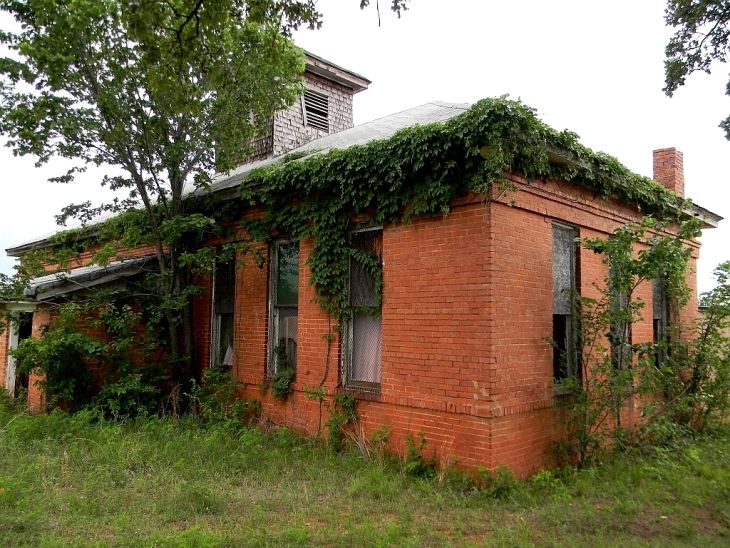
Color image of overgrown schoolhouse, Fallis, Oklahoma.
Brick School, Fallis, OK, 2011
Fallis was not always a ghost town. Author Vingetta Elizabeth Roe's novel, A Divine Egotist, was published in 1916. Without mentioning Fallis by name, the recent resident is to have observed, first-hand, “a town that is fast approaching the dignity of cityhood.” Originally [UPDATE: a Christian Mission among Natives, then] a segregated, African American community, the Fallis Blade had a Black Editor, advertising Black-owned businesses. Yankee capital flowed in. Diligent labor on productive land in the valley of Bear and Mission Creeks produced a cotton boom that generated a half-million, 1904 dollars. The Missouri, Kansas & Texas Railway and the Fort Smith & Western Railroad crossed paths at Fallis. To use a metaphor, my Rhodes research quickly became a maze of switches: I was shunted from one track to another in short order.

By the summer of 1917, months after Gertrude's death, widower 'Everet' was almost undoubtedly going by the name 'Ollie E. Rhodes.' He was a Telegraph Operator for the Denver & Rio Grande Railway Company ... at Grand Valley, Colorado. As the Roaring Twenties kicked in, he was with the Southern Pacific Rail Road at Casmalia, Santa Barbara County in California. He was barbering in Santa Margarita, San Luis Obispo County there, likely by 1922.

Thumbnail image of Luisa Anita (Garcia) Rhodes (1905-1955), c1943, Santa Margarita, CA. maestraslopez shared this with ancestry.com, 10 Mar 2013.
Luisa/Louise Anita Garcia (1907-1955) is known to be in Santa Margarita by 1920. In 1924, the teen bore son Edwin Rhodes (the name given Ollie Everett Rhodes’ father and brother). She bore daughter Gloria Aileen Rhodes the following year. Louise (right) is enumerated as divorced in 1930. The family afterwards referred to Edwin as 'Edmund.' Louise's San Luis Obispo Find A Grave memorial links to no kin.

Rhodes launched into an odyssey with the Atchison, Topeka & Santa Fe Railway. As Telegrapher and Clerk, he thrashed about in Arizona and California until his 44th birthday ... in 1938.

I now introduce Loretta Magdalen McGeough (1896-1976). She and Rhodes married in 1960. Santa Barbara voter registration records have the pair sharing an address (she using the surname Rhodes) c1939, however. 1933 birth records of stillborn daughter Sarah bear the surname Rhodes, as did Mary Ann, born two years later. Delay in solemnizing this Rhodes partnership may result from unresolved, earlier unions: Loretta had been married before. Three times, by my count. Twice by Catholic clergy.

Loretta was, apparently, the first wife for all but Ollie.

Image of Loretta McGeough (1896-1976), c1922.
Minnesota-born Loretta (left), working as a bookkeeper, was with her siblings and widowed father in Santa Barbara by 1920. In 1923, immediately after he finished a 3-year stint in the U.S. Army, she married Walter Henry Bruley (1903-1992) ... at Fort Collins, Colorado. Walter was an orphan. Not a prime candidate for online, family tree building. I sense it's a rare find, to discover divorce records: this marriage – to a Denver Tramway Conductor – concluded 28 January 1930. Walter's Find A Grave memorial, documenting a National Cemetery in Riverside, California, links to no kin.

Image of 1924 Brunswick label, ‘California, Here I Come,’ by Al Jolson.
Loretta's next union, with Santa Barbara phonograph salesman Frederick G. Orr (b1889), serves the theme: he too had already experienced matrimonial bonds. He'd stressed, but not identified, a 'dependent wife' when registering for the draft in 1917; Frederick was married, living alone in 1920. Though he'd been resident at the Y.M.C.A. before the couple set up housekeeping on De la Vina St. in 1924, the one-time rural New Yorker might have been 'a catch' for Loretta the Telephone Operator. He sold Brunswick phonograph players. Al Jolson signed with them that spring. His California, Here I Come charted at #1 in June.

Image of Bailard-Cramer Co. Pianos at 936 State St. as seen after the June 29, 1925 Santa Barbara earthquake.
An earthquake hit Santa Barbara the following June. It's unclear how much damage was done to inventory at Frederick's employers, Bailard-Cramer Piano & Phonograph Co. (left). One can surmise – likely for completely distinct reasons – that the couple's marriage took a shellacking in this period. Loretta moved on, Frederick escapes my ability to find him subsequently in any record. Perhaps the earthquake got him.

It's my belief that Frederick Orr doesn't even have a memorial at Find A Grave. He left no heirs I'm aware of. That too seems to be a limitation on representation in my online environment: few care sufficiently to request photographs of their graves.

Loretta's marriage the following year, to Vandal Martin Branstetter (1898-1988), reveals divorce to be far more common than I realized. Vandal left his widowed mother in Portland, Oregon to take up work as a Steam Shovel Operator in Santa Barbara. (Perhaps he warbled along with Al Jolson, en route.) Vandal and Loretta Orr, then of Los Angeles, married at Idaho Falls, Idaho in the autumn of 1926. Walter Bruley that year listed Loretta as his wife, in the Denver City Directory.

Vandal was back with his mother when, in 1930 and six weeks after Walter obtained a Denver divorce from Loretta E. [sic] Bruley, an Oregon court provided Vandal judicial separation from Loretta M. Branstetter. That's Loretta (McGeough, Bruley, Orr) Branstetter ... who would go on and marry Rhodes.

The following summer, in 1931, Vandal married fellow Portlander, Margaret Jolly Christie (1900-1962) at Skamania County, Washington. Except that her surname was Liston. A decade earlier, Margaret had married J. Delbert Liston (1894-1976). The Eugene, Oregon automobile salesman was enumerated as divorced in the 1930 census. By 1935, 'J. Del' was married to Junior High School Teacher Iva Belle Wood (1894-1947). Well, that was her maiden name: Iva had, in 1920, gone to Idaho to marry Charles Herman Brune (1900-1978). Charles in 1927 married Elizabeth Mills Harriman (1900-1974) ... also at Skamania, on the Columbia River and not far from the home place of your diligent family history contributor.

Thumbnail image of Iva Belle Wood, (1894-1947) 1915.
Elizabeth, thankfully, had not been married previously.

Iva (right), like Louise, Loretta, Walter, Frederick, Vandal, Margaret and J. Delbert, spent time as divorced persons in economic downturn of 1930. In Santa Barbara at the time, census takers might not have caught up with Ollie Everett Rhodes.

Vandal was, with his mother, settled and farming in Colorado by 1940. Second spouse Margaret, then a doctor's assistant, remained as a renter in Portland ... with 2 young daughters. Had he not succumbed at or near the U.S. Embassy in Costa Rica, Vandal might have a Find A Grave memorial. The most diligent among those who voluntarily inventory cemeteries could have clarified, via hyperlink, this relationship web.

Though she is buried in Portland, and he among an extensive Eugene family, childless couple Margaret and J. Delbert have memorials. And the divorced couple are hyperlinked (a diligent Find A Grave caretaker posted and sourced Margaret's Oregonian obit: it references Vandal). J. Del is not linked to second wife Iva, however. Iva shares a fate similar to Gertrude's: though her death certificate lists 'Iva W. Liston,' a grave marker in her parent's Wood plot reads 'daughter.' No surname at all is carved into it. Iva's Find A Grave memorial is not linked to anyone.

Elizabeth (Harriman) Brune bore Charles two sons. These parents are buried where they started a family while tending sheep. They are linked in a virtual, Wasco County, Oregon Odd Fellows Cemetery. Digital flowers also appear at these graves.

Image of Mildreth Margarite Ladner (1912-2008) & Gertrude Hardesty (1896-1916).
Gertrude, with a cousin's daughter.
I'm not casting aspersions. This post is to be a digital beacon. To lure those with family lore describing this cast of characters ... to leave comments below (or here), should they be able to corroborate, debunk or clarify my contention: that Everett Rhodes was initially married to Gertrude Hardesty. "Do I have sufficient evidence," I wonder, "to suggest caretakers of Ollie E. Rhodes' Find A Grave memorial accept a link to Gertrude's? How much social unpleasantry would this create?" [UPDATE: subsequent to this blog post, genealogy angels knit Ollie to his purported three spouses.]

Conversational taboo preserves family dignity. It also allows those subsequently afflicted, by disease or societal choices, to be handicapped in isolating belief that they are the first in their family to ever experience a particular hardship. I try to avoid false pride; forgo taking unwarranted, psychic credit for ancestors' meritorious conduct when I find it. So too do I try to avoid shame. Particularly with regard to slave-owning ancestors. I admittedly find it generally challenging not to judge historical figures against contemporary mores.

When I am able to suspend judgment, I actually grow closer to 'what was.' It seems somehow more rewarding than allowing imagination to paint the past.

Those of you who delve concertedly into family history will understand my sense of immersion; of being neck-deep … cross-referencing documents as I'm retaining names and dates. While the image of the log schoolhouse (below) initiated this study, it was an extraordinary observation that prompted me to draft this post.

Today is the centenary of Gertrude's death. Happy New Year, everyone!


This photograph, of a rustic, one-room schoolhouse near Agra, Oklahoma, triggered my labyrinthine investigation. Gertrude is depicted with the letter C.

Image of Oak Dale School, near Agra, Okla.

I find this final image (below) compelling, and wish it to be unleashed onto the World Wide Web. O. E. & May's children: Hallie Hardesty (1893-1980), Roy David Hardesty (1891-1970) and Gertrude Hardesty (1896-1916). Roy married a divorced woman whose own father declared himself 'widowed' in the 1920 census ... though his spouse lived on. Roy's son, my father, would divorce before establishing a family. I myself am twice divorced.

Portrait of siblings Hallie Hardesty (1893-1980), Roy David Hardesty (1891-1970) and Gertrude Hardesty (1896-1916).

With deep appreciation for all archivists, particularly those who took time to post the above photographs.